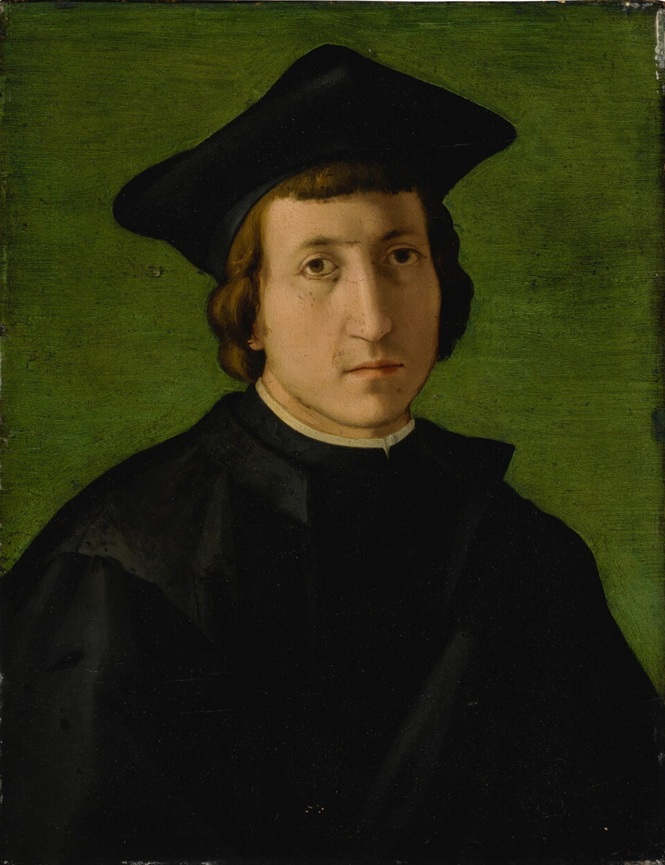
On 28 November 2026, Düsseldorfer Auktionshaus will offer a sixteenth-century portrait of a man at auction. The painting is cautiously catalogued as the work of a probably Florentine master. Its execution, dimensions and, above all, the treatment of the face make a comparison with portraiture in the circle of Andrea del Sarto entirely reasonable. Domenico Puligo and Franciabigio also offer several points of comparison.
A man wearing a broad black beret looks towards the viewer, his head slightly turned and his expression difficult to read. He wears an almost entirely black robe. The background consists of a restrained interior. The painting needs little to make an impression. There are no hands holding objects, no books or other possessions to tell us anything about the sitter’s identity. Almost all the attention falls on his head.
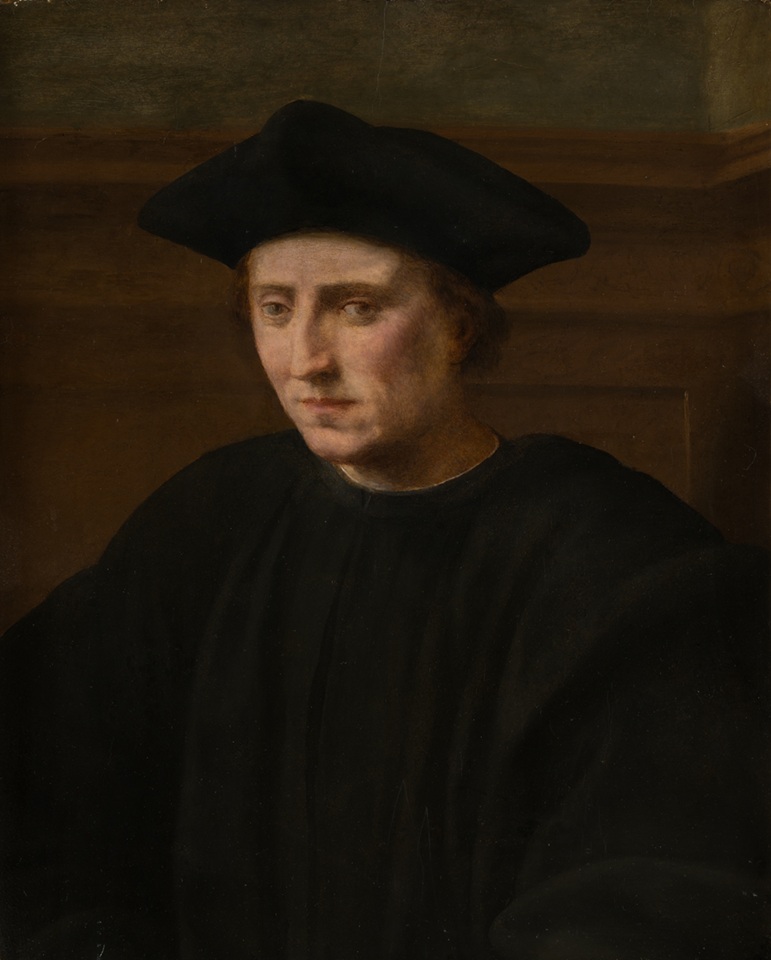
The transition from light to shadow is remarkably soft across the face. The nose, eye sockets and cheeks are not defined by emphatic outlines. Instead, the artist has built up the forms through subtle variations in tone. This recalls Florentine portraiture of the years 1515-1535, and more specifically Andrea del Sarto and certain painters who adopted his approach.
At the time of writing, bidding has already reached €5,000 against an estimate of €1,500. It is easy to see why the portrait is attracting attention. The catalogue names no artist and provides no provenance, exhibition history or literature, yet the painting itself allows for a considerably more specific art-historical interpretation than its broad description suggests.
The painting will be offered on 28 November as lot 1781 at Düsseldorfer Auktionshaus. The catalogue entry reads Italienischer Meister, wohl Florenz, erste Hälfte 16. Jhdt and it is painted in oil on panel, measuring 60.5 × 49.5 centimetres.[1]
The Quality of the Painting Behind the Black Robe and Hat
The portrait belongs to a type particularly popular in early sixteenth-century Florence, the half-length portrait of a man in dark clothing, usually set against a neutral or architectural background. It directs attention to the sitter’s individual features. The face is modelled through variations of colour and light.
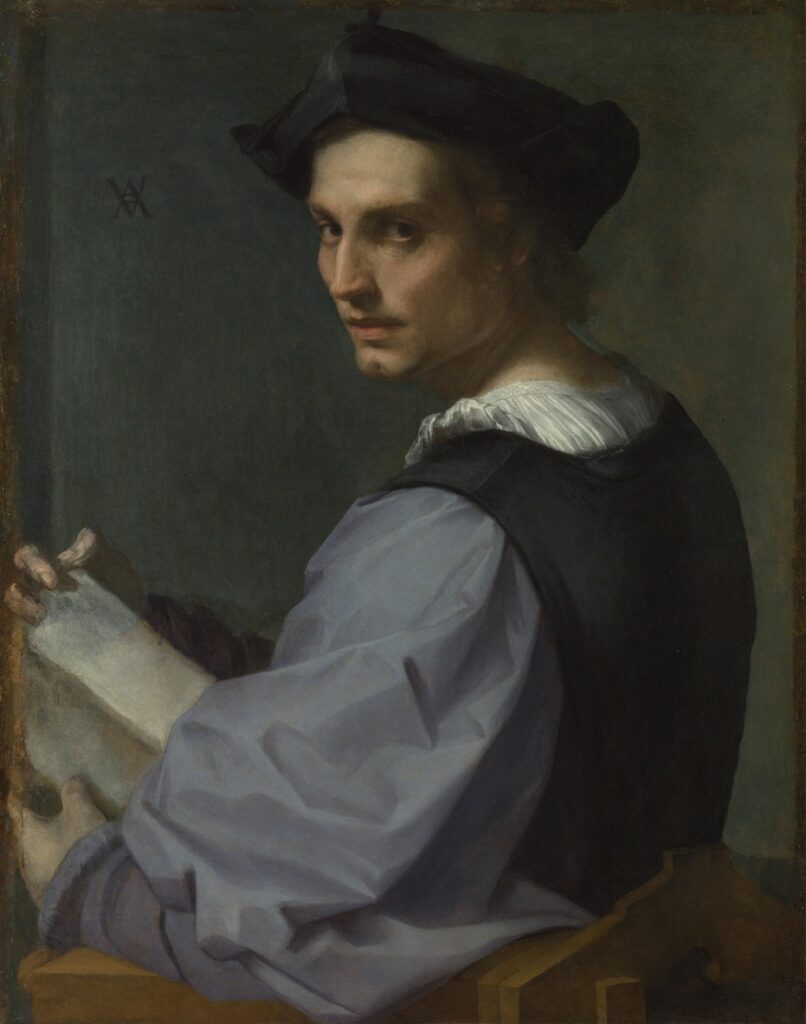
This is also the clearest indication of a possible connection with a particular Florentine artistic milieu. The approach belongs to a tradition that goes back to Leonardo da Vinci and was developed in Florence by Andrea del Sarto, among others. We are looking at the use of sfumato, a restrained palette and the modelling of forms through subtle transitions of colour and light.[2]
What this panel lacks, however, is compositional tension. The portrait is simple and static. Precisely this simplification is often found in the work of painters associated with Del Sarto.
Domenico Puligo as a Possible Lead
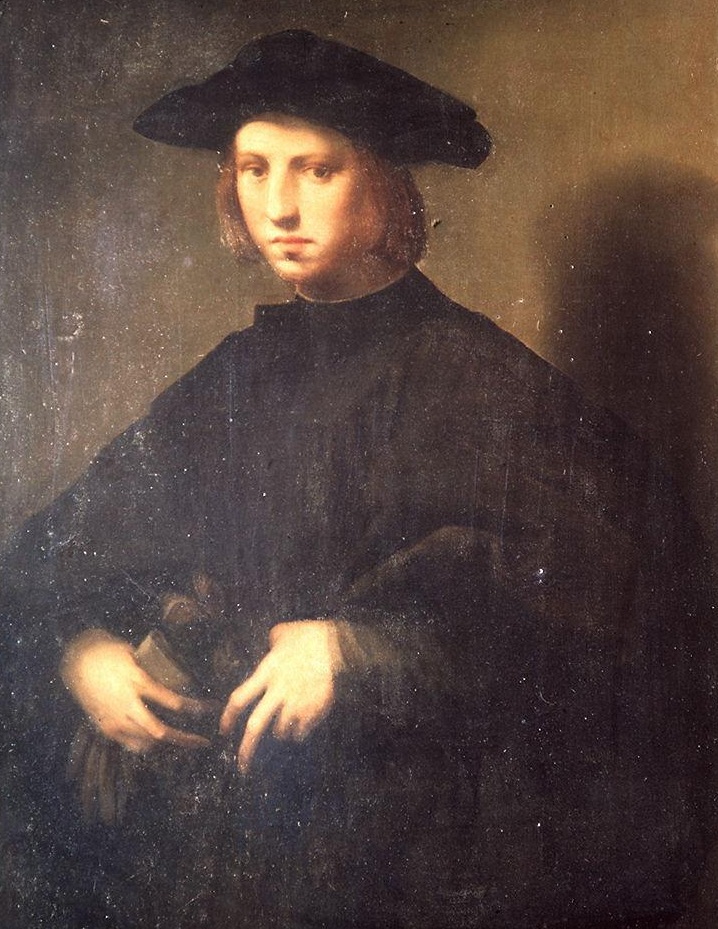
Among the generation of artists working in Florence under Andrea del Sarto’s influence, Domenico Puligo (1492-1527) deserves particular attention. His painting is characterised by soft modelling. Outlines often lose their sharpness, while faces are constructed from delicate transitions between light and dark.
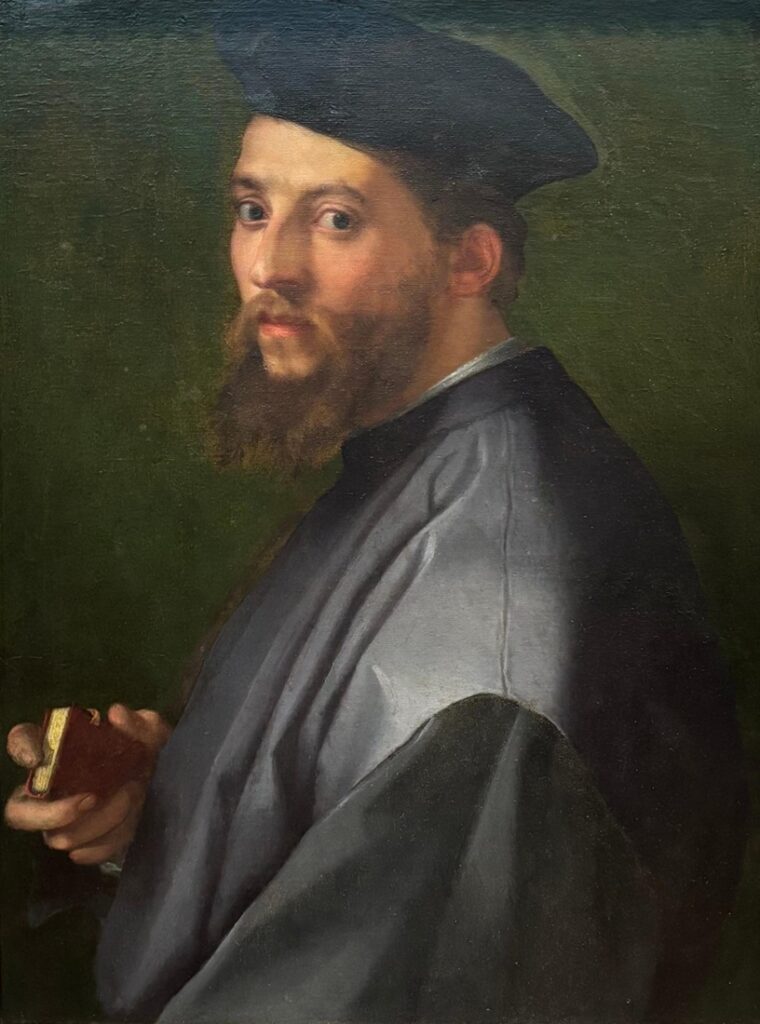
A relevant comparison can be found in the Gemäldegalerie in Berlin: Puligo’s Portrait of a Man, circa 1520-1525.[3] The two portraits share similar dimensions, a tradition of dark dress and a strong focus on the sitter’s psychological presence. The relationship between the face and the headwear is also comparable. The broad, dark beret forms a visual mass against which the lighter face stands out.
The compositions are not identical, but they share a recognisable approach to portraiture. Even more interesting is Puligo’s portrait of a man from around 1525 in the Galleria Palatina at Palazzo Pitti in Florence. That painting was long attributed to Andrea del Sarto.[4] In the past, Puligo’s portraits were repeatedly mistaken for works by his more famous contemporary. The similarities lie not only in the choice of subject but also in the technique used to model the face.
Franciabigio and Florentine Male Portraiture
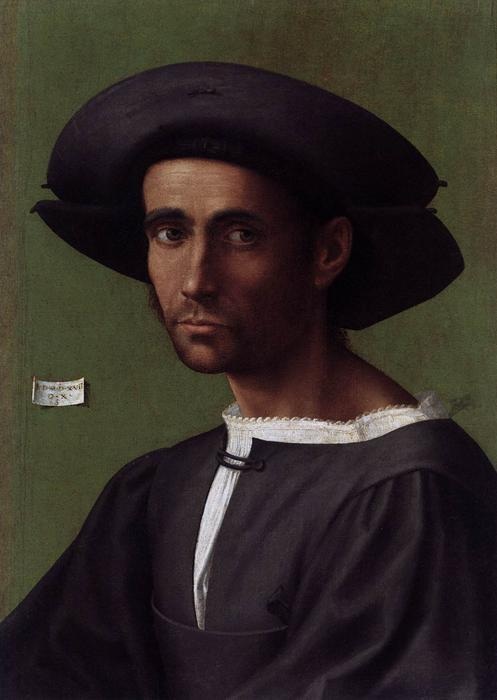
A second name that deserves serious consideration is Franciabigio (circa 1484-1525). Franciabigio worked closely with Andrea del Sarto. Particularly relevant is his dated Portrait of a Man of 1517 in the Liechtenstein Collections.
This painting likewise depicts a man in dark clothing against an almost neutral background. The viewer encounters a face for which the artist needs very few devices to suggest individuality and character. The composition is deliberately restrained. All unnecessary details have been left out.[5] The face in the panel now coming to auction, however, is softer and less sculptural.
A portrait can closely resemble the work of a recognised artistic circle without necessarily being painted by one of its leading members. The distinctions between an autograph painting, a workshop product and a later imitation can be subtle. Particularly in portraits with a limited palette and similar costumes, the risk of a hasty identification is considerable.
Pier Francesco Foschi, a Third Possibility?
The third artist worth investigating is Pier Francesco Foschi (1502-1567). Foschi trained in the circle of Andrea del Sarto and later worked with Pontormo. For many years, his portraits were frequently catalogued under the names of other artists.
A particularly relevant comparison appeared at Sotheby’s in New York in January 2021. It was Foschi’s Portrait of a Man in a Black Hat, Bust-Length, an oil painting on panel measuring 59 × 46 centimetres. The subject bears similarities: a man in a broad black beret and dark robe, set against a plain background.
More striking still is its attribution history. The painting was offered under Pontormo’s name in 1928. It later circulated as a work by Andrea del Sarto and then Franciabigio, before eventually being placed within Foschi’s oeuvre. This succession of attributions shows just how close the stylistic affinities within this Florentine group can be.[6]
An Old Name on the Reverse?
The reverse of the Düsseldorf panel deserves at least as much attention as the front. Several old inscriptions, stamps and remnants of partially damaged paper are visible. One small label towards the top of the panel is particularly intriguing.
The handwritten inscription may contain a name ending in Sarto. This does not, of course, establish that the portrait was ever attributed to him on sound grounds. Old labels may record an attribution that has since been rejected, a dealer’s note or a simple administrative reference.
What Do Collectors Pay for Comparable Portraits?
Commercially, an anonymous Florentine portrait from the first half of the sixteenth century occupies a very different category from an accepted work by Domenico Puligo, Franciabigio or Pier Francesco Foschi. At Sotheby’s in New York in January 2021, Foschi’s aforementioned Portrait of a Man in a Black Hat, Bust-Length carried an estimate of $60,000-80,000 and achieved a reported price of $140,000.
The painting also had a long and well-documented history. It had been known since 1928, passed through the hands of several established art dealers and formed part of David G. Carter’s collection from 1959 onwards.
Another Foschi, Portrait of a Young Man in a Black Cap, was offered at Sotheby’s in New York in January 2022 with an estimate of $50,000-70,000. The work was larger, measuring 74.9 × 60.3 centimetres, and came with historical provenance and references in the literature. It remained unsold.[7]
Even a convincingly attributed portrait by a recognised artist, supported by historical documentation, will not necessarily find a buyer at the price level suggested by the auction house. Size, condition, presentation, attribution history and the auction context can all have a major impact on a work’s commercial position.
The market for later imitations is even more relevant in this respect. It can show just how limited demand may be when a painting is not regarded as an autograph work by a known master. For now, the portrait under discussion sits precisely within this tension. In our view, the photographs suggest interesting painterly quality, but the catalogue offers no named artist, no documented provenance and no attribution supported by scholarly research.
The €1,500 figure therefore represents a cautious market positioning for a work whose most important art-historical questions remain unanswered.
A Famous Name Is Not Essential
The question of whether the portrait was painted by Puligo, Franciabigio or Foschi is certainly interesting. Florence had a thriving culture of portraiture in the opening decades of the sixteenth century. During this period, painting moved from relatively formal likenesses towards portraits in which individuality, pose and psychological presence became increasingly important.
Andrea del Sarto played a central role in this development, but his influence extended far beyond a handful of famous pupils. A much wider circle of artists adopted and adapted his painterly solutions. This also helps explain why some portraits, despite their quality, remain without a secure attribution in museum collections to this day.
This comparison matters because it shows that an anonymous attribution does not necessarily imply a lack of quality. Sometimes there is simply no decisive evidence to assign a painting to an individual artist. That does not diminish its art-historical interest. The real question is how convincingly the work can be placed within a specific painting tradition.
A Matter of Quality and Evidence
In our view, the appeal of the Düsseldorf portrait lies in a combination of factors. Its dimensions are consistent with Florentine portrait production in the early sixteenth century. The restrained black robe, broad beret and architecturally ordered background all fit within the same tradition.
The soft modelling of the face shows clear affinities with painting in Andrea del Sarto’s circle. The reverse of the panel may also contain information about earlier attributions or ownership. Its visible quality raises questions that the present catalogue entry does not answer.
The auction on 28 November will chiefly show how much value buyers are prepared to place on that art-historical possibility in the absence of an established artist’s name. In our view, this makes the lot more interesting than its brief catalogue description might suggest.
Do you have a particular interest in this artist or subject?
Do you own a painting by this artist, have you come across a comparable work, or do you have information that might be relevant to further research? We welcome contact from collectors, art dealers and researchers with an interest in this artist or related subjects.
We regularly research paintings appearing on the art market, exploring questions of attribution, quality, provenance and previous sales. If you have a question about a particular work or would like to share information with us, please feel free to get in touch at info@antonello.art.
Notes and Sources
[1] Düsseldorfer Auktionshaus, Katalog 02/2026, lot 1781, Italienischer Meister, wohl Florenz, erste Hälfte 16. Jhdt., Herrenportrait. Auction held on 28 November 2026, Düsseldorf.
[2] The National Gallery, London, Andrea del Sarto, Portrait of a Young Man, circa 1517-1518, inv. NG690.
[3] Staatliche Museen zu Berlin, Gemäldegalerie, Domenico Puligo, Portrait of a Man, circa 1520-1525, inv. 239.
[4] Ministero della Cultura, Italy, catalogue record 0900196341, Domenico Puligo, Ritratto d’uomo, circa 1525, Palazzo Pitti, Galleria Palatina, Florence.
[5] Liechtenstein Collections, Franciabigio, Portrait of a Man, 1517, inv. GE 851.
[6] Sotheby’s, Master Paintings Part II, New York, 22-30 January 2021, lot 561, Pier Francesco di Jacopo Foschi, Portrait of a Man in a Black Hat, Bust-Length.
[7] Sotheby’s, Master Paintings Part II, New York, 18-28 January 2022, lot 329, Pier Francesco Foschi, Portrait of a Young Man in a Black Cap.