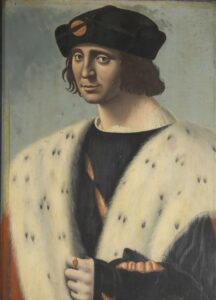
A panel measuring just 21.5 by 17.5 centimetres, cautiously catalogued by Hargesheimer as “probably workshop or school” of Rembrandt and possibly a self-portrait, has already attracted considerable bidding ahead of the sale. The estimate starts at €150, at the time of writing, bidding stands at €1,400. It is above all the work’s size that makes the lot more interesting than it might initially appear.
[Update 12-09-2026: The lot was sold for €22,000.]
Among the Old Masters auction house Hargesheimer will offer in Düsseldorf on 12 September, this lot does not stand out for its scale, provenance or lengthy catalogue entry. Quite the opposite. It is a small male head on oak panel, measuring 21.5 by 17.5 centimetres, from a private collection in Rhineland-Palatinate and catalogued as Rembrandt Harmensz. van Rijn, probably workshop or school, Possibly Self-Portrait as a Young Man. The estimate is €150–300.[1]
That estimate has already been left some way behind, with several bidders pushing the work to €1,400 before the auction has even begun. That does not make it a Rembrandt, and even “workshop” remains only one possibility within the broader qualification “probably workshop or school”. But the bidding activity becomes easier to understand once one considers that 21.5 by 17.5 centimetres is by no means an unusual format for a Rembrandtesque tronie.

Exactly the Scale on Which Such Heads Were Painted
Rembrandt and artists in his circle produced small head studies and self-portraits in the late 1620s and 1630s that were scarcely larger than the current panel. These were not reduced versions of formal portraits, but concentrated studies of face, light, costume and expression: the world of the tronie. Such works probably derived from prototypes by Rembrandt that remained in the studio and could be copied by assistants or pupils as exercises or models.
The composition of this small panel also belongs to that visual world. A young man’s head emerges almost independently from a dark background, a broad cap encloses the face from above, while warm light falls across the forehead, nose and cheek. Reddish-brown clothing dissolves into the shadows, and a sharp grey-white accent at the collar draws the eye back towards the head. It is an image that depends entirely on light and physiognomy rather than setting or narrative detail.
The surface appears old and somewhat worn in places, and earlier restoration is noted. On the reverse is an old Swedish-language label reading Manshuvud / Tyskt 1700-tal, “male head, German, eighteenth century”. Above all, this indicates that the painting previously circulated under a much broader attribution.

From £300 to £2,000 at Almost Exactly the Same Size
A recent comparison shows how quickly even a modest follower attribution can move beyond a low estimate. On 10 March 2026, Roseberys in London offered a Portrait of a Bearded Old Man Wearing a Hat as Follower of Rembrandt. Oil on panel, 21.2 by 17.8 centimetres. The estimate was approximately €350–470. The work realised around €2,500, including buyer’s premium.[2]
That result may be more relevant here than spectacular multimillion-euro prices. It shows that the market for a convincing decorative Rembrandtesque head on panel can quickly move beyond a few hundred euros, even without a workshop attribution. One level higher, the difference becomes much greater. In April 2024, Dorotheum offered A Tronie of a Bearded Man as Workshop of Rembrandt van Rijn. Again, the dimensions were almost identical, 20.5 by 17.3 centimetres. The estimate was €20,000–30,000.[3]
There was, however, considerably more behind that attribution. The panel had undergone dendrochronological analysis, with the earliest likely date of execution placed in the 1640s. A Rembrandt specialist also pointed to related versions in two museum collections and regarded this example as particularly close to Rembrandt within that group.

A Provincial Auction and a 22-Centimetre Panel
There is a precedent that fits this story almost too neatly. In October 2007, a small head appeared at the regional English auction house Moore Allen & Innocent, catalogued as Follower of Rembrandt. Estimate approximately €1,200–1,800. The size 22.2 by 17.1 centimetres.
The painting ultimately sold for approximately €2.6 million, including buyer’s premium. The following year, Ernst van de Wetering accepted it as an autograph work by Rembrandt. Today, Rembrandt Laughing, circa 1628, is in the collection of the J. Paul Getty Museum.[4]
Discoveries of this kind are, of course, exceptional. An autograph Rembrandt self-portrait sold by Sotheby’s in 2020, Self-Portrait of the Artist, Half-Length, Wearing a Ruff and a Black Hat of 1632, measures 21.8 by 16.3 centimetres. It realised approximately €17 million, including buyer’s premium.[5] At this scale, then, one finds serious self-portraits, tronies and studio studies alike.

The Painting That Went from $15,000 to $675,000
In 2019, Christie’s New York sold a circular A Portrait of the Artist from the Bass Museum of Art. The painting measured just 29.2 centimetres in diameter and was offered as Manner of Rembrandt, without reserve. The estimate was $15,000–20,000.[6] Bidders paid little attention to that range, the recorded final price was $675,000.
Following restoration and further research, the same painting is now presented as Workshop of Rembrandt, Portrait of Rembrandt as a Young Man, circa 1628-31. This is not an argument for predicting a comparable discovery with the current lot. It demonstrates something rather different, with small Rembrandtesque heads, the bidding market can sometimes price a hypothesis much faster than a cautious catalogue attribution does.

What Are the Bidders Seeing?
A regional auction house is offering a broadly catalogued Old Master panel at a low starting level. It is precisely in catalogues like these that careful looking can pay off, not because every broad attribution conceals a major name, but because the opening price can sometimes say very little about the level of attention an object will ultimately attract.
The difference between the prices achieved by the other tronies discussed here lies in dendrochronology, provenance, condition, comparisons with other versions and specialist opinion. That is where the real tension in this lot lies. If the panel proves convincing from a technical point of view and material analysis supports a seventeenth-century origin, the current price begins to look interesting.
On 12 September, we will find out how many others have reached the same conclusion.
Do you have a particular interest in this artist or in this subject?
Do you follow this artist, or have you come across a work you would like to know more about? We regularly research works appearing on the market and are always happy to exchange views on quality, provenance, art-historical context and previous auction results. You can contact us directly via info@antonello.art.
Notes and Sources
[1] Hargesheimer Kunstauktionen Düsseldorf, Sculptures, Bronzes & Old Master Paintings, Düsseldorf, 12 September 2026, lot 3685, Possibly Self-Portrait as a Young Man, catalogued as “Rembrandt Harmensz. van Rijn, probably workshop or school”, oil on oak panel, 21.5 × 17.5 cm, estimate €150-300.
[2] Roseberys London, Old Master, British & European Pictures, 10 March 2026, lot 40, Follower of Rembrandt, Portrait of a Bearded Old Man Wearing a Hat, oil on panel, 21.2 × 17.8 cm, estimate £300-400, realised £2,000 including buyer’s premium.
[3] Dorotheum, Old Master Paintings, Vienna, 24 April 2024, lot 112, Workshop of Rembrandt van Rijn, A Tronie of a Bearded Man, oil on panel, 20.5 × 17.3 cm; estimate €20,000-30,000.
[4] Moore Allen & Innocent, Cirencester, 26 October 2007, lot 377, catalogued as Follower of Rembrandt; estimate £1,000-1,500, hammer price £2.2 million. J. Paul Getty Museum, Rembrandt van Rijn, Rembrandt Laughing, circa 1628, oil on copper, 22.2 × 17.1 cm.
[5] Sotheby’s, Rembrandt to Richter, London, 28 July 2020, lot 12, Rembrandt van Rijn, Self-Portrait of the Artist, Half-Length, Wearing a Ruff and a Black Hat, 1632, oil on oak panel, 21.8 × 16.3 cm, estimate £12-16 million, realised £14,5 million including buyer’s premium.
[6] Christie’s New York, 29 October 2019, lot 812, A Portrait of the Artist, Manner of Rembrandt, 29.2 cm diameter, collection of the Bass Museum of Art, estimate $15,000-20,000.