A more than two-metre-wide animal painting from the circle of Roelant Savery looked, before the sale, as though it might trigger serious bidding competition. It did not. Catalogued by auction house Herbette and Cabinet Turquin as a work from Savery’s workshop, the painting was hammered down at €25,000 against an estimate of €30,000-40,000. That result becomes less surprising once its scale, attribution and quality are examined more closely.
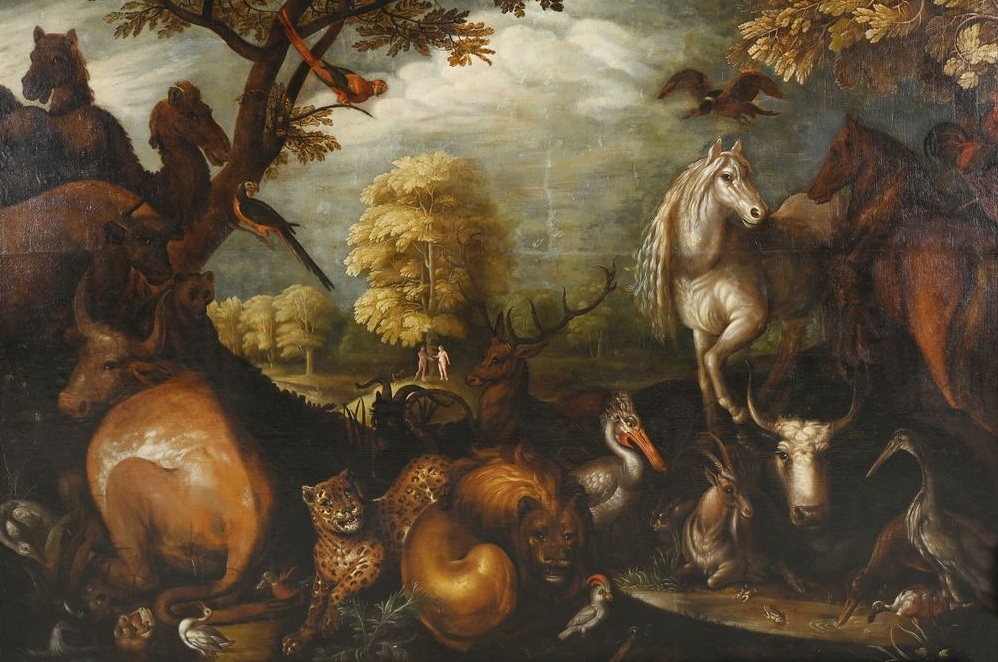
At the French auction house Herbette, a monumental Paradis terrestre appeared for sale, oil on canvas, measuring 163 by 237 centimetres, and populated with horses, deer, cattle, exotic big cats and birds. It was catalogued as “Atelier de Roelandt Savery”, with an estimate of €30,000-40,000.[1] It was hammered down at €25,000.
That is below estimate, and more importantly far removed from the sums that can be paid for strong, well-documented paintings by Roelant Savery himself. In our view, however, closer examination suggests that the result was not a missed discovery. The visible quality of execution, the cautious attribution and the thin art-historical record together go a long way towards explaining why the bidding did not progress any further.
The key word here is ‘workshop’
Looking only at the name can easily create the wrong price expectations. This was not offered as an autograph painting by Roelant Savery, nor as a work attributed to him. The catalogue designation was atelier de, and with an artist such as Savery that distinction makes a considerable difference.
The better autograph paintings generally have more in their favour than simply a recognisable world of animals. They may carry a signature or date, occupy a convincing stylistic position within the oeuvre, have an old provenance, or be firmly documented in the literature. The standard reference remains Kurt J. Müllenmeister’s Roelant Savery. Kortrijk 1576–1639 Utrecht. Hofmaler Kaiser Rudolf II. in Prag. Die Gemälde mit kritischem Oeuvrekatalog, published in 1988.[2]
Herbette gave no Müllenmeister number for the present painting. Nor was any historic provenance, previous sale, exhibition history or other literature cited. That matters, because at €30,000, €50,000 or more, the market generally wants to know what exactly supports such proximity to the master.
The scale is more convincing than the execution
Scale was the painting’s strongest argument. At 163 by 237 centimetres, it has a physical presence that most Savery-related animal paintings on the market simply do not possess. On a wall, the work must be considerably imposing. But in our view, scale and quality do not quite go hand in hand here.
The strongest passage is on the right. The pale horse is modelled with considerable clarity and set slightly apart from the surrounding animals, immediately drawing the eye. The light falling across its neck and chest, together with the white clouds nearby, gives the animal volume and makes it the visual focal point of the painting. The spotted predator to the left of the lion also has enough presence to hold its own against the dark foreground.
Elsewhere, however, the handling is markedly more uneven. In the dark left half in particular, bodies and contours crowd closely together. The brown horses, deer and other animals seem more stacked upon one another than convincingly organised in space. Some of the heads are rather generically rendered. The lion in the centre has weight in the photograph, but lacks the precision one expects in Savery’s strongest animal figures.

Workshop work or an autograph Savery?
The same applies to the birds. The parrots high in the tree are effective because of their contrasting accents of colour, but their function is primarily compositional rather than an indication of particularly high quality. The woodland edge and distant landscape create sufficient depth to set off the foreground, but contain relatively little refinement.
That distinction matters, because Savery’s best works are often smaller, yet the individual animals retain their character within them. This canvas works above all from a distance. That is not insignificant, but any attempt to place it substantially closer to Savery himself seems driven largely by a romanticised reading of the painting.
Old restorations matter more at this scale
With a canvas measuring 163 by 237 centimetres, condition becomes more significant. Old restoration on a work of this scale could range from local retouching to relining, abrasion or more extensive intervention. A bidder may therefore also be taking on a substantial conservation issue. Transport is no simple matter at this size either. That will likely have reduced the number of potential bidders.
The market’s verdict was actually fairly logical
A Savery-related animal painting kept at some distance from the master, even if visually convincing, belongs to a different segment of the market. A “Savery-like painting” and “a strong Savery” are two entirely different categories commercially.
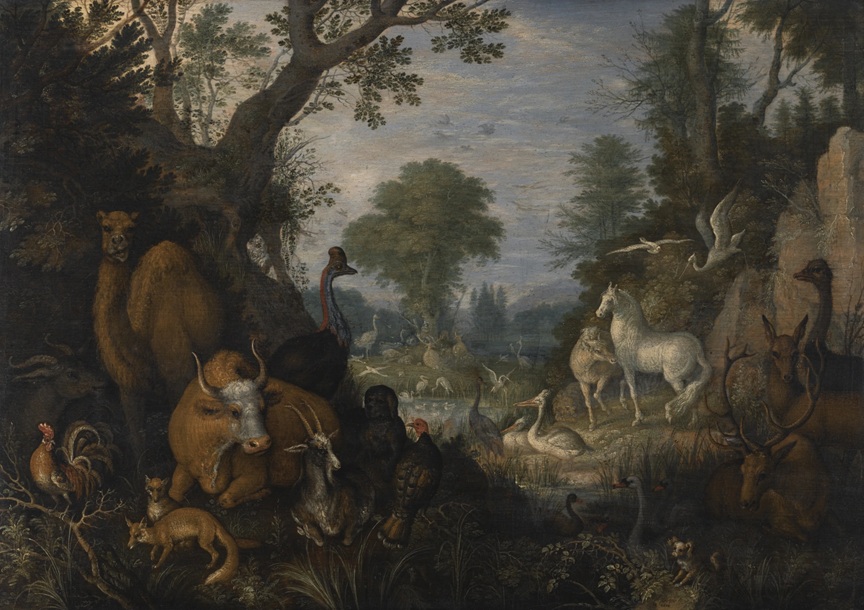
When quality, documentation and subject all come together, the result can be far higher. In 2016, Sotheby’s sold Savery’s signed and dated Orpheus Charming the Animals of 1618 for £450,000. That painting had a substantial provenance, exhibition history and published literature, and was accepted as a fully autograph work by Savery.[3]
Why did it stop at €25,000?
In retrospect, the €30,000-40,000 estimate looks more ambitious than cautious. The painting had clear strengths, its scale, its immediate decorative impact, and a catalogue attribution directly linking it to Savery’s workshop.
What it lacked were precisely the factors needed to move it into a higher segment of the market. There was no published signature or date. No documented provenance. No reference to Müllenmeister, and no published exhibition or literature history.
The monumental scale initially suggests an important painting. Look for longer, however, and the execution only partly fulfils that promise. The white horse and several other animals are convincing, but elsewhere the animal figures are more modestly painted and the spatial organisation is less precise. What remains is an imposing seventeenth-century animal painting from the immediate Savery orbit, but without sufficient art-historical grounding or visible refinement to move into a higher category.
Do you have a particular interest in this artist or in this subject?
Do you follow this artist, or have you come across a work you would like to know more about? We regularly research works appearing on the market and are always happy to exchange views on quality, provenance, art-historical context and previous auction results. You can contact us directly via info@antonello.art.
Notes and sources
[1] Herbette, Objets d’art et de bel ameublement, tableaux anciens, XIXè et modernes, Doullens, 27 September 2026, lot 21, “Roelandt Savery (1576–1639). Atelier de. École flamande XVIIe. ‘Paradis terrestre’”, oil on canvas, 163 × 237 cm; estimate €30,000-40,000.
[2] Kurt J. Müllenmeister, Roelant Savery. Kortrijk 1576–1639 Utrecht. Hofmaler Kaiser Rudolf II. in Prag. Die Gemälde mit kritischem Oeuvrekatalog, Freren: Luca Verlag, 1988.
[3] Sotheby’s, Old Masters Evening Sale, London, 10 December 2016, Roelandt Savery, Orpheus Charming the Animals, 1618, realised price £452,750.