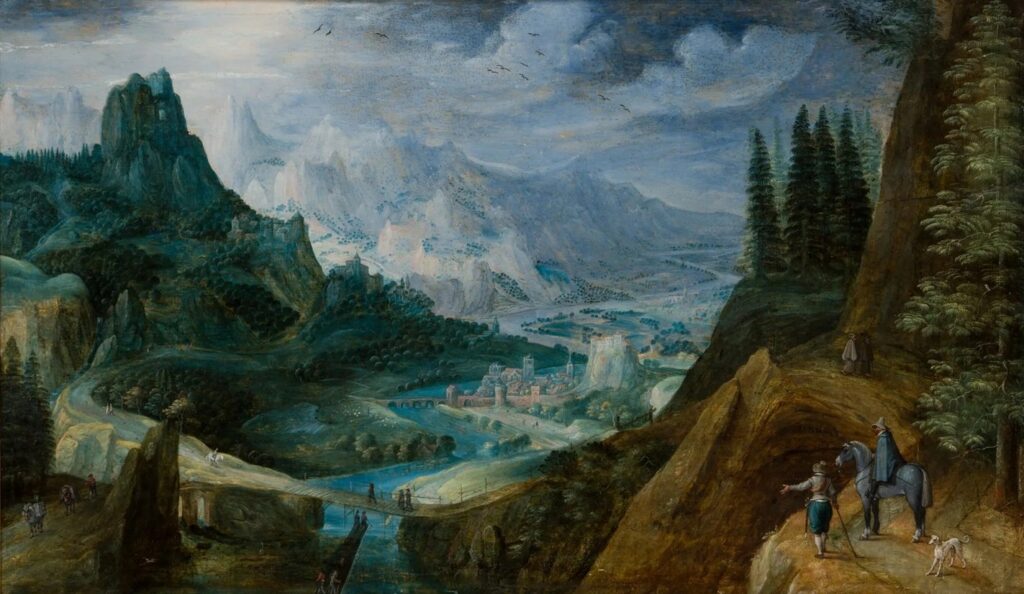
On 30 October 2026, Beaussant Lefèvre will auction a panoramic mountain landscape by the Flemish painter Tobias Verhaecht (1561-1631) in Paris. The painting carries an estimate of €4,000-6,000.[1] Its atmospheric depth and layered composition are particularly striking. In this article, we consider how this modest estimate compares with the market for Verhaecht’s landscapes.
A panel measuring roughly 40 by 70 cm depicts a sweeping river valley, rock formations, fortified towns and mountain ranges that gradually fade into the atmospheric distance. In our view, the landscape coming up for auction at Hôtel Drouot on 30 October has many of the qualities that make Verhaecht’s painting so appealing.
The estimate of €4,000-6,000 therefore seems modest, especially when compared with some other auction results for the Antwerp painter. In 2023, for example, a pair of mountain landscapes fetched more than €44,000 at Artcurial.[2] That makes this small painting worth a closer look: at first glance, the composition displays greater ambition and visual appeal than its estimate might suggest.
A landscape that gradually unfolds
Imposing rocks dominate the left side of the composition. Their peaks rise above a densely wooded slope, while towers and small buildings nestle among the rocks below. On the right, a steep, brown-toned cliff topped with tall trees forms a second boundary within the composition.
Between these two dark masses, a broad river valley opens up. A settlement with towers and defensive walls stands beside the water, while paths and tiny human figures connect different parts of the landscape. Farther back, the mountains gradually dissolve into the atmospheric distance.
In our view, the spatial arrangement is carefully constructed. The eye is drawn from the dark foreground along several diagonal lines into the landscape. A road winds down from the left, while a bridge spans the water. At the lower right stand a horseman, a figure on foot and a dog. Their presence contrasts with the barely discernible figures near the bridges and in the distance. This difference in scale greatly strengthens the sense of distance.
Verhaecht uses several techniques to suggest depth. The foreground is dominated by deep greens and warm earth tones. As the landscape recedes, the palette shifts towards cooler blues and greys. The most distant mountain ranges are almost indistinguishable from the sky. It is above all this atmospheric transition that makes the painting so appealing. The composition invites the eye to wander, and much of the work’s strength lies in that quality.
An artist between Patinir and Bruegel
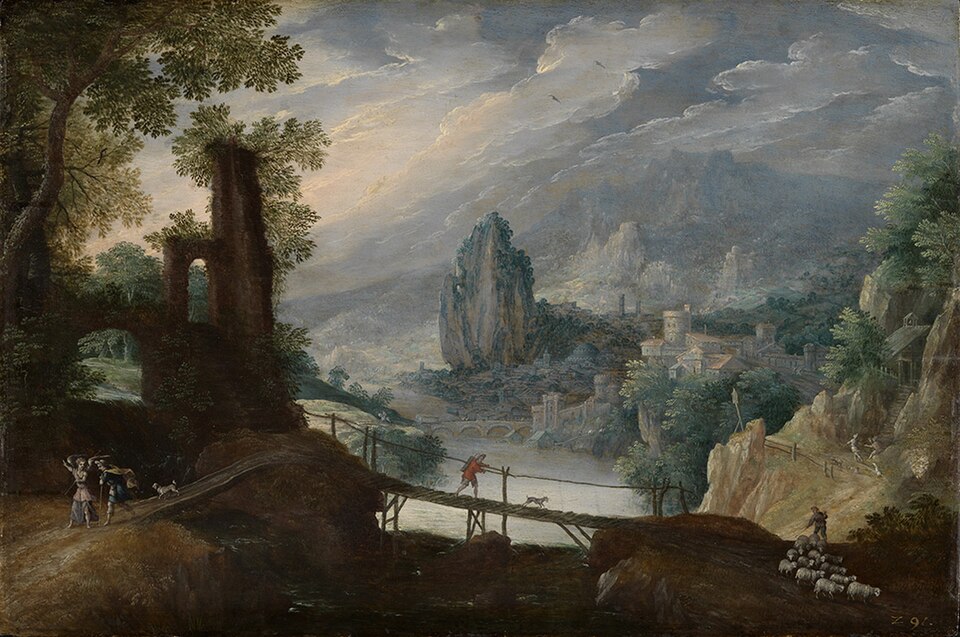
Tobias Verhaecht was among the artists who carried the sixteenth-century tradition of the so-called world landscape well into the seventeenth century. That tradition has its roots in the work of painters such as Joachim Patinir, Herri met de Bles, Joos de Momper and Pieter Bruegel the Elder. Their landscapes combine elevated viewpoints with expansive panoramas, bringing mountains, rivers, settlements and human activity together in a single scene.
These were not intended as accurate depictions of actual geographical locations. Instead, the artist could assemble different elements into an imaginary world in which nature occupies a far greater place than humankind. Verhaecht ran a large workshop and collaborated with artists including Jan Brueghel the Elder and Frans Francken II, who painted the figures in his landscapes.
Striking similarities with other paintings
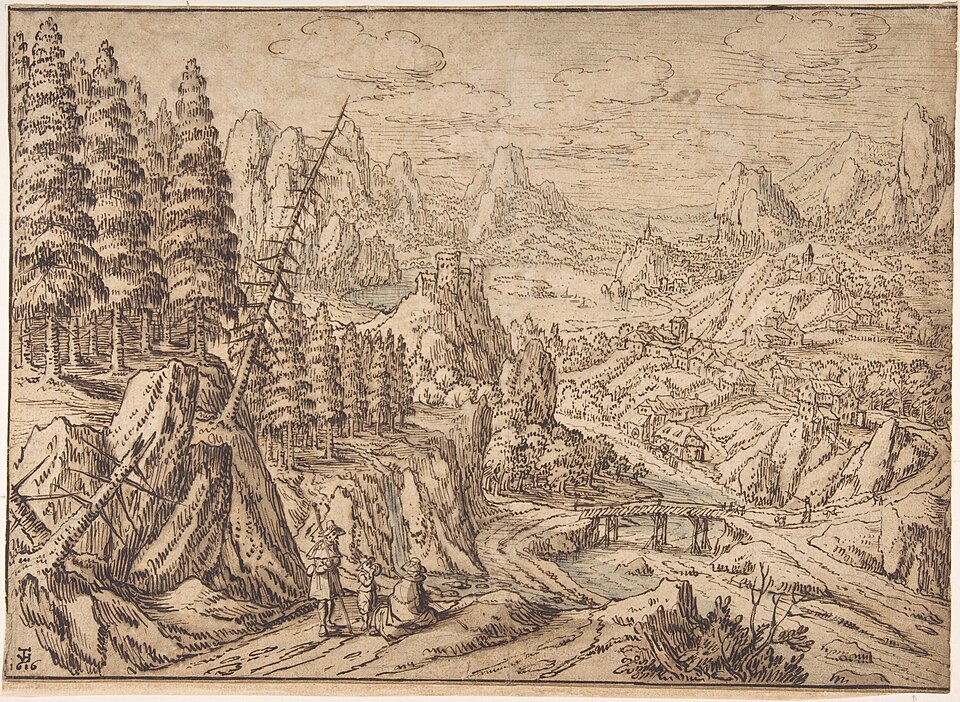
One of the most interesting art-historical comparisons is Mountainous Landscape with Venus and Adonis, a painting by Verhaecht dating from around 1600 in the Thyssen-Bornemisza collection in Madrid. Measuring 40 × 68 cm, it is also executed in oil on panel.[3]
Both paintings belong to the same type of panoramic mountain landscape, with small figures set within an expansive natural setting. In each, the relationship between the landscape and the human presence is fundamental to the composition.
A second relevant painting is held by the Staatliche Kunsthalle Karlsruhe. Mountain Landscape with Tobias and the Angel, also dated to around 1600, measures 45 × 66 cm. The catalogue also records that the painting originally formed a pendant pair with a depiction of the Flight into Egypt.[4]
This history shows that Verhaecht’s landscapes were not always conceived as independent paintings. Some formed pairs in which similar mountain landscapes framed different religious subjects. What is interesting about the present lot is that the catalogue identifies no specific religious or mythological subject. The human figures are described simply as ‘staffage’. This may indicate that the work was conceived primarily as a landscape.
A recurring repertoire of motifs
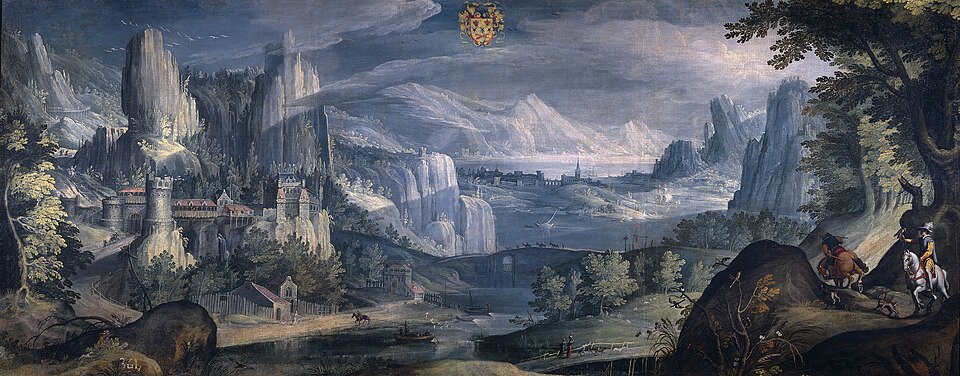
The striking combination of rock formations, bridges, a river valley and horsemen belongs to a repertoire of motifs that the artist returned to repeatedly. In the present painting, the appeal lies above all in the coherence of the different landscape zones and the atmospheric treatment. His paintings appear at auction with some regularity, but they vary considerably in size, date, subject, documentation and condition.
One useful comparison is Le Christ tenté, auctioned by Tajan on 22 June 2021. The painting, measuring 45 × 65 cm, carried an estimate of €4,000-6,000. It sold for €8,500.[5] The auction catalogue refers to a drawing associated with the painting.
On 12 June 2025, Bukowskis auctioned River Landscape with Figure Staffage, measuring 55 × 82 cm. The work was monogrammed and dated 1611 and was recorded in the RKD’s documentation. Estimated at SEK 300,000-400,000, it achieved a hammer price of just SEK 270,000, approximately €25,000.[6]
At the upper end of the market is a sale at Artcurial on 22 March 2023. A pair of large mountain landscapes by Verhaecht was offered there. The two canvases carried a combined estimate of €15,000-20,000 and sold for €45,000.[2] That result demonstrates that collectors can be willing to pay considerably higher sums for Verhaecht’s landscapes.
For the present painting, however, several details are missing. No precise date is given, no signature is mentioned, and the available catalogue description makes no reference to a previous owner, historical publication or any other documented variant.
Why this landscape still deserves attention
Based on previous results, the estimate of €4,000-6,000 does not seem unreasonable. The present lot does not stand out for an exceptional provenance, a documented date or a demonstrable connection to an important museum work. Any interest in it must first and foremost come from the painting itself. In our view, there are good reasons for that interest.
The composition has a convincing sense of space. The massive rock formations, central river valley and various routes through the landscape are skilfully balanced. The overall impression is monumental. Above all, the atmospheric treatment of the background gives the painting its appeal.
For us, the reason to follow this painting lies primarily in the composition itself. It is a compelling example of the imaginative landscape painting on which Verhaecht built his reputation. The auction therefore offers an interesting opportunity to see how much weight collectors place on these visible qualities when the art-historical documentation is limited.
Do you have a particular interest in this artist or in this subject?
Do you follow this artist, or have you come across a work you would like to know more about? We regularly research works appearing on the market and are always happy to exchange views on quality, provenance, art-historical context and previous auction results. You can contact us directly via info@antonello.art.
Notes and sources
[1] Beaussant Lefèvre & Associés, Tableaux, mobilier et objets d’art, Hôtel Drouot, Paris, 30 October 2026, lot 131, Tobias Verhaecht, Paysage montagneux animé de personnages (Mountain Landscape with Figures), oil on cradled panel, 40.5 × 68.5 cm, estimate €4,000-6,000.
[2] Artcurial, Maîtres anciens et du XIXe siècle, Paris, 22 March 2023, lot 92, Tobias Verhaecht, Paysages montagneux animés de personnages, a pair of oil paintings on canvas, one monogrammed and dated 1626. Estimate €15,000-20,000; reported result €44,608.
[3] Museo Nacional Thyssen-Bornemisza, Madrid, Tobias Verhaecht, Mountainous Landscape with Venus and Adonis, c. 1600, oil on panel, 40 × 68 cm, inv. no. CTB.1996.177.
[4] Staatliche Kunsthalle Karlsruhe, Tobias Verhaecht, Gebirgslandschaft mit Tobias und Engel (Mountain Landscape with Tobias and the Angel), c. 1600, oil on oak panel, 45 × 66 cm, inv. no. 2466.
[5] Tajan, Old Master Drawings and Paintings, Paris, 22 June 2021, lot 58, Tobias Verhaecht, Le Christ tenté, oil on oak panel, 45 × 65 cm. Estimate €4,000-6,000; reported result €8,500. The catalogue refers to a related drawing, RKD documentation no. 187250.
[6] Bukowskis, Stockholm, 12 June 2025, lot 629, Tobias Verhaecht, River Landscape with Figure Staffage, oil on reinforced panel, 55 × 82 cm, monogrammed and dated 1611. Estimate SEK 300,000-400,000; hammer price SEK 270,000.