On 29 September, The Auction Room London will offer a large ebony document casket inlaid with ivory from the VOC period, bearing the coat of arms and name of VOC official Abraham van Berlecom. The estimate of £4,000-6,000 (approximately €5,000-7,000) stands, in our view, in sharp contrast to those of related VOC armorial caskets.
[Update 29-09-2026: the lot was sold for €22,000.]
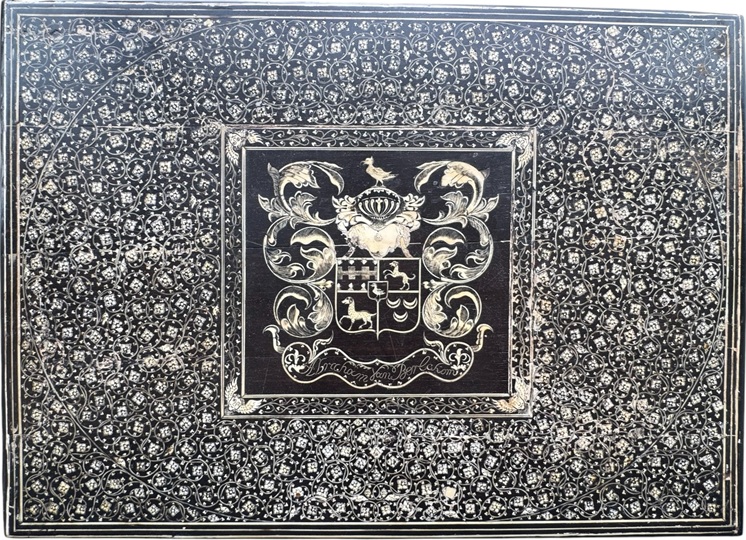
The quality and the estimate are the first things that stood out for us. This lot from The Auction Room London’s Fine Art Sale will be offered on 29 September with an estimate of £4,000-6,000. This is not a small or anonymous Indo-European casket, but a document casket measuring 60 centimetres wide and 42 centimetres deep, inlaid with ivory and centred on the lid by a family coat of arms, beneath which appears the name ‘D’Heer Abram Van Berlecom’.
The auction house dates it to circa 1717-1729 and identifies the commissioner as Abraham van Berlecom, chief of the VOC settlement at Bimilipatnam on the Coromandel Coast.[1] At first glance, that sounds like an ideal combination of VOC history, heraldry and rarity. But not every richly inlaid casket from India is rare.
A name that can be traced directly
Van Berlecom was present in Bimilipatnam from at least 1717 and died in 1729. A document from August 1725 places Van Berlecom as chief alongside the council of Bimilipatnam. This makes 1729 a plausible latest date for the casket’s manufacture. That distinction matters, particularly because a date in the 1720s would make this casket early in comparison with several better known examples.
An appealing document casket
Almost the entire exterior of the casket is covered by an exceptionally fine network of slender curling vines and small flowers. Against the dark ebony, the effect is almost lace-like. There are virtually no empty fields; even the front and side panels are densely worked.
On the lid, this pattern is interrupted by a rectangular field containing the quartered family coat of arms, helmet and crest, together with the name Van Berlecom. The heraldic element is therefore not simply an isolated nameplate applied to an otherwise generic casket. Visually, it forms the centre around which the surrounding decoration is organised.
This floral pattern is characteristic of a small group of early 18th-century caskets that were for many years almost automatically attributed to Vizagapatam. Today, the precise place of manufacture remains a matter of debate.[2] The auction house includes Bimilipatnam as the place of manufacture in the title. Van Berlecom worked there, but that does not in itself prove that local craftsmen made the casket.
A small, but not closed, group
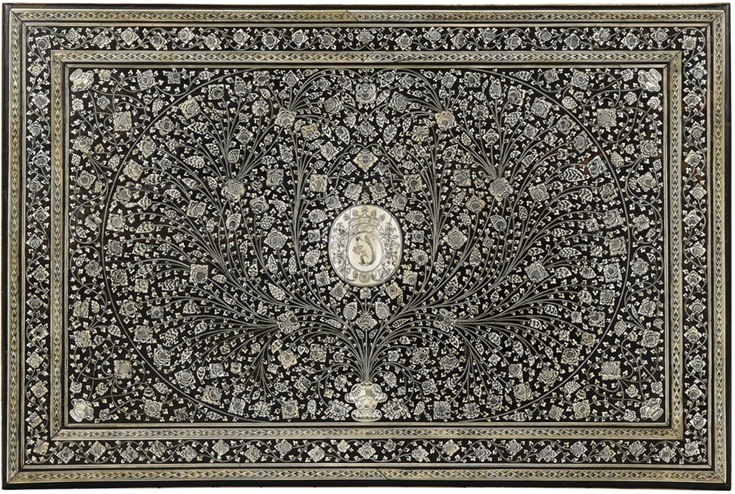
A group of five particularly finely inlaid document caskets is known. These include examples associated with Jan Albert Sichterman, the Falck family, the Alberda family of Menkema and Jacob Mossel, as well as an early museum example in the Victoria and Albert Museum. In 2019, Christie’s described the Sichterman casket as the largest and most intricately inlaid of this group.[3]
This is where an important part of the appeal of the present lot lies. Several of the canonical examples are held in museum or historic collections. The Falck casket has been in the Rijksmuseum since 1971.[2] The Sichterman casket entered the Groninger Museum in November 2019.[4]
Additional examples are known on the art market. A smaller casket bearing the arms of VOC official Galenus Mersen, dated circa 1740 and likewise attributed to Masulipatnam, has appeared in the trade. Others have surfaced at auction. The Van Berlecom casket therefore becomes more interesting when considered as a possible early addition to a small, documented group.
The known examples associated with Sichterman, Falck, Mersen and Mossel are generally dated to the 1730s and 1740s. If the proposed pre-1729 dating of the Van Berlecom casket proves correct, it would shift the chronology of this type noticeably backwards.
The Sichterman casket
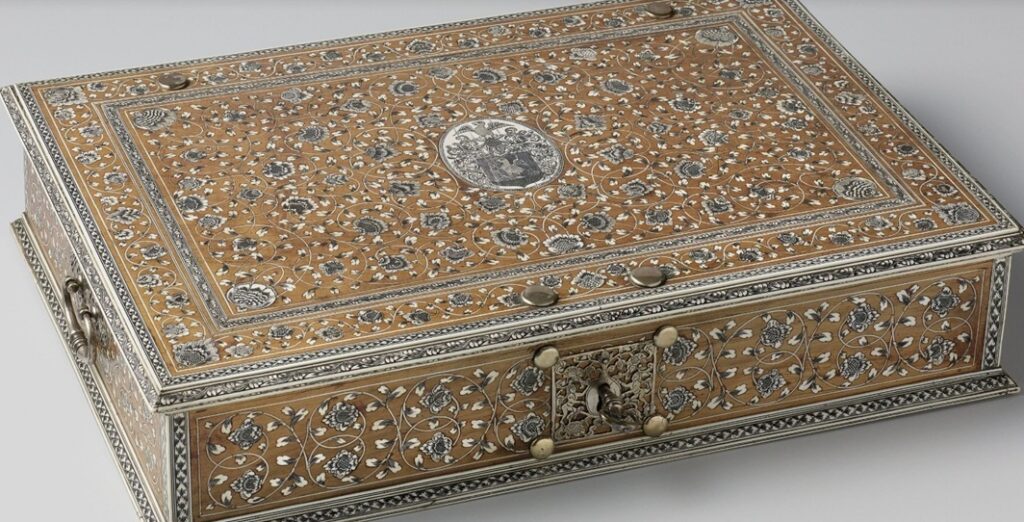
For the market, the most obvious comparison is the large document casket made for Jan Albert Sichterman. Not simply because of the VOC connection: the dimensions are strikingly close, with the Sichterman casket only marginally larger. It too features exceptionally fine ivory inlay, a personalised family coat of arms and a commissioner from the upper ranks of the VOC administration.[3]
Christie’s offered the Sichterman casket on 13 November 2019 with an estimate of £40,000-60,000. Its provenance was considerably stronger: it was almost certainly commissioned for Sichterman and subsequently remained within the family by descent.[3]
A potentially even better market comparison
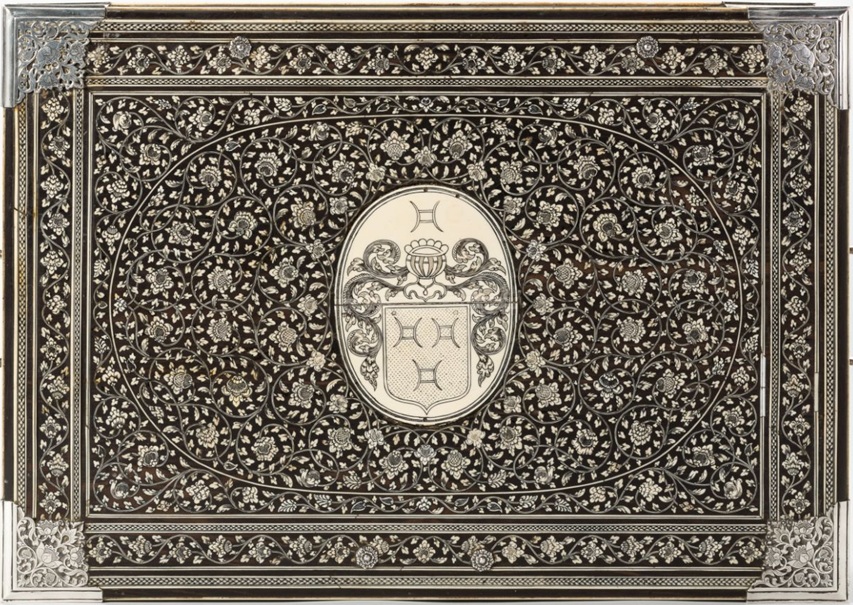
Another casket may be an even more relevant comparison. AAG Auctioneers in Amsterdam offered an ebony document casket dating from circa 1720, inlaid with pen-engraved ivory and mounted with silver. Its lid likewise bore a family coat of arms, and the object was possibly associated with VOC merchant Johan van Oordt. It carried an estimate of €25,000-35,000.[5]
The attribution to Van Oordt was cautiously phrased as ‘possibly’, while the casket itself was considerably more richly mounted in silver and retained an elaborate fitted interior. Nevertheless, two closely comparable early 18th-century caskets carried estimates substantially above that of the present lot.
What may explain the low estimate
The weak point begins with the provenance. The auction house gives no more than private collection.[1] For an object that may be three centuries old and which, according to the catalogue, represents a new addition to a small and studied group, that is remarkably thin. We do not know when the present family or collection acquired the casket, where it was during the 19th or 20th centuries, or why it appears not to have surfaced previously in the literature.
The photographs raise a second question. The interior of the Van Berlecom casket is almost entirely empty. Only the inside of the lid carries a centrally placed inlaid floral motif. This contrasts with both the Sichterman casket and the AAG example, which have fitted interiors with compartments and drawers.[3][5] The distinction between an originally plain interior and one from which fittings have subsequently been removed is relevant both art historically and commercially.
The exterior is not untouched either. There are scattered losses and damage to the light-coloured inlay, together with wear and scratches. The auction house also notes that the original small ball feet are missing.[1] Then there is the ivory itself. Import and export regulations may present practical restrictions for international buyers. That does not diminish the art-historical significance of the casket, but it does make the market for such objects more complicated.
The VOC connection is clearly present
Many objects on the art market acquire additional appeal through a broad colonial or VOC association. Here, the connection is more precise. A name appears on the object, and that name corresponds to a VOC servant from Delft who demonstrably built his career in Bimilipatnam during the relevant period.
This does not appear to be an ordinary Coromandel casket onto which an attractive VOC story has subsequently been projected. Its personalisation, dimensions and Van Berlecom’s biography place the object close to a small group of armorial document caskets made for senior VOC officials.
And this is precisely where the estimate becomes interesting. The relevant comparisons are not at the £4,000-6,000 level. An almost equally large early 18th-century armorial casket was estimated at €25,000-35,000, while Christie’s placed a £40,000-60,000 estimate on the richer and better-documented Sichterman casket.[3][5] There are, of course, differences in provenance, silver mounts, interior fittings and condition.
What this auction may reveal is how much value the market places on something that can no longer readily be tested against many of the established examples, because so many are held in museum and historic family collections. A large, personalised VOC document casket that may predate a significant part of the known group and has now unexpectedly returned to the market. In our view, the estimate therefore appears notably cautious.
Do you have a particular interest in this artist or in this subject?
Do you follow this artist, or have you come across a work you would like to know more about? We regularly research works appearing on the market and are always happy to exchange views on quality, provenance, art-historical context and previous auction results. You can contact us directly via info@antonello.art.
Notes and sources
[1] The Auction Room London, “29th September Upcoming Highlights”, 4 September 2026, An Important and Rare Dutch VOC Armorial Pen-Engraved Ivory Inlaid Ebony Document Casket, estimate £4,000-6,000; Fine Art Sale, 29 September 2026, lot 212.
[2] Rijksmuseum, Document Casket, object number NG-854, circa 1740, Masulipatnam.
[3] Christie’s, London, The Collector: European and English Furniture, Ceramics, Portrait Miniatures & Works of Art, 13 November 2019, lot 129, document casket of Jan Albert Sichterman, 14 × 63.5 × 43 cm, estimate £40,000-60,000.
[4] Groninger Museum: the institution acquired the Sichterman casket in 2019 and dates it to circa 1740-1745.
[5] AAG Auctioneers, The Asian Art Sale, Amsterdam, 27 November 2017, lot 205, ebony document casket with pen-engraved ivory inlay, circa 1720, possibly made for Johan van Oordt; 13.5 × 57.8 × 40.6 cm; estimate €25,000-35,000.