A monumental Flemish School painting, without any further attribution and carrying an estimate of £10,000-15,000, fetched £63,200 including buyer’s premium at Woolley & Wallis on 9 September. The surprise lies less in the quality of the painting itself than in the combination of bizarre iconography, scale, long-standing provenance and a lack of readily comparable material.
At first glance, The World Reversed or The Hares’ Revenge is not the sort of Old Master that immediately makes a connoisseur want to zoom in on the handling of the paint. The execution is uneven. Figures are at times rendered almost schematically, the space is exaggerated rather than convincingly constructed, and across the larger passages it lacks the refinement that might make a convincing attribution to a name such as Jan van Kessel attractive. But in our view, that is not really the point of this painting.
Across a canvas measuring 166 by 211 centimetres, the hares have completely taken over the social order. People and hunting dogs, normally the pursuers, are captured, put on trial and killed. Beneath a red-and-blue tent, a court of hares sits in judgement, elsewhere troops march, prisoners are led away and various forms of retribution unfold. The composition reads less as a single moment than as an absurdist panorama in which there is something to discover everywhere.
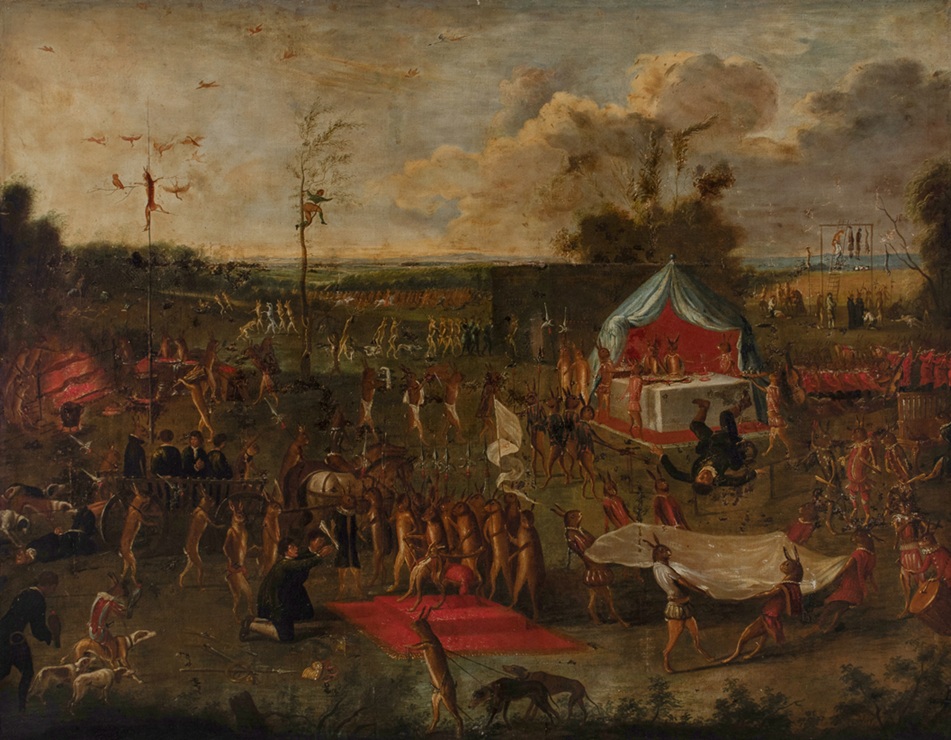
Its commercial success was not entirely unexpected, helped by the low estimate, which probably drew in more bidders. The auction house cautiously catalogued the painting as Flemish School c.1700 for its sale of 9 September 2026, with an estimate of £10,000-15,000. It ultimately realised £63,200 including buyer’s premium.[1]
An old joke, not an invention of the early 18th century
The motif of prey animals reversing roles with their human hunters is centuries older than this painting. The basic principle of the reversal is simple. What man did to the hare, the hare now does to man.[2] What makes this work remarkable is that this long-established tradition has here grown into a painting more than two metres wide, apparently intended to be read both from a distance and at close quarters.
A painting that belonged to a historic house
One of the work’s strengths is its provenance and, with it, its British history. According to the auction house, by 1871 at the latest it belonged to a family at Newhouse, near Salisbury, and subsequently passed down by descent within the same family. The painting was already mentioned in 19th-century literature, giving it a demonstrable connection with this family context from an early date.[3]
This is not a work whose significance depends on a succession of famous collectors’ names. It has something else, a long-standing connection with a historic house. For a painting with such an eccentric subject, that is more meaningful than a lengthy chain of previous ownership.
The comparisons that stand out
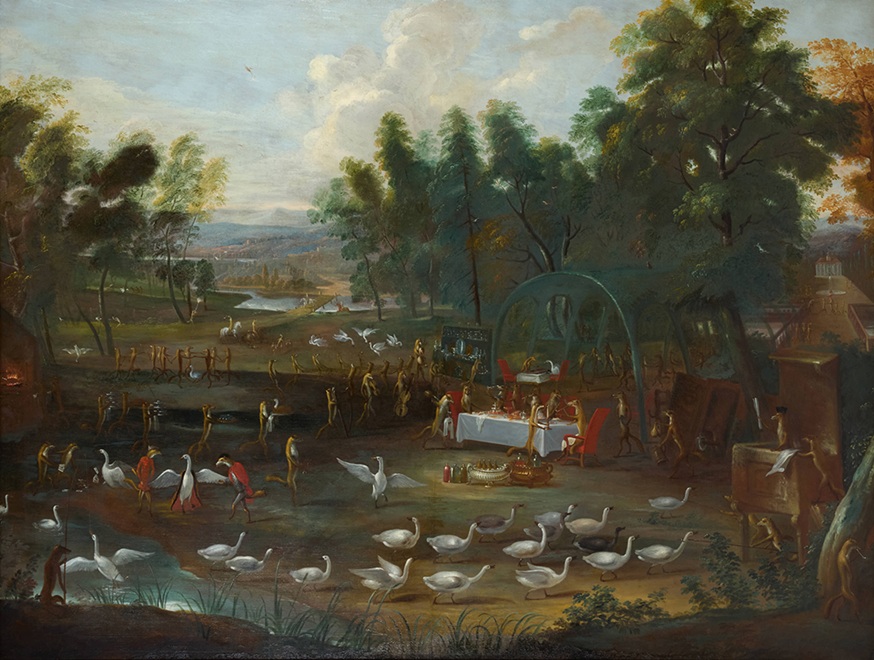
Prices for Jan van Kessel tell us little when the present cataloguing is specifically not Van Kessel. More interesting is another large Flemish painting sold by Dreweatts in November 2025: A Fête Champêtre of Foxes and Swans, likewise on canvas and of comparable dimensions. The work was estimated at £15,000-25,000 and sold for £35,500.[4]
The painting had been offered at Sotheby’s in 1985 as attributed to Jan van Kessel I, at Christie’s in 1988 as Circle of Van Kessel, and later as Flemish School. More interesting still, at an earlier auction it had been offered as a pair with a work by the same hand entitled Reverse World with the aftermath of the hares defeat of the human race.[4][5]
There thus appears to be a small group of monumental Flemish canvases in which animal societies and reversed human hierarchies are developed on a comparable scale. The number of related paintings remains small, and genuinely comparable works appear on the market so infrequently that buyers have little in the way of previous results to rely on.
No need for a name like Jan van Kessel
There is little reason to describe this as a finely executed animal painting. Some of the hares are handled quite effectively, but elsewhere bodies and gestures are resolved in an almost naïve manner. The groups in the background function more as signs within the narrative than as carefully modelled figures. Large dark passages and the red of the central tent organise the composition more strongly than any subtle effects of colour or light.
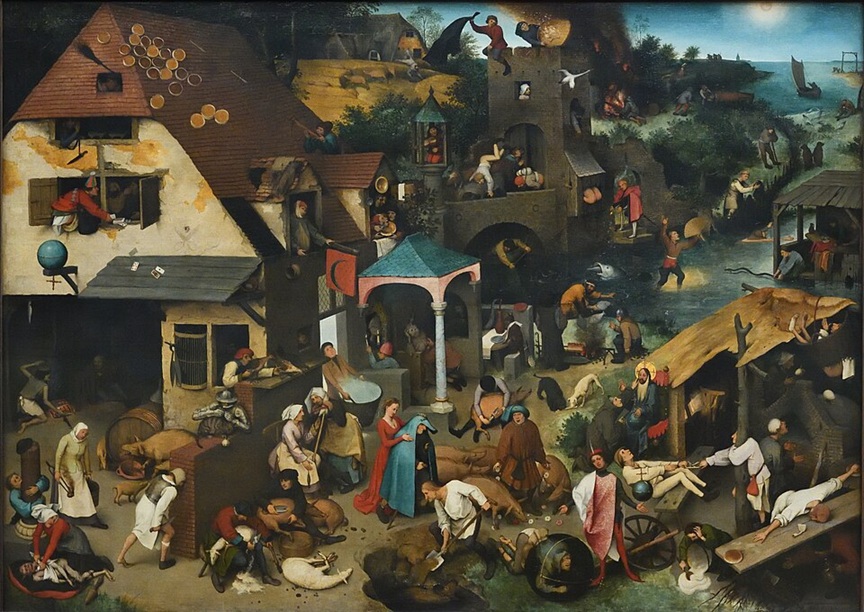
At this scale, the picture functions above all as a guide to looking and discovery. First the bizarre overall reversal, then one punishment, procession or detail after another. In spirit it is closer to a large decorative conversation piece than to the kind of small painting in which refined handling takes precedence. It might be compared with larger works in the style of Breughel, for example those structured around proverbs.
What £63,000 actually tells us
The result shows that an anonymous Old Master can become highly competitive in a bidding contest when several forms of scarcity coincide. Here there was an immediately recognisable subject, a format measuring more than two metres across and a documented presence in a single English family from at least 1871.
There is also a subject rooted in a centuries-old European visual tradition, with only a handful of paintings that can serve as genuinely useful comparisons. The sale demonstrates something else as well, just how far the market can sometimes move beyond the conventional hierarchy of a major name, secure attribution and refined technique when a work has almost no directly comparable material.
That, in our view, is precisely what makes this work interesting. Not the possibility that a famous artist might eventually be attached to it as an attribution, but the fact that this apparently was not necessary. The estimate was, in any case, comfortably exceeded.
Do you have a particular interest in this artist or in this subject?
Do you follow this artist, or have you come across a work you would like to know more about? We regularly research works appearing on the market and are always happy to exchange views on quality, provenance, art-historical context and previous auction results. You can contact us directly via info@antonello.art.
Notes and sources
- Woolley & Wallis, Old Masters, British & European Paintings, Salisbury, 9 September 2026, lot 120, Flemish School c.1700, The World Reversed or The Hares’ Revenge; estimate £10,000-15,000, result £63,200 including buyer’s premium.
- The Fitzwilliam Museum, Virgilius Solis the Elder, The World Turned Upside Down: Hares Roasting a Hunter, 1530-62, no. P.4962-R.
- John Gough Nichols, The Herald and Genealogist, vol. 6, London: J.G. Nichols and R.C. Nichols, 1871, p. 460; Country Life, 31 July 1926, p. 179. These literature references are taken from the Woolley & Wallis cataloguing.
- Dreweatts, A View from Across the Atlantic: The Pamela Ford Collection, Newbury, 18 November 2025, lot 58, Flemish School, early 17th century, A Fête Champêtre of Foxes and Swans, estimate £15,000-25,000, result £35,480.
- Christie’s, A fête champêtre of foxes and swans, oil on canvas, 165 × 217 cm, Hampton Court and Christie’s London, 9 December 1988, lot 80.