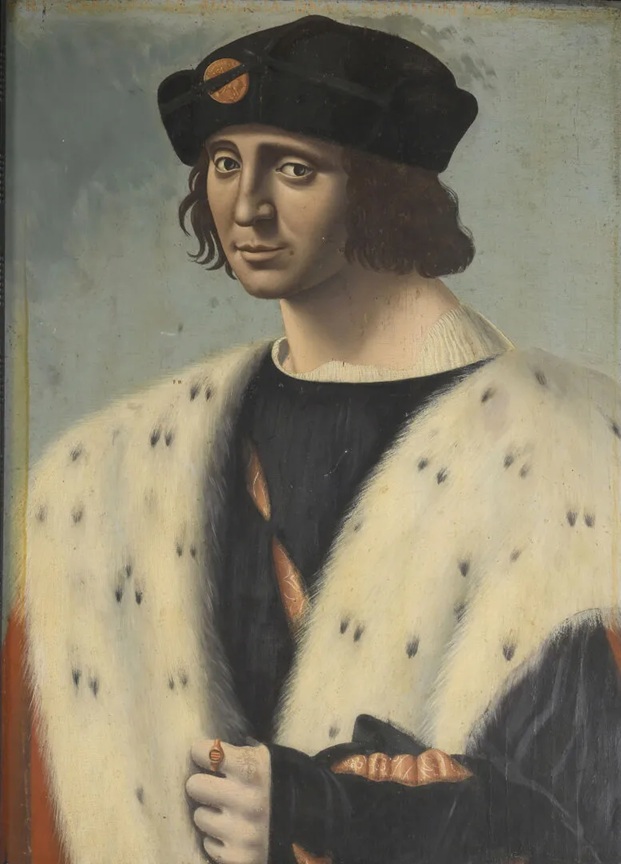
Auction house Daguerre estimated a panel portrait of Charles II d’Amboise at just €1,000-1,500. During the sale of the contents of the Château de Meillant, it hammered at €15,000. That does not necessarily mean bidders suddenly recognised a Bernardino de’ Conti. But there are good reasons why this particular painting invites further investigation.
A painting that sells far above its high estimate naturally attracts attention. Daguerre offered the work as Italian School, 19th century, in the manner of Bernardino dei Conti, with an estimate of €1,000-1,500. The panel depicts Charles II d’Amboise.[1] What did the bidders see that was apparently not reflected in the estimate?
The most tempting explanation is that someone believed the panel to be older than the 19th century. That is possible, but the history of the Château de Meillant offers an equally serious argument in the opposite direction.
Bernardino de’ Conti is No Coincidental Name
The reference to Bernardino de’ Conti is far more interesting in this lot than the conventional catalogue wording “dans le goût de” might suggest. Charles II d’Amboise (1471-1511) was not only lord of Meillant but also one of the most powerful French figures in Italy under Louis XII. And Bernardino de’ Conti did in fact paint Charles d’Amboise.
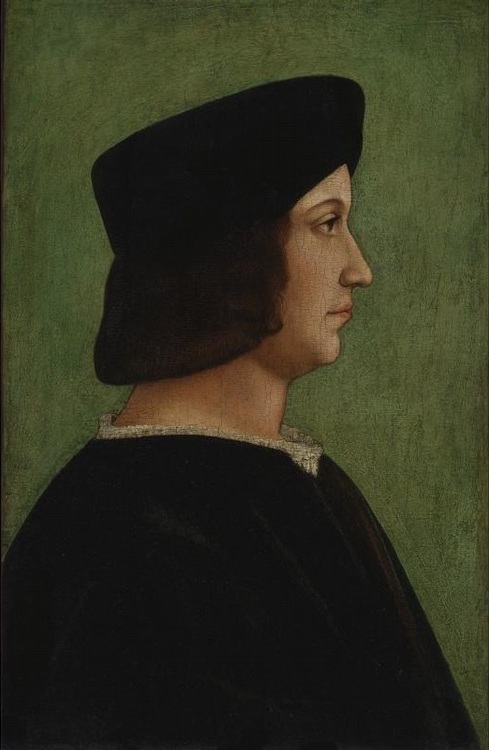
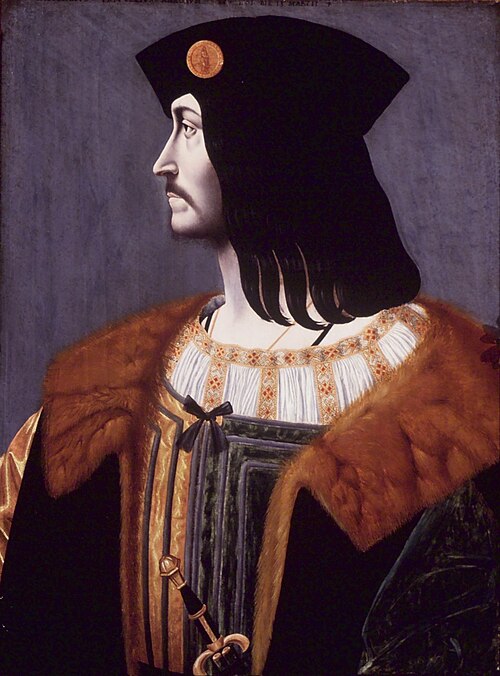
The Louvre explicitly refers to a portrait of Charles signed by Bernardino and dated 1500, now in the Musée Saint-Vic in Saint-Amand-Montrond. The sitter is shown in profile.[2] This is therefore not simply a case of a 19th-century artist painting an arbitrary Renaissance portrait in the style of a Lombard master. The artist invoked by the catalogue, the sitter and the château from which the panel was sold all belong to the same historical context.
That presumably accounts for some of the work’s appeal to bidders. Nor is it the only early portrait of Charles d’Amboise. The Louvre owns a second portrait, dating from around 1508-1510, long associated with Andrea Solario.[2] There is no simple situation in which a single authentic portrait of Charles d’Amboise served as an easily identifiable source for all later representations. His likeness circulated, was copied and was repeatedly reinterpreted.
Meillant Makes the Painting More Compelling, but Also More Suspect
The provenance from the Château de Meillant is the second element that may have fuelled the bidding. The d’Amboise family was directly responsible for an important part of the château’s present architecture. The Gothic building in which the painting found itself centuries later therefore genuinely belongs to the world of the sitter. Yet it is precisely the history of Meillant that provides the strongest argument in favour of the 19th-century dating.
From 1842 onwards, the château underwent an extensive restoration, and its interiors were also substantially remodelled. The catalogue is filled with 19th-century furniture and objects deliberately imitating 15th- and 16th-century forms. The same sale also included four monumental historical portraits by the 19th-century artist Joseph Wereszczynski, one of them thought to represent Charles II d’Amboise.[3] We therefore know that historical portraits were indeed produced or assembled at Meillant in the 19th century as part of an effort to make the château’s past visible once again.
This is important counterevidence to an overly romantic reading of the work. The panel’s painted surround fits remarkably well within such a programme. Allegories combined with a depiction of the family château itself sound far more like 19th-century historicist self-representation. It is even conceivable that the panel and its surround were assembled specifically for a historical portrait gallery.

Why €15,000 Then?
In Old Master painting, buyers sometimes pay for the space that remains between the facts. Here, that space is unusually large. We have a painting on panel depicting a historically specific sitter, coming from his own château and connected to a portrait tradition that includes two important Milanese examples from the early 16th century.
One of those was indeed signed by Bernardino de’ Conti and dated 1500. At the same time, the work offered at auction was catalogued merely as 19th-century Italian School and estimated at €1,000-1,500. For a bidder who thought the panel looked older when examined in person, €15,000 may have seemed a defensible price at which to pursue further research.
The difference between a 19th-century historicist copy and, for example, a 16th- or 17th-century version after an early portrait type is already considerable. A panel dating from the first half of the 16th century, even without a prestigious attribution, would be an entirely different object from an art-historical perspective. The wood could, for example, be subjected to dendrochronological analysis after the sale.
The Bernardino Name Changes the Valuation
A fully accepted work by Bernardino de’ Conti occupies an entirely different financial world. In February 2025, Sotheby’s in New York sold his Portrait of an Elegantly-Attired Noblewoman in Profile for approximately €3.0 million.[4] The difference in cataloguing is precisely the point. The Sotheby’s portrait was a thoroughly researched, fully accepted Bernardino with important provenance.
Even at the lower end of the accepted market, however, prices remain substantial. In 2013, Dorotheum sold a Madonna and Child by Bernardino for €180,000 including buyer’s premium, against an estimate of €150,000-200,000.[5]
An Older Painting?
The bidding up to €15,000 is no proof that the painting predates 1800. An auction price is not technical analysis, and two enthusiastic bidders do not constitute an art-historical consensus. Nor does the Meillant context point exclusively towards the Renaissance, quite the opposite.
The château was extensively restored in the 19th century and furnished with objects deliberately evoking its own medieval and early Renaissance past. An arbitrary 19th-century copy after Bernardino would probably have had greater difficulty explaining such a price. Here, however, subject, support, provenance and the existence of an early portrait by precisely the artist named in the catalogue all come together.
The catalogue attribution may prove entirely correct, and the panel may ultimately turn out to be simply part of Meillant’s 19th-century historicist interior. But the documentation leaves enough room not to accept that conclusion as the final word without technical examination. Because how old is the painting itself, independently of the Neo-Gothic world in which it was housed? That is probably what at least two bidders were prepared to investigate.
Do you have a particular interest in this artist or in this subject?
Do you follow this artist, or have you come across a work you would like to know more about? We regularly research works appearing on the market and are always happy to exchange views on quality, provenance, art-historical context and previous auction results. You can contact us directly via info@antonello.art.
Notes and Sources
[1] Daguerre, Château de Meillant, 1ère partie, Meillant, 20 September 2026, lot 92, École italienne, XIXe siècle, dans le goût de Bernardino dei Conti, Portrait de Charles II d’Amboise.
[2] Musée du Louvre, collection page Charles d’Amboise (1471-1511), maréchal de France, gouverneur de Milan en 1500 et protecteur du peintre, Portrait de Charles II d’Amboise, Bernardino de’ Conti, 1500, Musée Saint-Vic.
[3] Daguerre, Château de Meillant, 1ère partie, 20 September 2026, lot 114, Joseph Wereszczynski, four historical portraits, including one thought to represent Charles II d’Amboise.
[4] Sotheby’s New York, Master Paintings & Sculpture Part I, 6 February 2025, lot 311, Bernardino de’ Conti, Portrait of an Elegantly-Attired Noblewoman in Profile.
[5] Dorotheum, Old Master Paintings, Vienna, 15 October 2013, Bernardino de’ Conti, Madonna and Child, realised price €183,300.