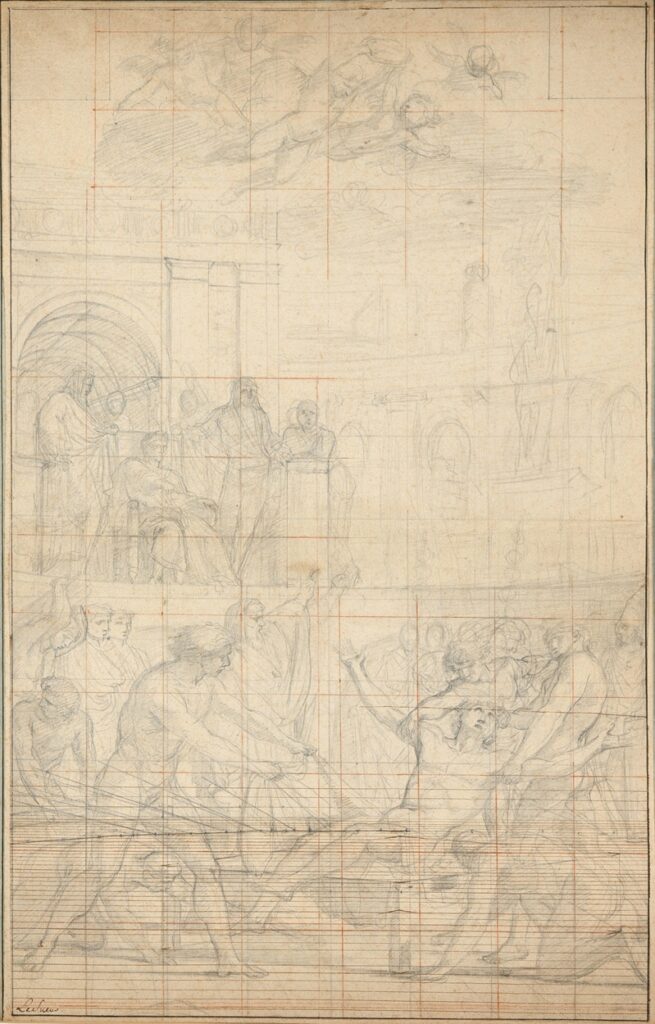
Under the broad title Martyrs in Rome, Zeeuws Veilinghuis offered a large, squared-up drawing bearing the name of Eustache Le Sueur (1616-1655). The scene appears to relate to the martyrdom of Saint Lawrence, a subject the French painter treated around 1652. A nineteenth-century description may shed new light on the work’s significance.
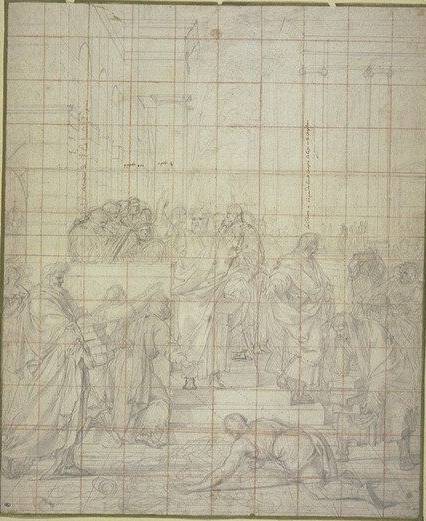
At first, we see a complex arrangement of figures, architecture and loosely sketched details. Yet the composition is carefully constructed. On the left is a Roman tribunal, while on the right a group of executioners surrounds an almost naked martyr. Above them, angels appear among the clouds. Red grid lines divide the entire sheet into squares, while horizontal lines at the bottom suggest a large gridiron.
The drawing bears the name Le Sueur at lower left. Measuring 51 × 32 cm, it is large for a work on paper. Its character is particularly interesting. Rather than a study of a single figure, it appears to be a design exploring an entire composition. The sheet was offered at Zeeuws Veilinghuis on 10 November 2026. The catalogue listed Eustache Le Sueur as the artist, gave the title Martyrs in Rome, and described the medium as pencil on paper, with a sun watermark. It achieved €92,000 against an estimate of €1,500.[1]
Such a result naturally attracts attention, but why did this particular drawing generate so much interest? The scene appears to be closely connected to an important commission from the final years of Le Sueur’s life. Moreover, an early composition for precisely this subject was described as far back as the nineteenth century.
The Martyrdom of Saint Lawrence
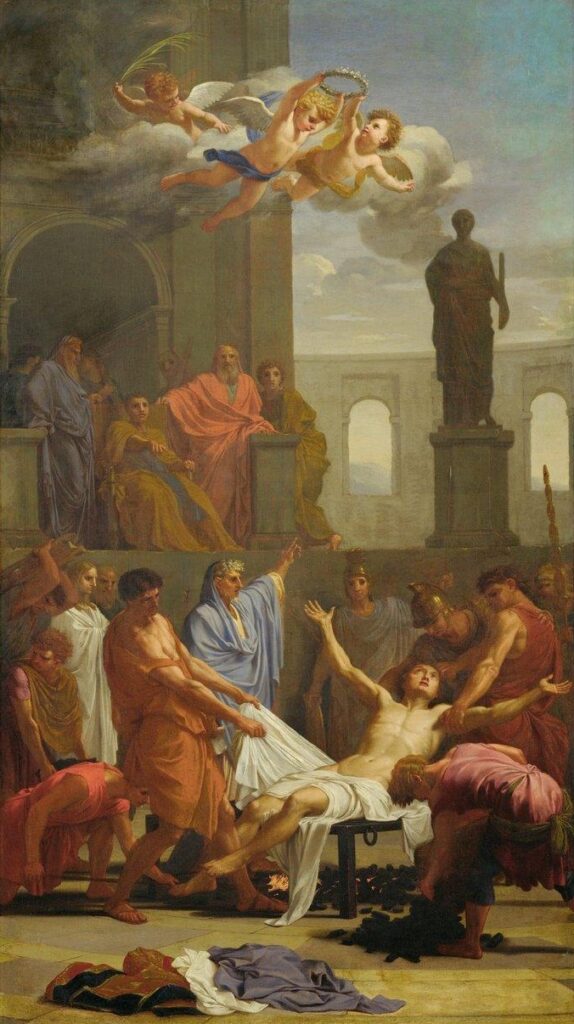
At the centre is an almost naked man held by several executioners. His body arches backwards, his head raised. The figure appears to be Saint Lawrence, who, according to Christian tradition, was martyred in Rome in 258. On the left, an authority figure sits on a raised platform within an architectural setting resembling a columned Roman building. The scene thus has an imperial character, with the sentence and its execution depicted simultaneously.
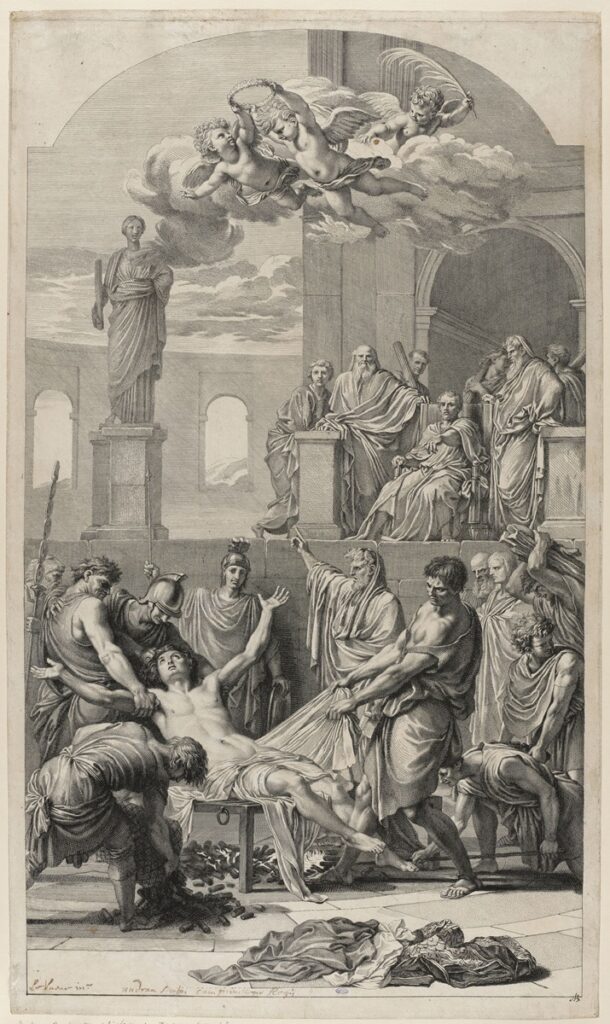
The angels above herald the martyr’s heavenly reward, so the drawing is concerned with more than suffering alone. This identification matters because, around 1652, Eustache Le Sueur painted a major work on the subject for a chapel in the Parisian church of Saint-Germain-l’Auxerrois.[2] Several preparatory studies for the commission are known.
Le Sueur and His Preparatory Process
Eustache Le Sueur was among the leading exponents of seventeenth-century French Classicism. Trained in Simon Vouet’s workshop, he worked under the influence of Raphael and Nicolas Poussin. Le Sueur never travelled to Italy, gaining his knowledge of Italian art through paintings, prints and drawings circulating in France.
Le Sueur made preparatory drawings for his major commissions. Some investigate an individual figure, while others focus solely on the folds of a garment or the movement of an arm. The Louvre holds several such studies directly connected with The Martyrdom of Saint Lawrence.
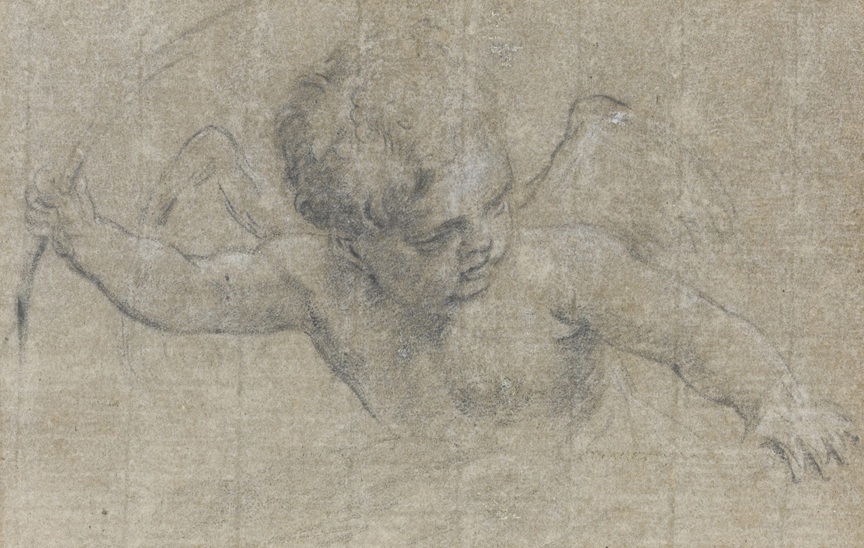
One, for example, shows a naked man pulling at a cloth. The figure can be identified as one of the executioners removing the fabric from Lawrence’s body. The studies are executed in black chalk with white heightening on grey paper.[3] Drawings connected with the commission also exist outside the Louvre. In July 2014, Sotheby’s in London offered a study of a putto holding a palm frond. The sheet was identified as a preparatory study for an angel in the upper left of the painting and had been included in a monograph on the artist.[4]
A Large Composition with a Red Grid
The red lines running across the drawing were almost certainly added to transfer the composition to a different scale. The technique was widely used in preparing paintings and large decorative commissions. A good example is Le Sueur’s preparatory drawing for The Preaching of Saint Paul at Ephesus in the Louvre.
Measuring 52.5 × 43.5 cm, the sheet is executed in black chalk and bears a grid in red chalk. The name Le Sueur also appears at lower left. The Louvre regards the drawing as a carefully developed design for the painting presented to Notre-Dame in Paris in 1649.[5] The similarity in working method to the drawing sold at auction is clear.
One difference, however, is that the composition for The Preaching of Saint Paul at Ephesus is largely worked out, whereas the martyrdom scene is not. Considerable attention is paid to the faces of the figures surrounding the martyr, but the architecture behind them remains mostly sketchy. Above, the angels are indicated with searching lines.
This uneven degree of finish gives the sheet the character of a composition still being developed, rather than a completed work. One possible purpose was to establish the relationships between the principal groups of figures. If so, it would be an early compositional study. The grid does not, however, prove that Le Sueur himself drew the sheet. A later draughtsman could equally have used this method to transfer an existing composition. The central question is therefore how old the drawing is and where it belongs in the development of the final composition.
A Historical Description Offers a Clue
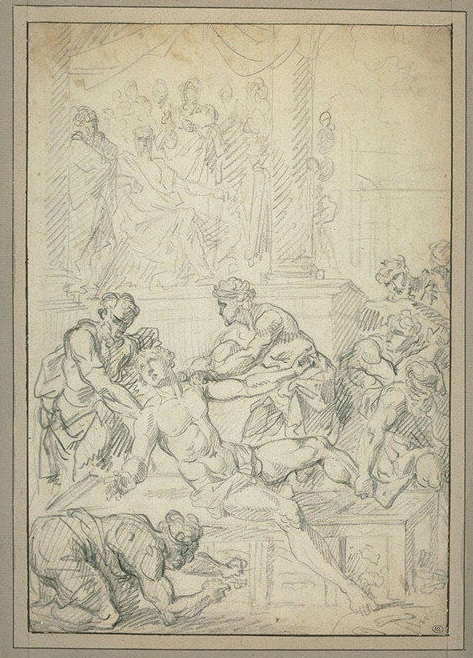
A nineteenth-century publication describes a drawing of Le martyre de saint Laurent. The author calls it a première pensée, an initial idea, which differs considerably from the finished painting. The composition is then described in these words, le gril occupe toute la largeur du dessin, et le tribunal est à gauche.
The gridiron occupies the entire width of the drawing, while the tribunal is on the left.[6] According to the author, only the movement of the saint remained unchanged in the painting as finally executed. This suggests that the artist had originally arranged the scene quite differently. Indeed, the architecture, the distribution of the groups of figures and the broad arrangement of the gridiron seem to point to a composition unlike that of the finished painting.
The nineteenth-century description, however, refers to a drawing in the Louvre. That sheet measures 31.1 × 21.7 cm, making it considerably smaller, and its attribution has since been revised. It is now catalogued as a copy after Eustache Le Sueur.[7] It nevertheless confirms that a composition was known in the nineteenth century in which the martyrdom of Lawrence was arranged differently from the finished painting. This raises the question of whether several drawings derive from the same early design. The surviving group thus appears to include both original studies and copies after this particular composition.
A Second Design in the Chennevières Collection
After describing the Louvre sheet, the nineteenth-century source states that Philippe de Chennevières also owned a compositional study for the martyrdom of Lawrence. Philippe de Chennevières (1820-1899) was an influential French art historian and collector with a particular interest in French drawings.
His extensive collection contained thousands of sheets, including works by Nicolas Poussin, Simon Vouet, Charles Le Brun and, indeed, Eustache Le Sueur. Following his death, a substantial part of the collection was dispersed. One major sale took place over several days in Paris in 1900. Where, then, did the second composition of Saint Lawrence from the Chennevières collection end up? Unfortunately, the drawing sold in Middelburg bears no visible collector’s mark that would link it directly to Chennevières.
The Significance of the Signature and the Paper
The signature tells us little on its own. Names were often added later to drawings by collectors, dealers or curators. Sometimes this was simply a way of recording an existing attribution, precisely because the artist had not signed the sheet.
In January 2022, Sotheby’s in New York offered a figure study by Le Sueur, also squared up, with a name inscribed in brown ink at lower left. Sotheby’s described it as an old attribution rather than an autograph signature.[8] Then there is the watermark. Watermarks can provide important clues about the origin and date of a sheet of paper. Perhaps the watermark pointed bidders towards a particular conclusion. The auction house described the medium as pencil on paper, but could it instead be black chalk? That would be consistent with Le Sueur’s known practice.
The Market for Drawings by Le Sueur
The market for drawings by Le Sueur is relatively small, and prices vary considerably. One important comparison is Saint Protais, sold at Christie’s in Paris in 2007. The drawing had a provenance extending back to an eighteenth-century collector. It had also appeared in scholarly literature and several exhibitions. Estimated at €100,000-150,000, the sheet realised €132,000.[9]
That was a well-documented drawing from the final years of Le Sueur’s life. Another comparison is David Dancing Before the Ark of the Covenant, also sold at Christie’s in Paris in 2007. This drawing bears a grid and an inscription. Estimated at €25,000-35,000, it realised €30,000.[10] The difference is considerable.
The previously mentioned study of a putto for The Martyrdom of Saint Lawrence was offered at Sotheby’s in 2014 with an estimate of £5,000-7,000. It was included in the monograph and had a documented provenance. The final result fell squarely within that range.[4] The quality of the individual sheet, its role within the artist’s oeuvre, its provenance and the certainty of attribution therefore appear to be the key factors determining its price.
An Original Design or an Old Copy?
For an autograph compositional drawing by Le Sueur, a price of €92,000 is not inconceivable. Yet there is an important counterargument, old copies are known to exist. As noted, the Louvre holds an early composition that is now regarded as a copy. Moreover, Le Sueur’s painting was reproduced by several engravers, enabling artists and collectors beyond his studio to study and copy the scene.[11] An old copy might show the same composition, with similar figures, architecture and even a grid.
Either we are looking at an original compositional study in which Le Sueur explored an early version of the martyrdom, or the sheet is an old copy after such a design. Resolving that question would require close comparison with accepted drawings by Le Sueur, further examination of the paper and a more complete reconstruction of its provenance. All of this would be essential, and the buyer will no doubt already be considering such research.
Do you have a particular interest in this artist or subject?
Do you own a painting by this artist, have you come across a comparable work, or do you have information that might be relevant to further research? We welcome contact from collectors, art dealers and researchers with an interest in this artist or related subjects.
We regularly research paintings appearing on the art market, exploring questions of attribution, quality, provenance and previous sales. If you have a question about a particular work or would like to share information with us, please feel free to get in touch at info@antonello.art.
Notes and Sources
[1] Zeeuws Veilinghuis, Exclusive Items & Indonesian Paintings, Middelburg, 10 November 2026, lot 7, Eustache Le Sueur, Martyrs in Rome.
[2] Sotheby’s, London, Old Master & British Drawings, 9 July 2014, lot 25, Eustache Le Sueur, Study of a Putto Holding a Palm.
[3] Musée du Louvre, Département des Arts graphiques, Eustache Le Sueur, Études d’un homme nu, debout, tirant sur quelque chose, INV 30643, and Étude d’homme nu, la figure du bourreau, dans le Martyre de St Laurent, INV 30691.
[4] Sotheby’s, London, Old Master & British Drawings, 9 July 2014, lot 25, Study of a Putto Holding a Palm. Black chalk heightened with white on brown paper, squared up for transfer. Estimate £5,000-7,000, sale price £6,250. See also Alain Mérot, Eustache Le Sueur 1616-1655, Paris, 1987.
[5] Musée du Louvre, Département des Arts graphiques, Eustache Le Sueur, Prédication de saint Paul à Éphèse, MI 909. Black chalk, squared up in red chalk, 52.5 × 43.5 cm.
[6] Archives de l’art français, vol. II, p. 88, under Le martyre de saint Laurent.
[7] Musée du Louvre, Département des Arts graphiques, Martyre de saint Laurent, copy after Eustache Le Sueur, INV 30840. Black chalk, 31.1 × 21.7 cm.
[8] Sotheby’s, New York, Master Works on Paper from Five Centuries, 26 January 2022, lot 21, Eustache Le Sueur, Study of a Man, Seen from Behind, His Head Turned to the Left and Arm Outstretched.
[9] Christie’s, Paris, Dessins Anciens et du 19è Siècle, 22 March 2007, lot 58, Eustache Le Sueur, Saint Protais. Black and white chalk on brown paper, 41.6 × 24.3 cm. Estimate €100,000-150,000, sale price €132,000.
[10] Christie’s, Paris, Dessins Anciens et du 19è Siècle, 22 March 2007, lot 59, Eustache Le Sueur, David Dancing Before the Ark of the Covenant. Black chalk, grey wash and a grid, 25.4 × 36.3 cm. Estimate €25,000-35,000, sale price €30,000.
[11] Wellcome Collection, Saint Laurence of Rome: His Martyrdom, engraving by Gérard Audran after Eustache Le Sueur.