An early sixteenth-century Madonna of the Rosary by Goossen van der Weyden and his workshop will go under the hammer at Lempertz in Cologne on 21 November 2026. The monumental panel, documented in art-historical literature as early as 1913 and held in a German private collection for generations, carries an estimate of €180,000-220,000. Its unusual iconography and publication history make it a compelling lot, but the qualified attribution and restoration history complicate any assessment of the likely result.
[Update 21 November 2026: The lot was sold for €170,000.]
Lempertz is offering a painting that entered the art-historical literature more than a century ago, yet whose whereabouts in 1989 could no longer be traced, even by a researcher at the Metropolitan Museum of Art. The work is Madonna of the Rosary with Two Donors and Saints Dominic and Francis, a large early sixteenth-century panel associated with Goossen van der Weyden (c. 1465-after 1538), the grandson of Rogier van der Weyden.
The work measures 185 × 154 cm and carries an estimate of €180,000-220,000. Its scale and intriguing history are far from commonplace in the relatively small auction market for Goossen van der Weyden. At the same time, it is not an undisputed autograph work. The auction house also points to restoration interventions that have altered the painting’s appearance.[1]
For us, this is a good opportunity to examine more closely how the altarpiece and its estimate compare with the market. A recent sale of two workshop panels at Koller in Zurich realised approximately €102,000, while the artist’s auction record at Sotheby’s stands well above €1 million. These figures represent two ends of a market in which quality, attribution and art-historical significance carry considerable weight.
A Madonna between two Flemish pictorial traditions
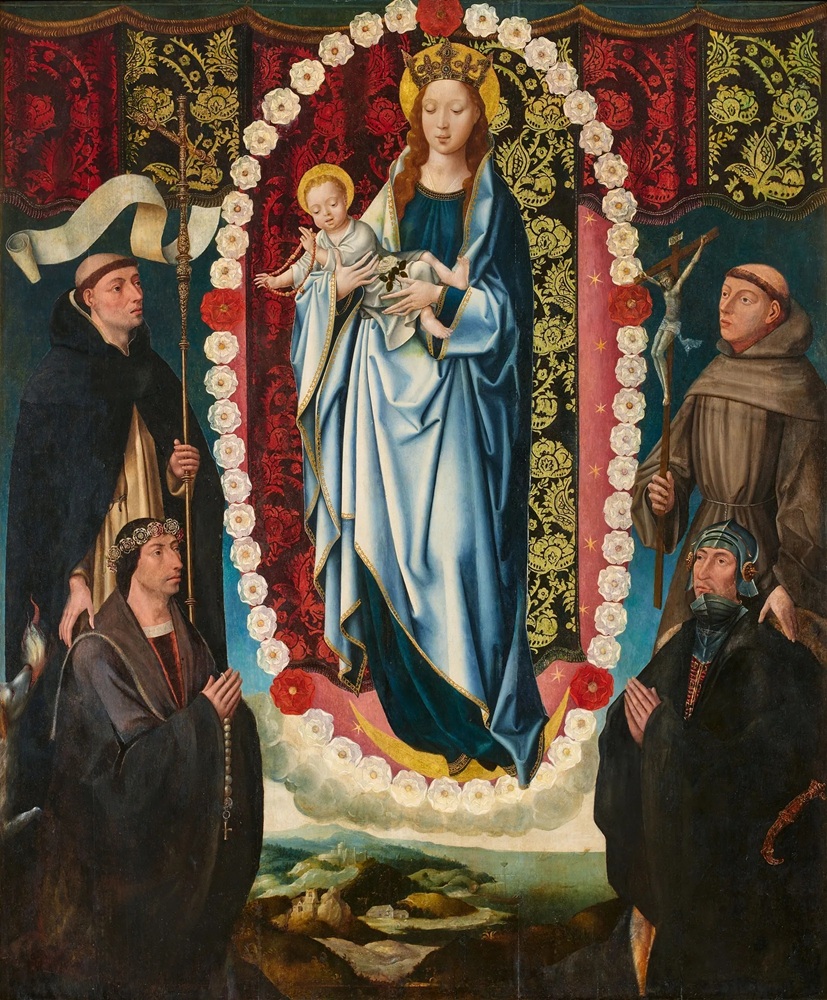
The painting depicts a crowned Virgin Mary with the Christ Child, standing on a crescent moon and surrounded by a wreath of white and red roses. Two male donors kneel on either side, with Saints Dominic and Francis standing behind them.
Mary dominates the composition. Her pale blue mantle falls in long, angular folds, and her figure is framed by a garland of flowers. Behind her hangs a richly decorated textile patterned in red and gold. Beneath Mary’s feet, a sweeping landscape opens up, with hills, buildings, water and ships. The heavenly apparition is thus set against an earthly landscape.
The figure of Mary still draws strongly on the fifteenth-century tradition. Her facial expression, the modelling of her hands and the sharp folds of her mantle recall the visual language developed by Rogier van der Weyden and his followers. The landscape belongs to a later generation, in which landscape painting began to emerge as a subject in its own right. This tension between inherited forms and new developments is characteristic of Goossen van der Weyden’s oeuvre.
On the left kneels a man wearing a garland of flowers on his head, with a rosary between his clasped hands. On the right is an older man in a dark cloak, with a helmet and pieces of armour. Both figures are depicted individually, but their identities remain unknown. The composition has a powerful monumental presence. Yet the proportions of the figures are at times somewhat awkward, and the groups do not always fit together entirely smoothly. Such variations are consistent with workshop production.
A painting known as early as 1913
The most important historical source for the painting is a publication by the Belgian art historian Georges Hulin de Loo from 1913. He examined the painter and his workshop, drawing among other things on works from Tongerlo Abbey and a panel now known as The Donation of Kalmthout in the Gemäldegalerie in Berlin. The Madonna of the Rosary now coming to auction was also discussed. Hulin de Loo placed it within the production of Goossen’s workshop.[2]
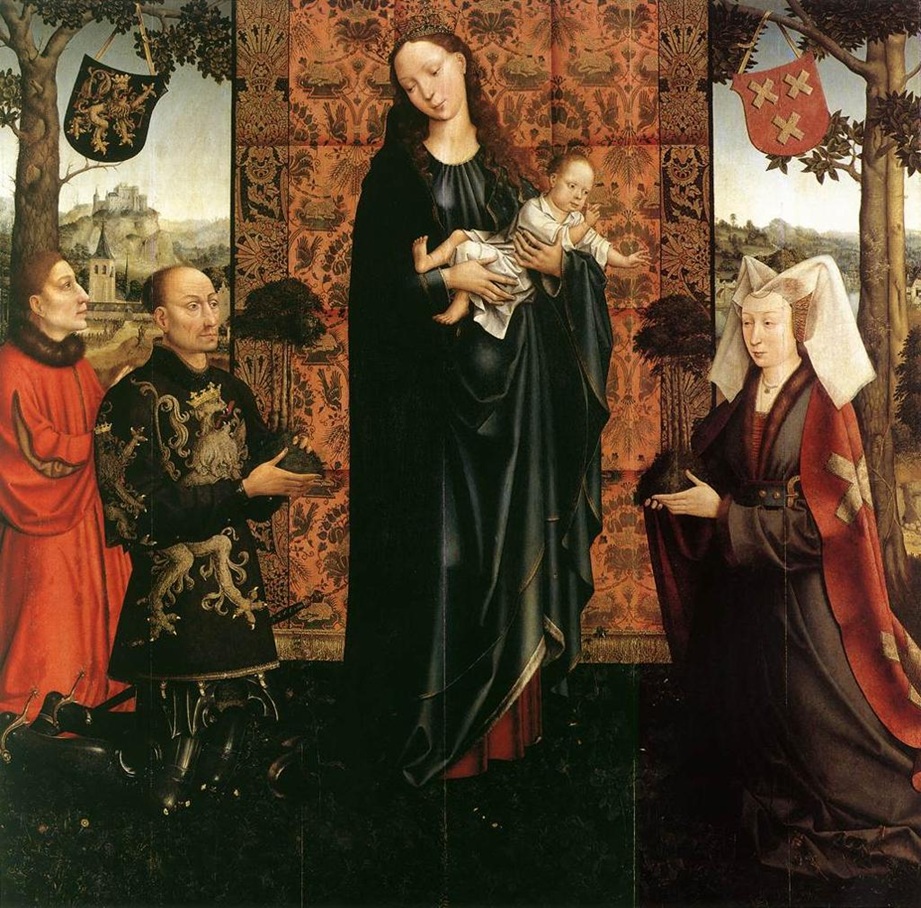
Goossen’s name was known from archival sources, but individual paintings had long been attributed to other artists or anonymous masters. The Berlin panel The Donation of Kalmthout, dated to around 1511-1515, played a key role in this process. It depicts a noble couple transferring land to Tongerlo Abbey.[3]
The Madonna of the Rosary was among the paintings Hulin de Loo used to establish the boundaries of Goossen’s oeuvre and the work of his workshop. The painting was therefore not linked to a recognised artist’s name only recently. Its place in the debate surrounding Goossen van der Weyden goes back to the period when his oeuvre was first studied systematically. Significantly, Hulin de Loo already regarded it as a workshop painting.
A painting whose whereabouts could not be traced
A second important publication appeared in 1989. Guy C. Bauman published a study in the Metropolitan Museum Journal of an early sixteenth-century rosary altarpiece that the museum had acquired a few years earlier. During his research, Bauman came across the painting Hulin de Loo had published in 1913.
He reproduced it as a work from Goossen van der Weyden’s workshop and pointed out its relationship to the painting in New York. He considered the treatment of the Virgin and Child particularly comparable. But Bauman had access only to the old black-and-white reproduction. In his article, he wrote that he had been unable to establish the painting’s whereabouts at the time.[4]
This does not mean that the work was entirely unknown or forgotten. The scholarly literature recorded the painting, and it was held by an institution for at least part of its recent history. Until 2025, it was on long-term loan to Kolumba, the art museum of the Archdiocese of Cologne.
The connection with the Metropolitan Museum
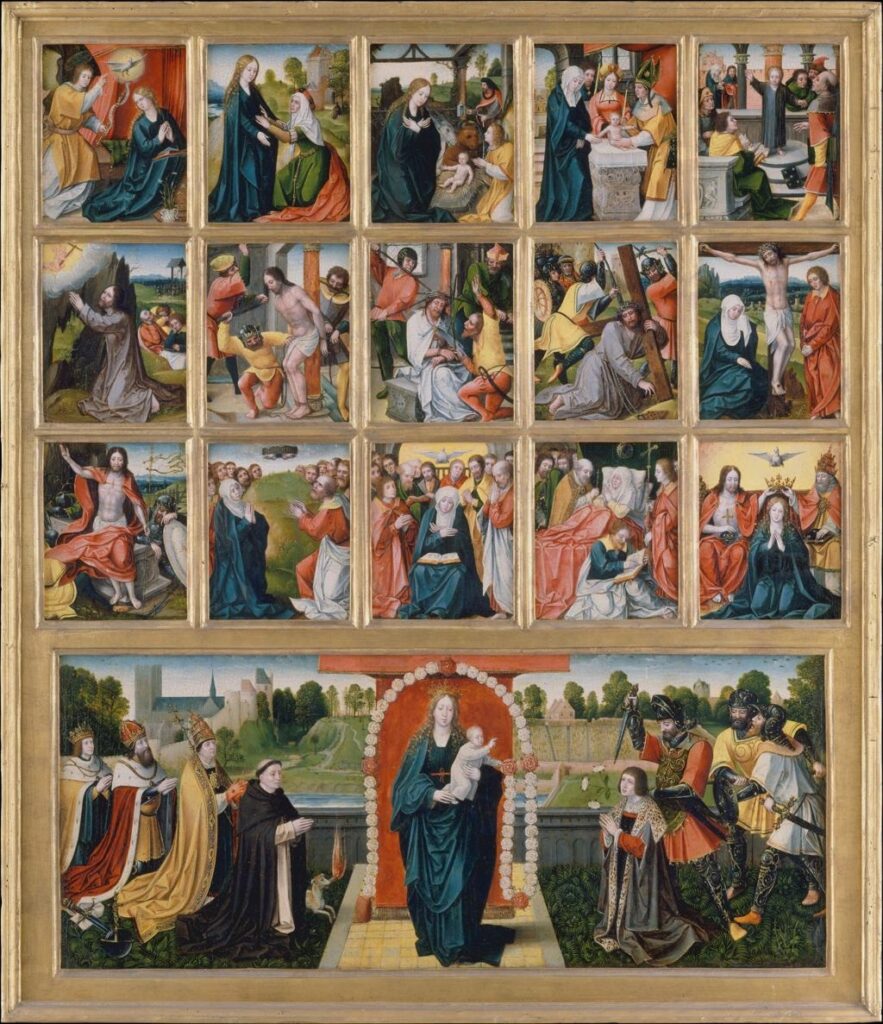
The New York altarpiece, The Fifteen Mysteries and the Virgin of the Rosary, dates from around 1515-1520. In 1989, Bauman proposed an attribution to Goossen van der Weyden. The Metropolitan Museum now catalogues the altarpiece as the work of an anonymous ‘Netherlandish (Brussels) Painter’.[5]
The similarities between the two Madonnas of the Rosary remain relevant. The iconography, Mary’s central position and the treatment of the wreath of flowers point to a shared pictorial tradition. The dating and geographical context are also closely related.
Above all, the comparison shows how difficult it is to define the boundaries of the oeuvre. Goossen van der Weyden was also an artist who ran a substantial workshop. An attribution to Goossen van der Weyden and his workshop does not necessarily mean that assistants were responsible for only a small part of the painting.
Condition: the main complication
Lempertz notes that the 1913 reproduction shows differences from the painting’s present appearance. According to the auction house, restoration interventions took place after the old photograph was made, probably consisting largely of later overpainting.[1]
Restoration is not in itself unusual for a monumental panel from the early sixteenth century. Many paintings of this period have suffered damage, alterations to their supports or earlier restorations. But the nature and extent of those interventions make a substantial difference.
A painting in which mainly the background has been partially retouched will be assessed differently from one in which significant passages of faces, hands or drapery have been overpainted. In the present case, the wooden panel has also been cradled, an intervention often associated with earlier attempts to stabilise historic wooden supports. Condition is therefore an important factor in determining the eventual hammer price.
What does the auction market tell us about such works?
The market for Goossen van der Weyden is difficult to analyse because comparable sales are scarce. Large religious paintings bearing his name do not appear regularly at auction. Moreover, catalogue attributions range from autograph works to those by his workshop, circle or followers.
On 27 March 2026, Koller in Zurich sold two altarpiece wings depicting Saint John and Saint Catherine, attributed to the workshop of Goossen van der Weyden. The two panels each measured approximately 85 × 32 cm. The estimate was CHF 40,000-60,000. The pair realised approximately CHF 95,000, including buyer’s premium.[6]
At the same time, the painting offered in Cologne differs considerably from these altarpiece wings. The Madonna of the Rosary is larger, has more complex iconography and boasts an earlier and more substantial publication history. The Koller result nonetheless confirms that buyers are prepared to pay substantial sums for well-catalogued works from Goossen’s workshop.
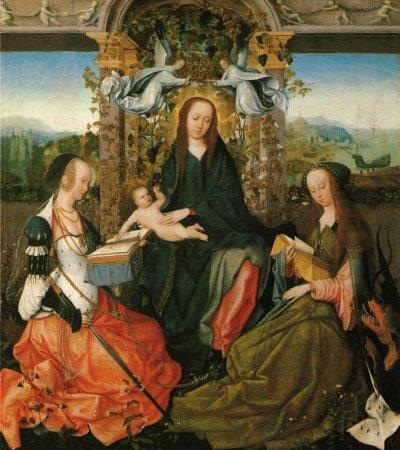
A second comparison concerns a painting of the Virgin and Child with two female saints, catalogued as an autograph work. The Virgin and Child with Saint Catherine of Alexandria and Saint Margaret of Antioch measures 72.4 × 64.2 cm and was offered at Christie’s on 7 July 2004.
The realised price was approximately €115,000 against an estimate of £60,000-80,000.[7] The painting was attributed to Goossen himself, but was much smaller than the present lot. The same painting subsequently returned to the market. On 28 March 2023, Aguttes offered it in Paris with an estimate of €200,000-300,000.
By then, the painting had acquired a documented provenance: a stamp from the collection of Marie-Louise of Austria, Duchess of Parma, was present on the reverse. There was, however, an important restriction. The painting could not leave Italy, limiting the pool of potential international buyers.[8]
The auction record is not a useful direct comparison
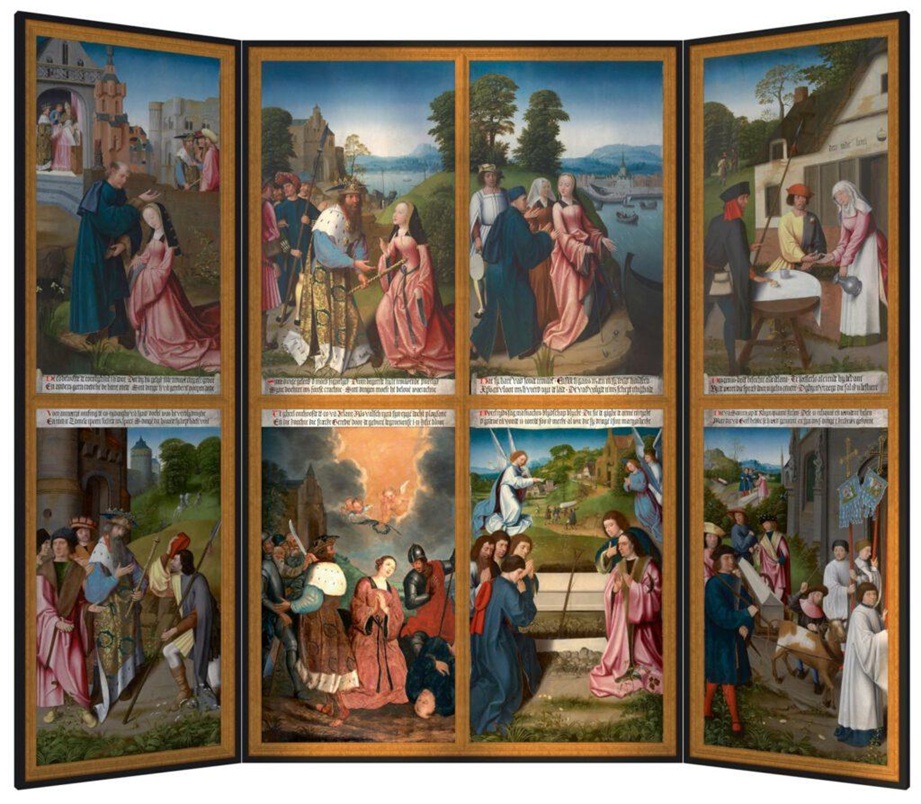
The best-known auction result for Goossen van der Weyden is the sale of Seven Scenes from the Life and Veneration of Saint Dymphna. This group of panels, from an altarpiece made around 1505 for Tongerlo Abbey, was offered at Sotheby’s on 8 December 2010. The estimate was £1,000,000-1,500,000. The realised price was approximately €1.4 million, including buyer’s premium.[9]
These panels belong to the core of the artist’s oeuvre. Their provenance is linked to a documented commission, while the paintings also have the coherence of a narrative cycle and particular art-historical significance. Moreover, the sale comprised several panels.
A documented cycle largely accepted as autograph, with a historical monastic provenance, is commercially a very different proposition from a monumental religious painting attributed to the artist and his workshop. The record demonstrates what the market is capable of paying for an important work by Goossen van der Weyden. It tells us far less about what an individual workshop painting should be expected to fetch.
Is the €180,000-220,000 estimate attractive?
Against this background, the Lempertz estimate does not seem unreasonable, but neither does it appear conservative. The work has several qualities that may be commercially relevant. Its large scale makes it stand out among the surviving paintings. The iconography is interesting, and the early references in the literature provide a historical foundation that many workshop paintings lack.
The long history of private ownership is also relevant. The loan to Kolumba gives the painting an institutional context. Against this stand two important uncertainties: the extent of Goossen’s own contribution and the scale of the later restoration interventions. These are precisely the factors that distinguish an art-historically interesting workshop painting from one for which collectors are prepared to pay high prices.
The recent Koller sale shows that workshop paintings can attract interest at around the €100,000 level. The smaller Madonna sold at Christie’s in 2004 realised a sum in the same range. This places the current lot in an interesting position.
The estimate presumably reflects a combination of scale, early documentation, art-historical context and the scarcity of such large altarpieces on the market. A buyer will want to establish how much of the original paint surface remains visible, how the different parts of the composition compare in quality and whether the general workshop attribution might allow for an even more precise assessment.
A work open to renewed assessment
For us, the significance of this Madonna of the Rosary lies not only in the possibility that it will be traded again after more than a century. Bauman’s 1989 publication shows how limited the available information remained for a long time. He could work only from an old reproduction and did not know where the painting was located.
Today, the composition, support and painting technique can once again be compared with the now much better documented production of the Antwerp workshop. The auction will above all reveal how much weight the market gives to the combination of monumental scale, early art-historical documentation and an attribution that is not entirely certain.
Will buyers value the painting as an important early sixteenth-century altarpiece with unusual iconography, or will the workshop attribution and restoration history weigh more heavily?
Do you have a particular interest in this artist or subject?
Do you own a painting by this artist, have you come across a comparable work, or do you have information that might be relevant to further research? We welcome contact from collectors, art dealers and researchers with an interest in this artist or related subjects.
We regularly research paintings appearing on the art market, exploring questions of attribution, quality, provenance and previous sales. If you have a question about a particular work or would like to share information with us, please feel free to get in touch at info@antonello.art.
Notes and sources
[1] Lempertz, Old Masters and 19th Century Part I, Cologne, 21 November 2026, lot 1001, Goossen van der Weyden and workshop, Madonna of the Rosary with Two Donors and Saints Dominic and Francis.
[2] Georges Hulin de Loo, ‘Ein authentisches Werk von Goossen van der Weyden im Kaiser-Friedrich-Museum. Die gleichzeitigen Gemälde aus Tongerloo und Lier und die Ursprünge der Antwerpener Schule um 1500’, Jahrbuch der Königlich Preussischen Kunstsammlungen 34 (1913), pp. 59-88.
[3] Staatliche Museen zu Berlin, Gemäldegalerie, The Donation of Kalmthout, c. 1511-1515, inventory no. 526.
[4] Guy C. Bauman, ‘A Rosary Picture with a View of the Park of the Ducal Palace in Brussels, Possibly by Goswijn van der Weyden’, Metropolitan Museum Journal 24 (1989), pp. 135-151.
[5] The Metropolitan Museum of Art, The Fifteen Mysteries and the Virgin of the Rosary, c. 1515-1520, attributed to an anonymous Brussels painter, inventory no. 1987.290.3a-p.
[6] Koller Auktionen, Old Master Paintings, Zurich, 27 March 2026, lot 3015, Studio of Goossen van der Weyden, Wing of an altar: Saint John and Saint Catherine. Estimate CHF 40,000-60,000; realised price CHF 93,750 including buyer’s premium.
[7] Christie’s, Old Master Pictures, London, 7 July 2004, lot 18, Goswijn van der Weyden, The Virgin and Child with Saint Catherine of Alexandria and Saint Margaret of Antioch.
[8] Aguttes, Maîtres anciens, Paris, 28 March 2023, lot 2, Goswin van der Weyden, Vierge à l’Enfant entourée de sainte Catherine d’Alexandrie et sainte Marguerite d’Antioche. Estimate €200,000-300,000.
[9] Sotheby’s, Old Master & British Paintings Evening Sale, London, 8 December 2010, lot 4, Goswijn van der Weyden, Seven Scenes from the Life and Veneration of Saint Dymphna. Estimate £1,000,000-1,500,000. Realised price £1,161,250 including buyer’s premium.