On 11 November 2026, a small Flemish portrait of a woman dating from around 1500 sold at the Vienna auction house im Kinsky for €16,900. Catalogued as Flemish School, the painting nevertheless bears striking similarities to works by the Master of the Princely Portraits. Above all, the curious alignment of the eyes raises questions. Is the resemblance coincidental, or does it point to the influence of a particular artistic tradition?
When we first noticed this portrait of a woman, sold at auction in Vienna on 11 November 2026, it was one eye that caught our attention. The sitter’s right eye (on the viewer’s left) does not seem to look in quite the same direction as the other. The discrepancy is subtle, yet sufficient to lend her face a somewhat peculiar expression. Her gaze does not appear to settle on a single point, and the longer one looks, the more she seems to have a slight squint.
This apparent awkwardness in the painter’s handling is intriguing. It recalls a distinctive characteristic of the artist known to art history as the Master of the Princely Portraits, an anonymous late fifteenth-century painter chiefly associated with portraits of figures at the Burgundian court.
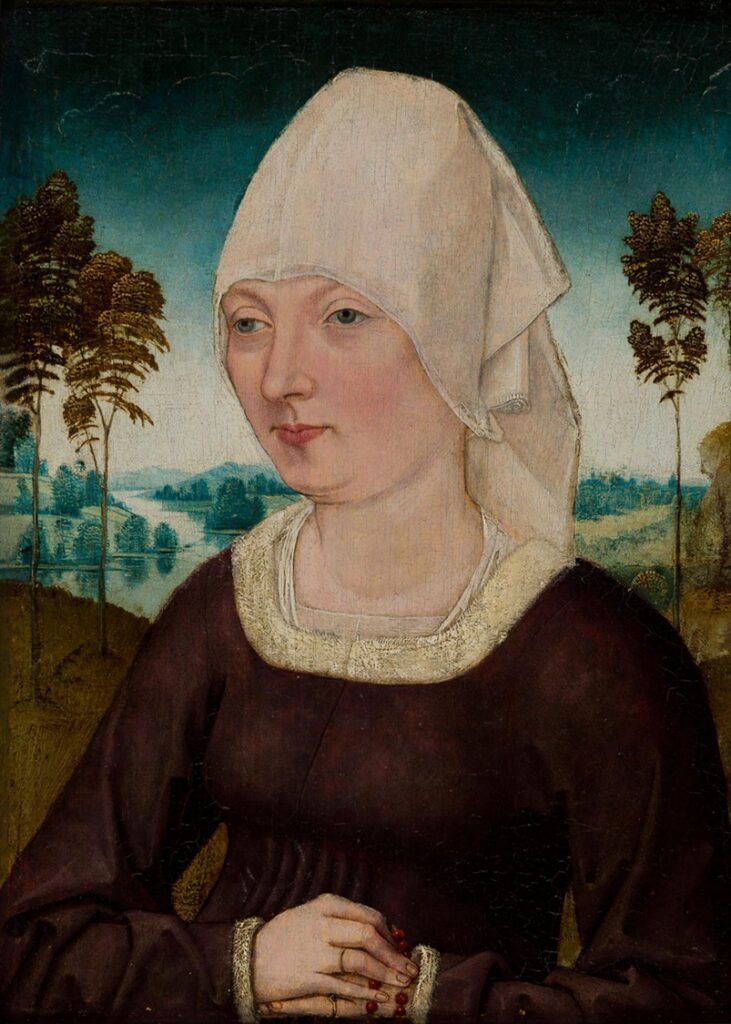
The portrait was offered by im Kinsky as Flämische Schule um 1500 (Flemish School, around 1500), under the title Bildnis einer Dame mit einer weißen Haube (Portrait of a Lady in a White Headdress). Painted in oil on panel, it measures 33.5 × 24.5 cm. Its only published provenance is a European private collection. Estimated at €5,000-10,000, it ultimately sold for €16,900.[1]
That is not a high price for a good Early Netherlandish portrait, but it may be for an anonymous painting with little provenance and an extensive restoration history. More compelling is the question of whether the work offers more art-historical clues than its broad catalogue attribution initially suggests.
An Unusual Gaze as a Stylistic Hallmark
The most intriguing feature of the portrait is the position of the eyes. The woman’s right eye, on the left of the painting, seems to be set slightly differently in her face from what one would expect given the turn of her head. Its line of sight does not quite agree with that of the other eye. The discrepancy appears to concern not only the pupils but also the placement and shape of the eyelids.
This need not mean that the painter intended to depict a cross-eyed sitter. It seems more likely that we are seeing a degree of awkwardness in the construction of the face. This is precisely the kind of feature characteristic of the Master of the Princely Portraits. The comparison becomes more persuasive when the woman’s gaze is set alongside that in portraits attributed to the master.[2]
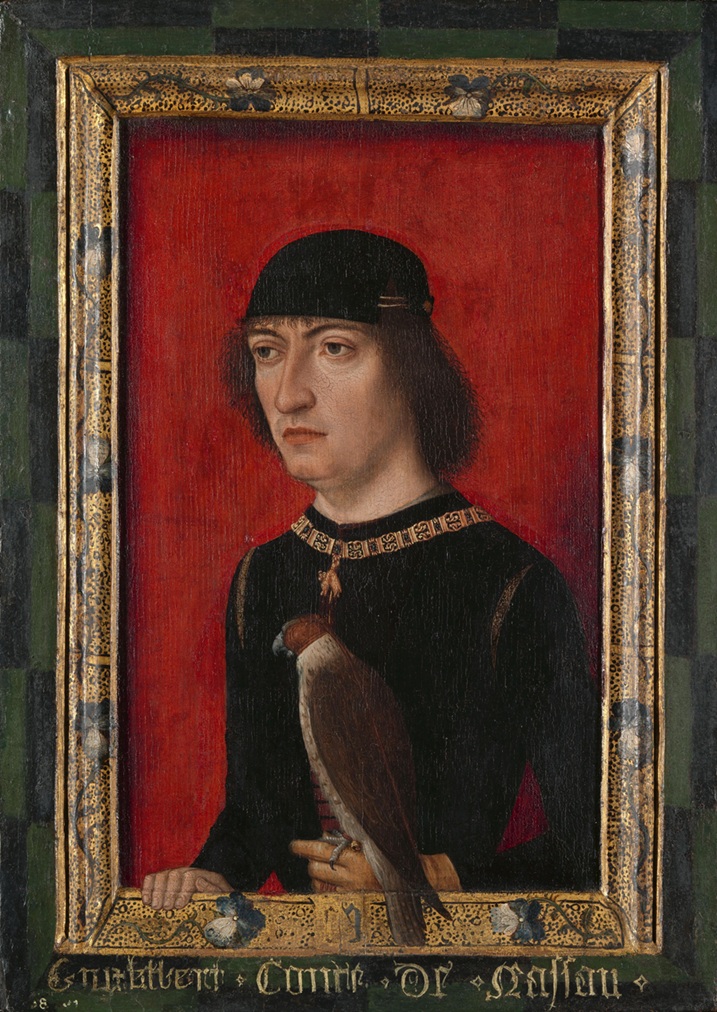
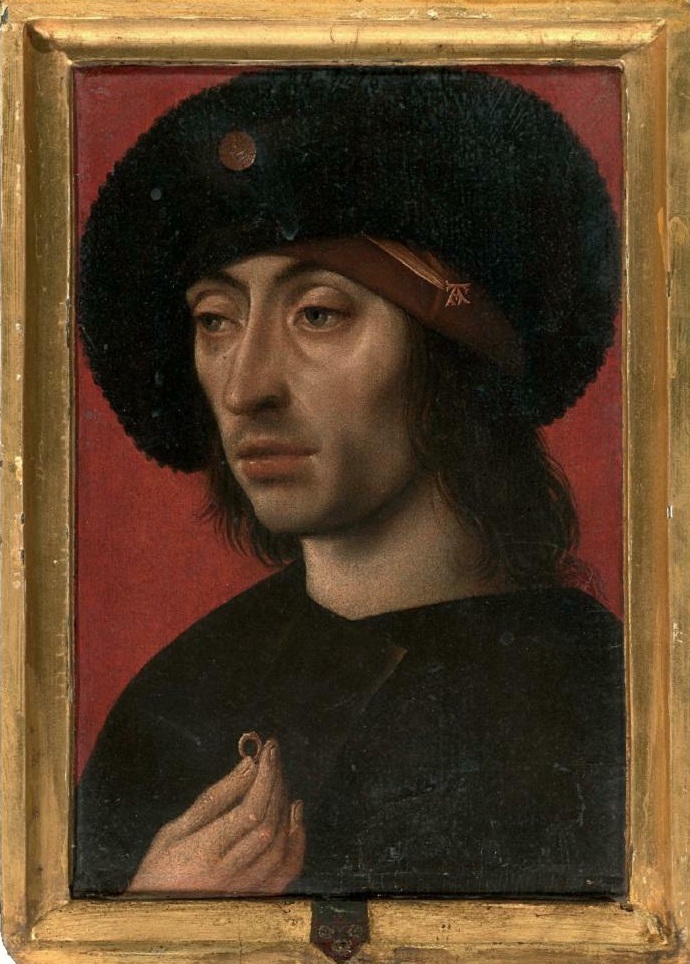
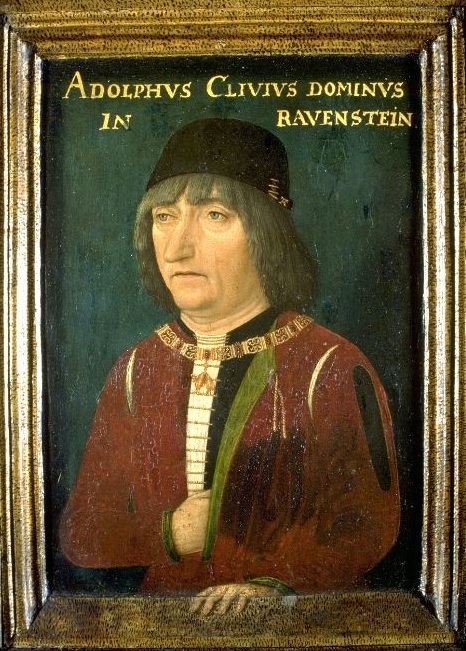
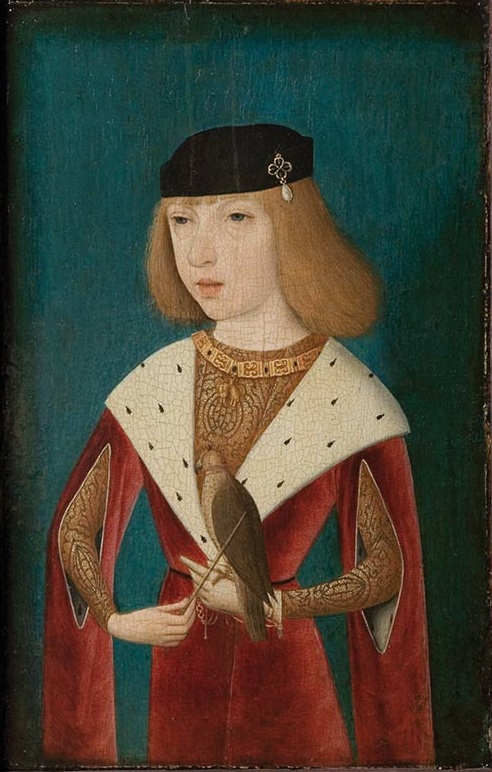
In the Rijksmuseum’s Portrait of Engelbert II of Nassau, the eyes are not rendered in perfect symmetry. Likewise, in the Portrait of Adolf of Cleves and portraits of Philip the Fair, the painter appears to model the eyes separately, without always situating them convincingly within a coherent perspective. The result is a somewhat distant gaze, and the woman in the Vienna portrait produces a similar effect.
The phenomenon is not simply a consequence of the head being shown in three-quarter view. In a convincing three-quarter portrait, the eyes naturally differ, and the eye farther from the viewer is foreshortened. Yet both eyes retain a consistent direction of gaze. In works by the Master of the Princely Portraits, that coherence sometimes seems to be missing.
Precisely such recurring peculiarities can provide valuable clues when studying anonymous masters. A painter may be easier to identify by the problems he repeatedly struggles with than by generic features such as expensive clothing or a particular pose. What we are comparing, in any case, is a painterly irregularity in the construction of the eyes.
But There Is More Than the Eyes
A comparison should not rest on the eyes alone, of course, and the portrait offers other points of contact. The woman is shown in three-quarter view, her hands held before her. She wears a dark reddish-brown gown and a striking white headdress. The auction house associates the white cap with the sitter’s married status. She wears rings on her fingers, and between her hands she holds a rosary.
The woman does not look directly at the viewer, and her head is turned slightly to one side. This combination of an individualised face and a relatively stiff, formally rendered body is also characteristic of several portraits by the Master of the Princely Portraits. The individuality of the facial features is often emphasised, while the neck, shoulders and clothing are treated more schematically.[3]
The proportions of head and body also merit attention. The headdress makes the head appear visually large, but even without it the upper half of the figure dominates. It is tempting to recognise another trait of the Master of the Princely Portraits here. His figures often have relatively large heads, while their shoulders and arms are handled more schematically.
That resemblance becomes less distinctive, however, when we remember how common this approach was in late medieval portraiture. On small panels in particular, the rendering of the body could play a secondary role. We should therefore consider how all these features work together. The unusual eyes, dominant head, somewhat stiff body and carefully arranged hands all occur in the same image.
The Hands and the Rosary She Holds
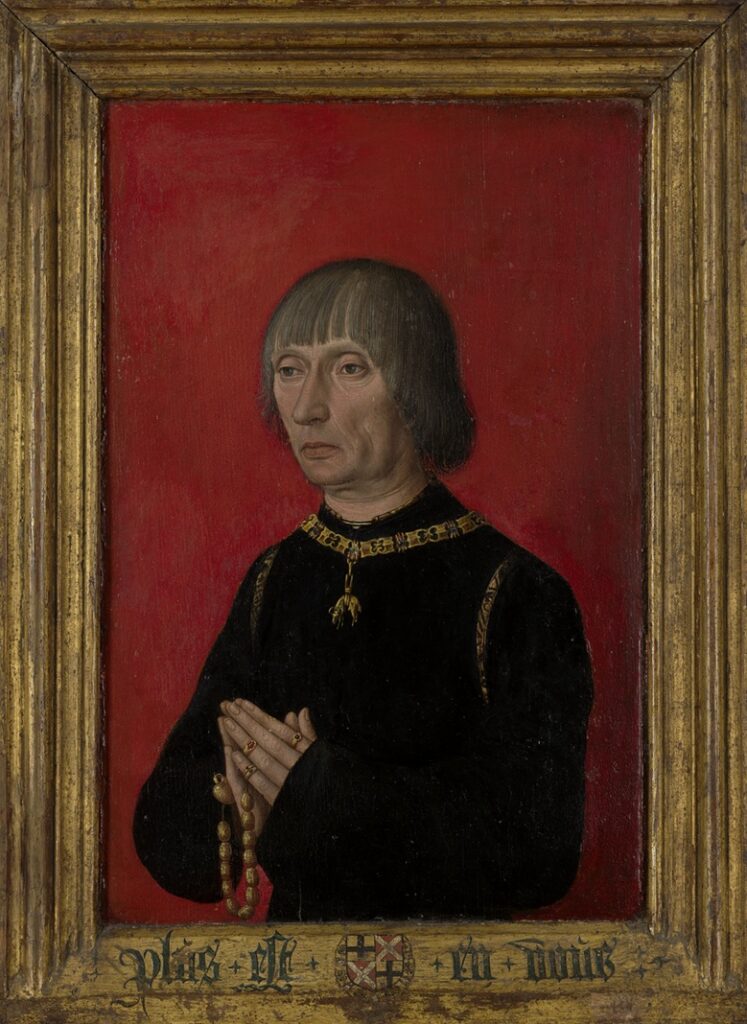
The position of the hands is noteworthy. The fingers overlap, and together with the red beads they form a small but important element at the bottom of the picture. This motif recalls the Portrait of Louis of Gruuthuse. That sitter also holds a rosary, and here too the hands are prominently integrated into the composition, while retaining a degree of anatomical stiffness.[4]
Louis’s hands are brought together in prayer, whereas the Viennese woman rests hers more loosely one over the other. Even so, both portraits belong to a late medieval tradition in which personal representation and religious devotion could be closely intertwined. A rosary was, of course, a common attribute in portraits around 1500.
A Striking Similarity in Size
One easily overlooked detail is the size of the Vienna portrait. It measures 33.5 × 24.5 cm. The Rijksmuseum’s Portrait of Engelbert II of Nassau measures 33.5 × 24 cm.[5] The dimensions are therefore almost identical. Small portrait panels of similar proportions were, however, not unusual in the late fifteenth century.
Both paintings have a vertical format and show a half-length figure with little space around the body, which fills almost the entire width of the panel. The composition concentrates on the face and hands. Other portraits by the Master of the Princely Portraits are also remarkably small. The Portrait of Jan Bossaert measures approximately 22.5 × 14 cm, while the well-known portrait of Philip the Fair in Paris measures 27 × 17.5 cm.[3]
It is not just the eyes and the construction of the body, but also the scale and composition that resemble the kind of portrait this master produced. In several works by the Master of the Princely Portraits, the frame and panel were carved from a single piece of wood. Unfortunately, that is no longer the case with this portrait.
A Portrait Tradition at the Burgundian Court
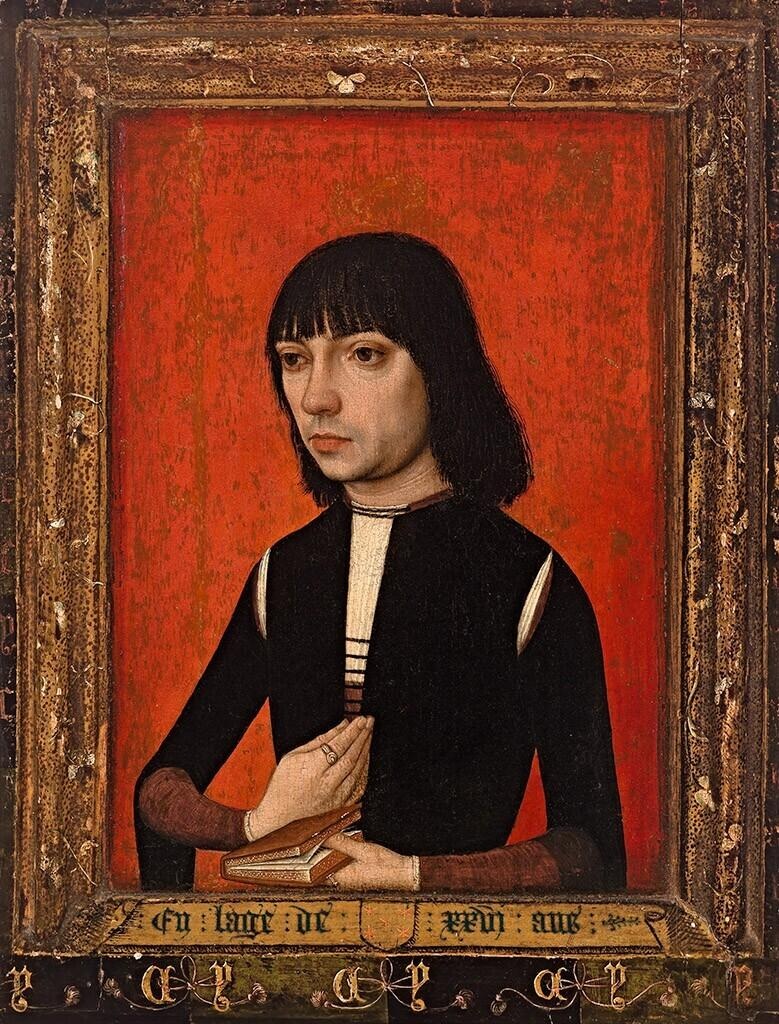
The name Master of the Princely Portraits was introduced by Max J. Friedländer in 1926. Friedländer grouped several paintings that he believed had been executed by the same anonymous artist. Among the principal examples are the Rijksmuseum’s Portrait of Engelbert II of Nassau, the Portrait of a Young Man of the Fonseca Family in Rotterdam, and the Portrait of Jan Bossaert, now in a private collection.
The group has been linked to painting in Brussels around 1490, in an artistic milieu strongly influenced by Rogier van der Weyden.[5] Yet the master differs from Van der Weyden’s more idealised portraiture. His sitters often have pronounced individual features, heavy noses, unusual mouths, sometimes awkwardly rendered eyes, and faces that do not conform to conventional ideals of beauty.
In the Vienna portrait, the woman has a long face, a rather small mouth, a clearly defined nose and a somewhat inward-looking gaze. The painter appears to have aimed at real, individual characteristics rather than a generic female type. The same concern with individuality can be seen in various portraits by the Master of the Princely Portraits.
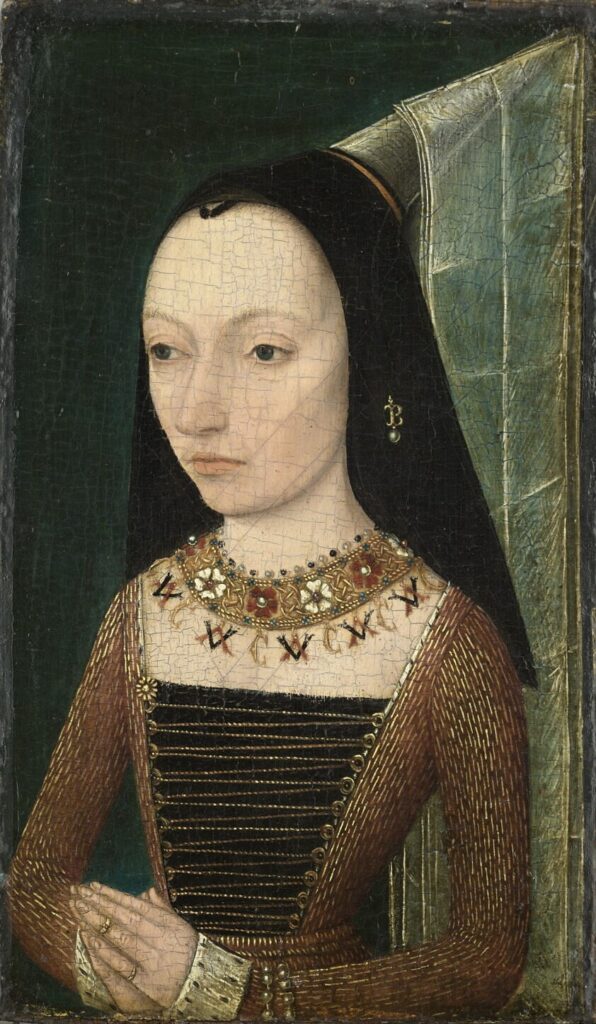
The Portrait of Margaret of York in the Louvre provides an example. The sitter likewise wears a prominent headdress and has a narrow, elongated face. The fabric largely determines the outline of her head. Her large eyes sit beneath clearly defined eyebrows. Such unusual facial construction is therefore not confined to the male court portraits for which the master is best known.[6]
The Background Is the Main Difference
The master’s well-known independent portraits generally have rather plain backgrounds, often red or greenish. The background of the portrait of Engelbert II of Nassau is bright red, and the portrait of Louis of Gruuthuse also uses red to set off the figure sharply. The woman in the im Kinsky painting is presented quite differently.
Behind her stretches an expansive landscape of trees, a river and distant hills. The trees on either side function almost like stage wings. They frame the figure while opening up the space behind her. This is where the comparison with the Master of the Princely Portraits becomes more problematic.
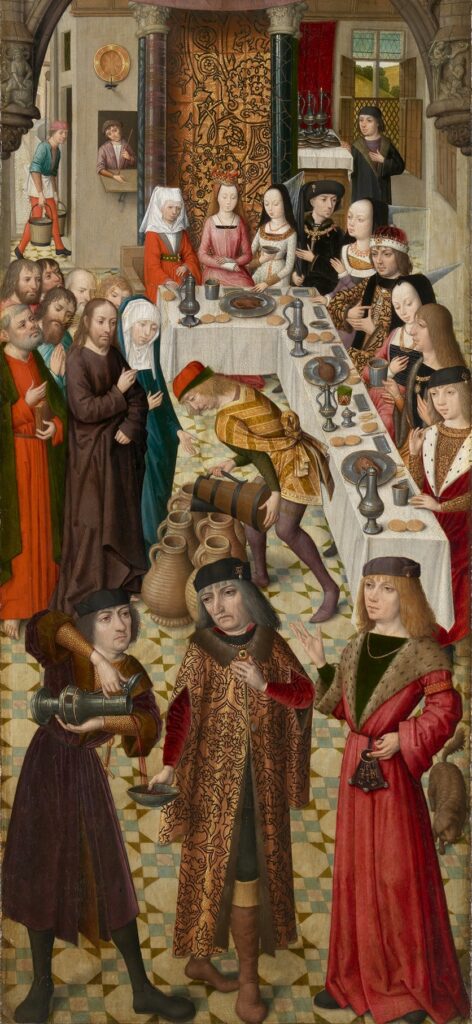
There are, however, examples of narrative compositions and elaborate backgrounds among works associated with this painter. One is the left wing, The Marriage at Cana, of the Triptych with the Miracles of Christ in the National Gallery of Victoria, Melbourne. That wing has been linked to the Master of the Princely Portraits on stylistic and technical grounds.[3]
The scattered trees, blue waterways and successive bands of landscape recall the broader Netherlandish landscape tradition of the late fifteenth and early sixteenth centuries. The figure is constructed compactly, while a sense of depth opens behind her. The landscape is therefore not merely an extension of the portrait figure. It could also reflect a common workshop practice in which the figure and background were not necessarily painted by the same hand.
A Surprising Comparison with Jan Mostaert
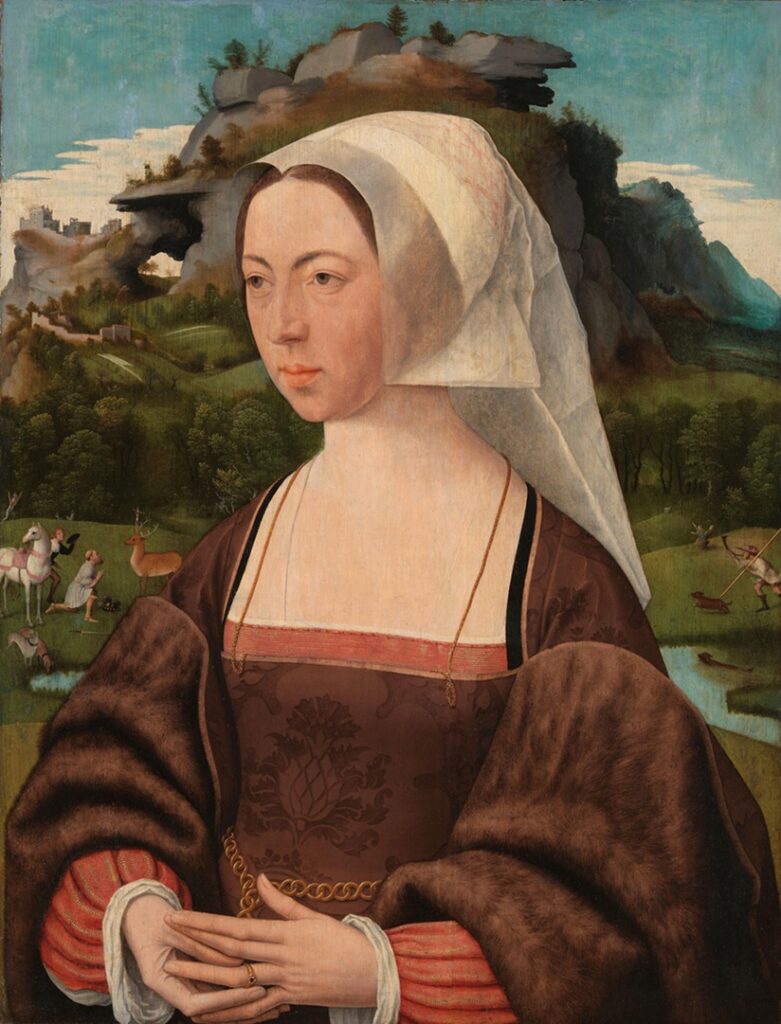
The Rijksmuseum holds a portrait of a woman by Jan Jansz. Mostaert that resembles the Vienna painting in several respects. Mostaert’s Portrait of a Woman likewise depicts a sitter in three-quarter view, wearing a white headdress whose fabric falls down beside her face. She wears a dark brown, fur-lined gown and stands before an extensive landscape.
In both paintings, the pale headdress contrasts sharply with the dark clothing. Both women appear against landscapes that open out behind their shoulders. There are also similarities in the tilt of the head and the restrained expression. Mostaert’s painting, however, is substantially larger, measuring 64.3 × 49.5 cm, and its execution is clearly different.[7]
This shows that, compositionally, the Vienna portrait should not be understood solely within the tradition of the Master of the Princely Portraits. It shares features with portraits by artists active somewhat later, and those similarities may stem from shared conventions in Netherlandish painting.
Was It Originally an Independent Portrait?
Was the painting originally intended as an independent portrait, or did it belong to a larger ensemble? Separate portrait panels were sometimes paired with a religious scene or a portrait of a spouse. In the Portrait of Louis of Gruuthuse, traces around the panel suggest that it probably once formed part of a diptych.[4]
The rosary in the Vienna portrait may simply have been a personal attribute, but it could also indicate a devotional function. The direction of the woman’s gaze is relevant here. She looks past the viewer, as though her attention were directed towards something beyond the composition. Independent portraits, however, could also feature a similar direction of gaze.
The Problem of Restoration
The portrait has an extensive restoration history. Restoration reports that we have been able to examine indicate that large areas of the face have been retouched. This follows damage caused by overly aggressive cleaning in the past. The eyes, facial modelling and anatomical proportions are therefore harder to assess as evidence of the original execution.
Some irregularities may have been accentuated, diminished or even introduced by later retouching. But a retouched face is not necessarily a face that has been redesigned. During restoration, existing forms are often followed, even when a substantial amount of the original paint has been lost. The asymmetrical placement of the eyes could therefore still reflect the original composition.
Even the Portrait of Engelbert II of Nassau in the Rijksmuseum, attributed to the master, has a complex conservation history. Parts of the clothing and headdress have been altered, and local overpainting and traces of earlier interventions are also present.[5]
An Oeuvre Whose Boundaries Continue to Shift
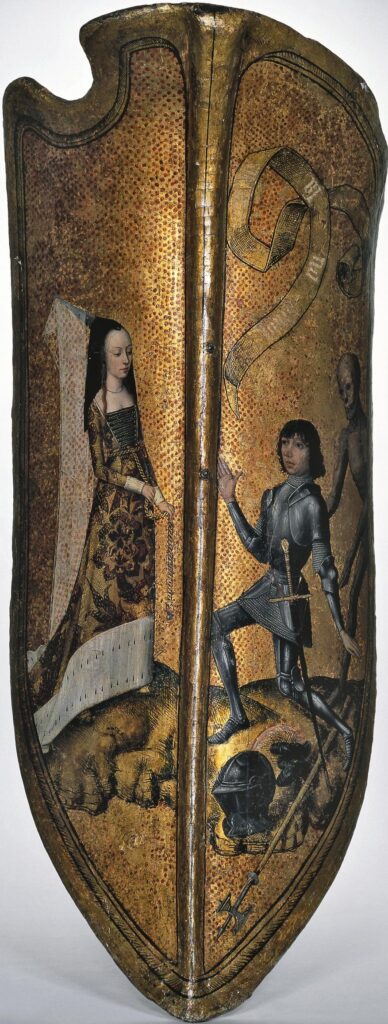
The Master of the Princely Portraits is not, moreover, an artist with a firmly established oeuvre. Since Friedländer proposed the group in 1926, works have been added, reconsidered or attributed to other painters. Alongside portraits, the proposed oeuvre includes religious paintings and even decorative objects, such as a painted parade shield.[8] The shield associated with the master in the British Museum, together with the religious compositions, shows that he did not always work within the same portrait format.
The question is whether the landscape in the Vienna painting corresponds in technique, palette and spatial construction to works that can be assigned to the master’s oeuvre with sufficient confidence. Ultimately, a painting need not be by the Master of the Princely Portraits himself to contribute to our understanding of the artistic milieu in which he worked.
A Compelling Affinity, but Not Yet a Convincing Attribution
When we compare the portrait of the woman with works by the Master of the Princely Portraits, it is above all the peculiar alignment of the eyes that remains striking. It closely corresponds to a feature explicitly described by art historians and recurring in several works associated with the master. The somewhat rigid construction of the body, the emphatic head, the closed pose and the rosary provide further points of contact. There is also the almost exact match in size with the Portrait of Engelbert II of Nassau.
There are differences, however. The extensive landscape background departs from the master’s usual approach. The comparison with Jan Mostaert’s Portrait of a Woman also shows that several features of the Vienna painting belong to a broader Netherlandish portrait tradition. Moreover, it is precisely the sitter’s face that has been extensively retouched.
For €16,900, someone acquired an anonymous Flemish portrait with a complicated restoration history. Yet close examination also reveals a painting that invites a more substantial art-historical discussion than the designation Flemish School, around 1500 might suggest.
Do you have a particular interest in this artist or subject?
Do you own a painting by this artist, have you come across a comparable work, or do you have information that might be relevant to further research? We welcome contact from collectors, art dealers and researchers with an interest in this artist or related subjects.
We regularly research paintings appearing on the art market, exploring questions of attribution, quality, provenance and previous sales. If you have a question about a particular work or would like to share information with us, please feel free to get in touch at info@antonello.art.
Notes and Sources
[1] Auktionshaus im Kinsky, Vienna, Alte Meister, 11 November 2026, lot 0510, Flemish School, around 1500, Bildnis einer Dame mit einer weißen Haube. Oil on panel, 33.5 × 24.5 cm, estimate €5,000-10,000, realised price €16,900.
[2] Alexia Coudray, Christina Currie, Bart Fransen, Steven Saverwyns and Elisabeth Van Eyck, “Portret van Johannes Despauterius. Een technisch en stilistisch onderzoek”, Het Land van Aalst, vol. LXXIII, no. 2, 2021, pp. 47-69.
[3] Catheline Périer-D’Ieteren, “Contributions to the Study of the Triptych with the Miracles of Christ: The Marriage at Cana”, Art Bulletin of Victoria, no. 31.
[4] Musea Brugge, Portrait of Louis of Gruuthuse, Master of the Princely Portraits, c. 1472-1482, oil on panel, inv. 0000.GRO1557.I.
[5] Rijksmuseum, Portrait of Engelbert II of Nassau, Master of the Princely Portraits, c. 1480-1490, oil on panel, 33.5 × 24 cm, inv. SK-A-3140.
[6] Musée du Louvre, Portrait de Marguerite d’York (1446-1503), oil on panel, inv. RF 1938 17.
[7] Rijksmuseum, Portrait of a Woman, Jan Jansz. Mostaert, c. 1520, oil on panel, 64.3 × 49.5 cm, inv. SK-A-3843.
[8] Stéphanie Deprouw-Augustin, “Jean Beugier, alias le Maître des portraits princiers, un peintre de la fin du XVe siècle entre Amiens, Bruxelles et Bruges”, Revue de l’Art, no. 208, 2020/2, pp. 17-29; and Deprouw-Augustin, “Jean Beugier alias le Maître des Portraits princiers: amorce de catalogue des peintures”, 5 July 2021.