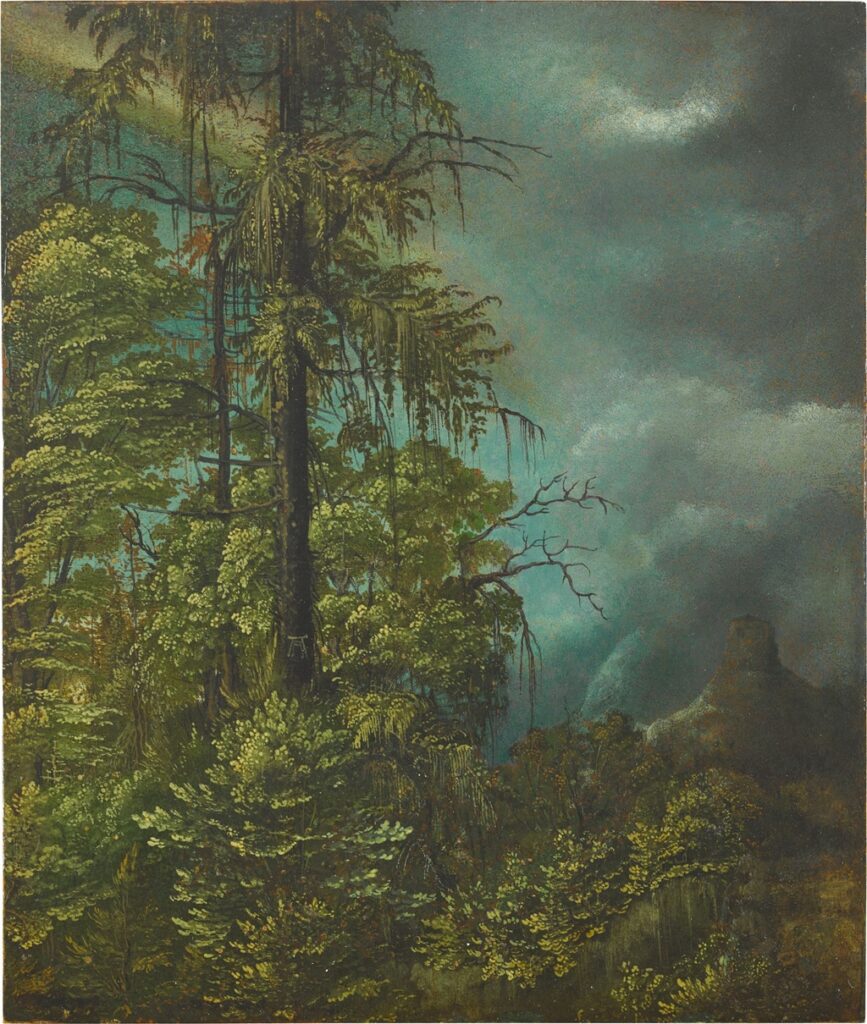
On 9 December 2026, Sotheby’s will offer a previously little-documented landscape by Albrecht Altdorfer in London, with an estimate of £3-5 million. Measuring just 23.4 × 19.8 centimetres, the painting bears striking similarities to a small group of landscapes through which the German Renaissance master transformed the genre around 1520. Its emergence offers a rare opportunity to acquire one of the earliest autonomous landscape paintings in oil.
A densely wooded forest with a colossal tree, a dark sky and a barely perceptible rainbow. There is no human figure or religious episode to be found. The trees, the sky and the light are enough. Around 1520, this was nothing short of radical. It was during this period that Albrecht Altdorfer (c. 1480-1538) began treating landscape as a subject in its own right, without the need for a saint or a human figure.
The small painting to be offered by Sotheby’s in London on 9 December carries an estimate of £3-5 million. The autonomous landscape occupies an exceptional place in Altdorfer’s oeuvre. Among the generally accepted oil paintings in which nature, without human figures, forms the subject, the two most important known examples are held by the National Gallery in London and the Alte Pinakothek in Munich.
The newly offered work appears closely related to these paintings, not only in its subject matter but also in its technique, composition and probable date. An Altdorfer is therefore coming to market for which, in our view, there is scarcely a recent, directly comparable sale.
A forest that leaves scarcely any room
The painting, titled A thickly wooded landscape with a rainbow behind the trees and a distant outcrop to the right beneath a cloud-laden sky, is executed in oil on parchment mounted on a wooden panel. The AA monogram appears on the trunk of the large tree. Its provenance can be traced to the aristocratic Harrach collection in Vienna. In 1957, the painting was acquired by the father of its present Swiss owner, and it has remained in the family ever since.[1]
Vegetation fills most of the composition. On the left and across the foreground, different species of trees, shrubs and trailing branches crowd together. An exceptionally large larch rises above this dense growth. Its dark trunk extends almost to the top of the painting, where it disappears among the branches. There is something unruly, almost unsettling, about the tree. Its branches spread in different directions.
Smaller trees with lighter green foliage grow between them. Their leaves are often indicated by small yellow-green touches of the brush. The vegetation is not handled uniformly. Some passages are meticulously worked, while others consist largely of dark areas of colour and suggestive lines. Without the great tree’s trunk, the forest would become an impenetrable tangle of leaves and branches. It gives the painting its essential structure, while the projecting branches lead the eye towards the right.
There, the dense growth gives way to a much more open space. Between the branches, a blue-green sky appears, partly obscured by heavy grey clouds. In the distance, a rocky outcrop comes into view, crowned by a dark form resembling a tower or fortification. Above it, the rainbow is painted with remarkable restraint. Rather than a brightly coloured arc dominating the composition, it is a faint, curving phenomenon of light, barely distinguishable from the surrounding atmosphere.
This contrast between the almost tangible vegetation in the foreground and the elusive atmosphere beyond is a major source of the painting’s quality. Altdorfer skilfully brings together two different ways of seeing. The forest invites close scrutiny of its details, while the sky asks to be experienced as a whole.
A close connection with a landscape in the National Gallery
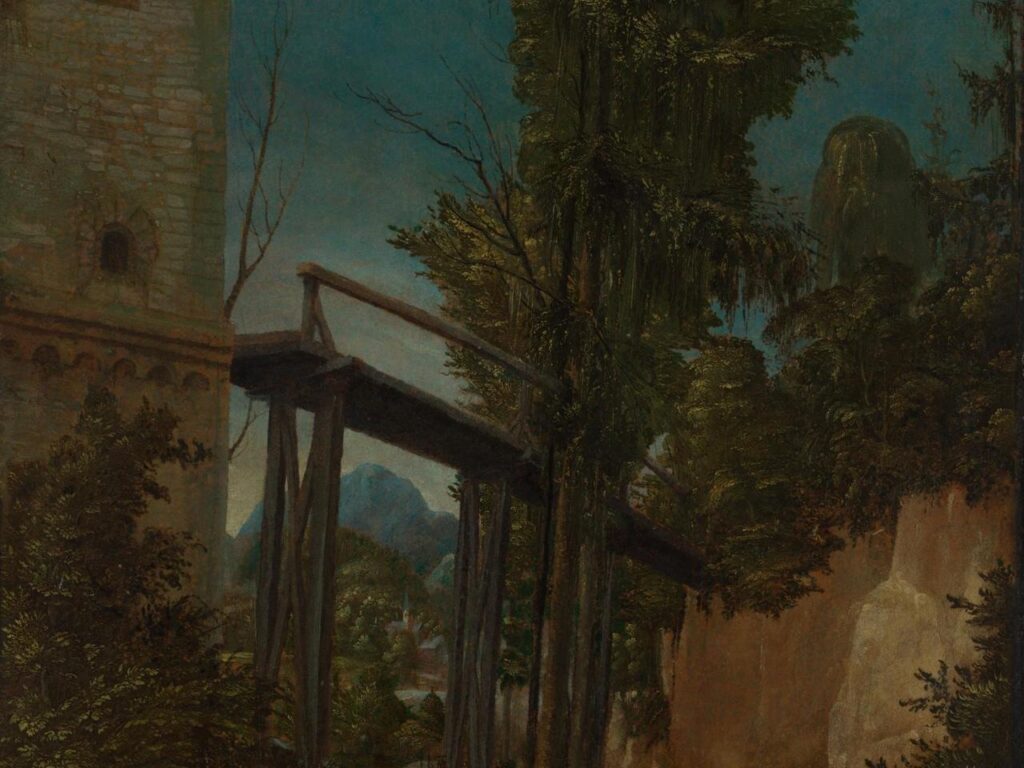
The most compelling art-historical comparison is Landscape with a Footbridge, which the National Gallery in London dates to around 1518-1520. Measuring 41.2 × 35.5 centimetres, it too is painted in oil on parchment mounted on wood.
In the London painting, too, an enormous larch dominates the composition. The tree has the same irregular arrangement of dark branches and overhanging foliage. Beneath it are smaller trees and shrubs, while in the distance the landscape opens onto mountains, buildings and sky. The principal difference is the presence of architecture.
In Landscape with a Footbridge, a high wooden bridge leads to a fortified building on the left. The structure introduces an unmistakable human intervention into the landscape. The bridge connects the cultivated world with nature. Yet the man-made buildings seem strikingly vulnerable beside the immense power of the trees.[2]
Both paintings place nature at their centre, but they do so differently. In neither work is the tree merely a background feature. Its branches grow irregularly, droop and cross one another. The trunk becomes a monumental element within an otherwise very small-scale composition. We do not know whether the newly offered painting predates or postdates Landscape with a Footbridge.
The Munich landscape as a second point of reference
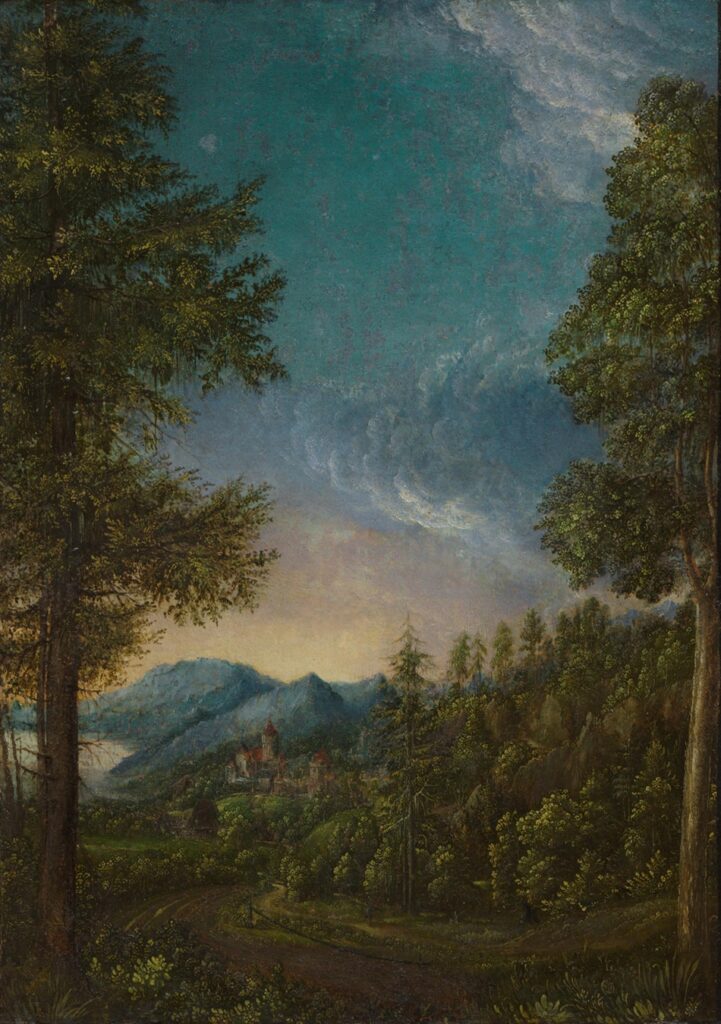
The Alte Pinakothek in Munich holds a second painting, The Danube Valley with Wörth Castle. Dated to around 1520-1525, it measures 30.5 × 22.2 centimetres. This work, too, was painted on parchment, in this instance mounted on beechwood. Altdorfer depicts an expansive landscape of hills, trees, buildings and a fortress. The composition offers a much clearer view of the surrounding terrain.
The painting is regarded as one of the earliest autonomous, topographically identifiable landscapes in German painting.[3] In the Munich work, the spatial organisation is more readily legible. The viewer can follow the landscape, identify its various elements and understand their relationship to one another.
Altdorfer’s landscapes were not necessarily topographical records. He combined natural elements, memories of actual places and compositional inventions to create new pictorial worlds. Landscape with a Footbridge, likewise, is understood more as a composite view of the Danube landscape than as an exact depiction of a particular location.
How landscape gained independence during the German Renaissance
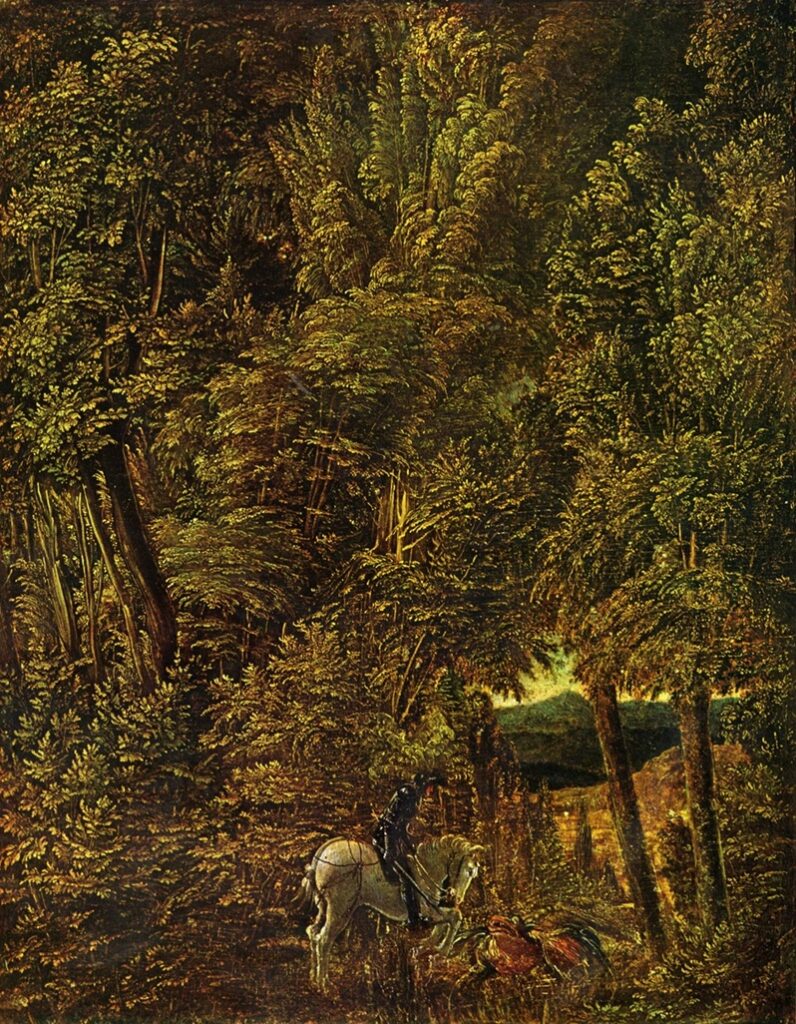
The significance of these paintings becomes clearer when we turn to an earlier work by Altdorfer. In St. George and the Dragon, dated 1510 and also in Munich, the religious narrative seems almost swallowed by the landscape. The painting measures 28.2 × 22.5 centimetres and is executed on parchment mounted on limewood.
St George and the dragon appear near the bottom of the composition and are strikingly small in relation to the mass of vegetation surrounding them. Trees occupy most of the painted surface. Their trunks, branches and leaves form a dense whole that disrupts the conventional relationship between principal subject and background. For that reason, the work is regarded as an important precursor to the autonomous landscape.[4]
The religious narrative is still present, but nature has almost entirely freed itself from its supporting role. Over the following years, Altdorfer would take this development further. In his autonomous landscapes, such as the present lot, human action disappears altogether.
Altdorfer did not create an interest in landscape out of nothing. Albrecht Dürer had already produced landscape studies in watercolour before 1500. In late medieval painting, too, landscapes were sometimes far more than neutral backdrops.[5] A tree could be observed with precision, while its branches and foliage could also be used to create rhythm, movement and tension.
Printmaking offers a surprising comparison
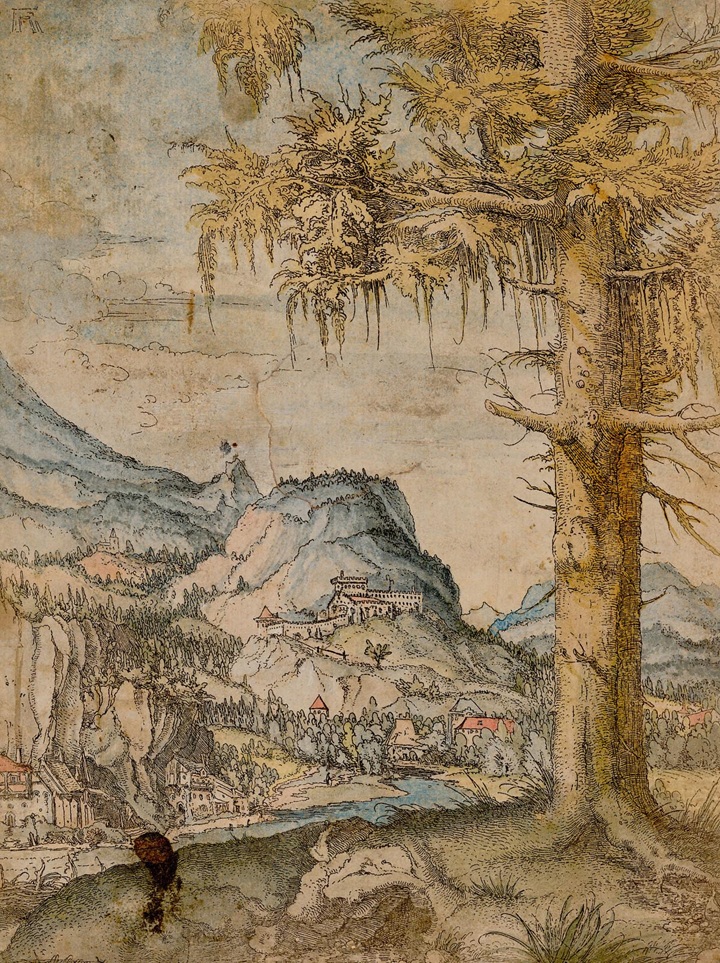
One of the most intriguing parallels comes not from painting but from Altdorfer’s graphic work. The Albertina in Vienna holds a hand-coloured etching entitled The Large Spruce, dated to around 1520. The plate measures 23.3 × 17.7 centimetres. The painting offered at auction measures 23.4 × 19.8 centimetres.
The comparison shows just how closely the new painting corresponds in scale to Altdorfer’s experiments with landscape. In The Large Spruce, too, an enormous conifer dominates the composition. The tree stands in the foreground, while an extensive landscape of mountains, buildings and other natural features unfolds behind it. The branches are drawn with great precision. Their irregular structure contrasts sharply with the landscape beyond. It is especially interesting that several impressions were hand-coloured.[6]
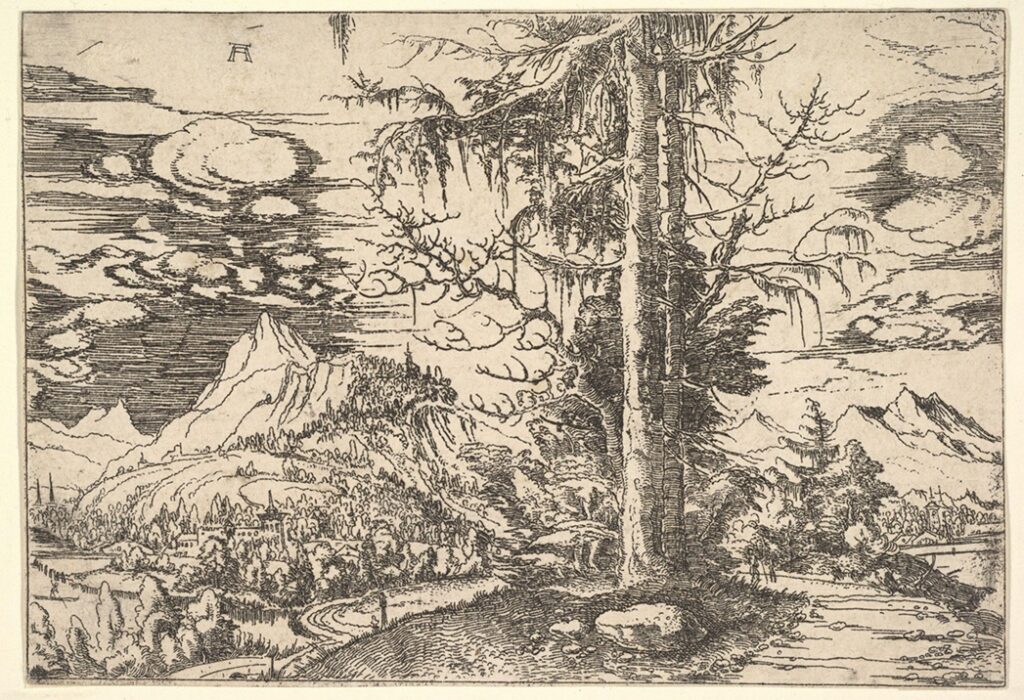
A second example is Landscape with a Double Spruce, an etching dated by the Metropolitan Museum of Art to around 1521-1522. Here, too, large conifers dominate the foreground, while a broad valley opens out behind them. These landscape prints were probably intended for a relatively small circle of connoisseurs interested in diminutive, unusual subjects.[7]
Parchment as a painting support and questions of condition
Sotheby’s describes the painting as oil on parchment mounted on panel. Parchment offers a relatively smooth, fine-grained surface suited to precise linework and tiny touches of paint. The choice of material accords with the refined handling of Altdorfer’s landscapes.
Parchment responds differently to fluctuations in humidity and temperature than wood. When mounted on a panel, the two materials form a composite support whose stability depends partly on the materials used and the method of attachment. In the present painting, a later transfer is also recorded. According to Sotheby’s, the parchment was transferred from an earlier panel.
The rainbow, but what does it mean?
The rainbow lends the painting a distinctive character within this small group of landscapes, although it is far from prominent. The subtle arc of light appears against a dark, cloud-filled sky and seems partly to dissolve into the atmosphere. The heavy clouds suggest rain or a storm. The clearing light and rainbow indicate a change in the weather.
In Christian tradition, the rainbow carried a meaning that went beyond the meteorological phenomenon. A small engraving by Altdorfer, The Infant Christ on the Rainbow Blessing, is dated by the Fitzwilliam Museum in Cambridge to around 1512. In that work, the rainbow is explicitly part of a Christian subject.[8]
In the present lot there is no figure of Christ, no recognisable Biblical episode and no other clear indication that requires a specific religious interpretation. Even so, the motif deserves more attention than a purely decorative detail. It is difficult to imagine that a sixteenth-century viewer would have regarded the rainbow solely as a neutral meteorological phenomenon.
A Renaissance landscape that recalls German Romanticism
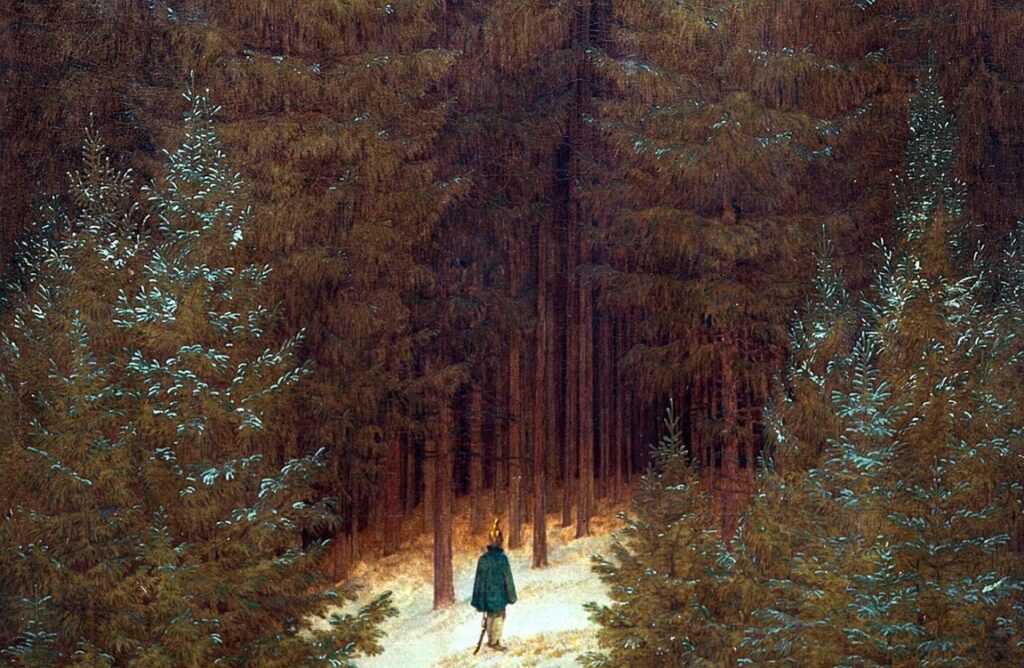
The dark trees, threatening sky and near-total absence of human presence inevitably bring to mind German Romantic landscape painting, particularly the works of Caspar David Friedrich. Yet Altdorfer was working some three centuries earlier. There is no walker, saint or traveller to establish the landscape’s scale. Nature stands here on its own.
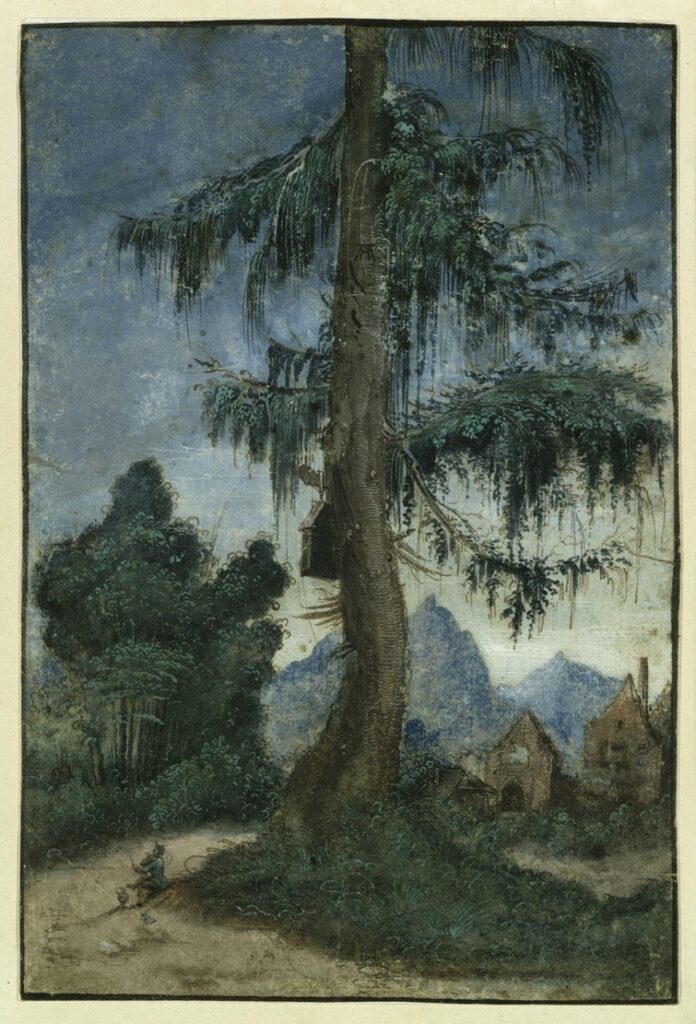
The painting shows how, around 1520, Altdorfer was exploring possibilities that would become important again much later in the history of European landscape painting. Another interesting comparison within his own oeuvre is in Berlin. The Kupferstichkabinett of the Staatliche Museen zu Berlin holds a drawing entitled Landscape with a Spruce, dated to around 1522. It combines a huge conifer with a mountainous landscape, a small human figure and a strikingly atmospheric sky.[9]
How many autonomous landscapes are actually known?
The exceptional rarity of the painting on offer is an important part of its commercial value. The National Gallery still describes Landscape with a Footbridge as one of only two known Altdorfer paintings without human figures. The other is in Munich.
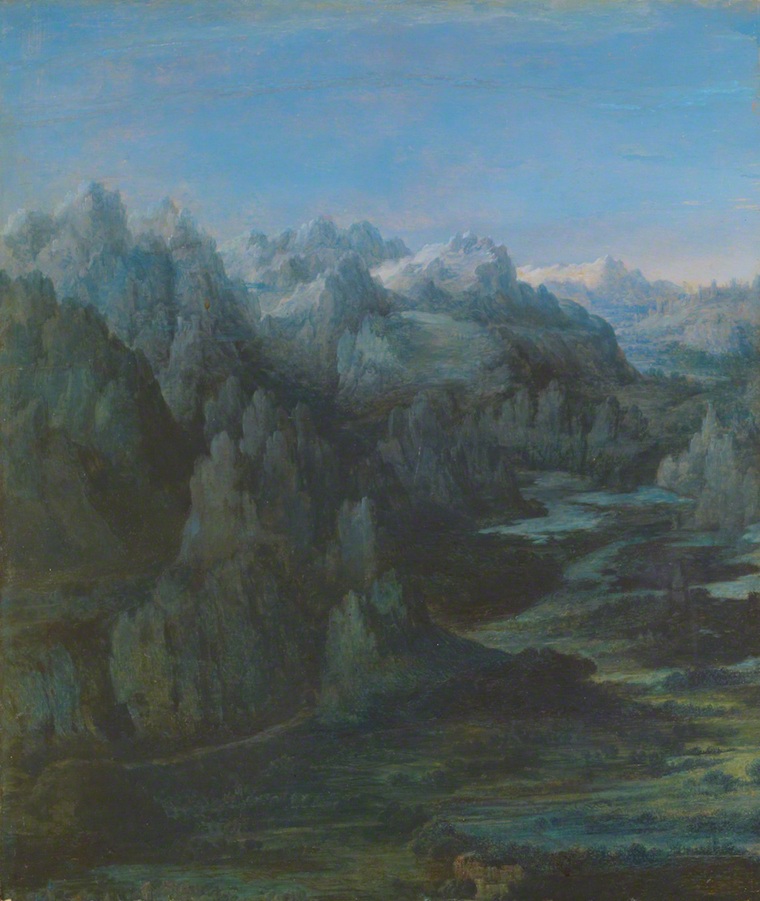
The Tokyo Fuji Art Museum owns a painting entitled Mountain Range, catalogued by the museum as a work by Altdorfer and dated to around 1530. It measures 53.1 × 45.1 centimetres and is painted in oil on panel. This work, too, depicts a landscape in which architecture is subordinate to nature. Its attribution, however, remains a subject of scholarly investigation. Altdorfer is considered a possible, but not conclusively established, author.[10]
The new Sotheby’s landscape seems most closely related to the technically and stylistically coherent group represented by the paintings in London and Munich. That is where the strongest comparison lies, and the work is being offered as an Altdorfer without any qualification to its attribution.
The Harrach collection and the painting’s little-known history
The provenance is notable, although not yet fully documented. According to Sotheby’s, the painting formed part of the Harrach collection in Vienna. It was acquired in 1957 by the father of the present owner. The Harrach family ranked among Austria’s leading aristocratic collecting dynasties. For many years, the collection was associated with the Palais Harrach in Vienna.
It was not until 1970 that a substantial part of the collection was transferred to Schloss Rohrau in Lower Austria, where the family’s paintings were once again made accessible to the public. By then, the Altdorfer landscape had already left the collection. Its provenance from such a historic collection is significant.
For the painting on offer, however, the details of its history within the Harrach collection have yet to be reconstructed. We do not know when it was acquired, which family member purchased it or how it was described in historical inventories. It may already have been regarded as a work by Altdorfer in the nineteenth century. Nor has it been established whether the painting appeared in earlier exhibitions or was reproduced in older scholarly literature.
It is precisely this gap in the record that makes the painting’s reappearance interesting. A work can remain in a private collection for decades without playing an active part in art-historical debate. When it is subsequently examined and published again, it may affect how an established oeuvre is understood. For an artist such as Altdorfer, this is potentially more consequential than for a painter whose output includes hundreds of comparable works.
The market for Altdorfer: strong demand, very little supply
Is the estimate cautious for a painting of such exceptional rarity? Altdorfer has a firmly established place in art history. Important paintings by him appear at public auction extremely rarely. The two principal museum comparisons have been in public collections for decades.
Landscape with a Footbridge was acquired by the National Gallery in 1961. The Danube Valley with Wörth Castle entered an important princely collection as early as the nineteenth century and is now part of the Bayerische Staatsgemäldesammlungen. An important historical point of reference is the National Gallery’s acquisition of Altdorfer’s Christ taking Leave of his Mother in 1980. The painting was purchased for £2.45 million.
That was an extraordinarily substantial sum for a work of the German Renaissance and demonstrates the institutional esteem in which major Altdorfer paintings are held. The painting was not, however, bought at public auction. The National Gallery acquired it through a private treaty sale from the Wernher collection, brokered by Christie’s.[11]
It is also an entirely different type of painting. Christ taking Leave of his Mother is a large religious composition measuring approximately 139 × 109 centimetres, with a historic provenance and a well-documented place in the oeuvre. Major Altdorfer paintings have long been regarded as exceptionally scarce works capable of commanding extraordinary sums.
What an attributed Altdorfer can fetch
At the other end of the market is an instructive sale from 2017. On 18 November of that year, Lempertz in Cologne offered a Portrait of a Cleric holding a Book. The painting was catalogued as “Albrecht Altdorfer, attributed to”. Measuring 34.7 × 26 centimetres, it carried an estimate of €40,000-50,000. The price realised was €50,000 including buyer’s premium.
Notably, Lempertz stated in its catalogue that two art historians had previously regarded the painting as an authentic work by Altdorfer.[12] The sale illustrates how complex the market for such paintings can be. Despite these favourable earlier scholarly opinions, the portrait was catalogued cautiously. That distinction in attribution status has major commercial implications. Much depends on the confidence potential buyers place in the attribution and the work’s condition.
What might stimulate interest in the painting?
An important commercial detail is that the painting carries the designation Guaranteed Property. This means that the seller receives a guaranteed minimum amount regardless of the auction’s outcome. For a painting with scarcely any recent comparable sales, it is noteworthy that the auction house is prepared to agree to such a guarantee.
That may reflect anticipated interest, the strategic importance of the lot or negotiations with the seller. At the current estimate, the chief commercial consideration seems to be neither its size, its decorative appeal nor even its historic provenance. Rather, it is the opportunity to acquire a painting from a market that barely exists. The two most important comparable landscapes are in London and Munich.
For collectors with a particular interest in the early German Renaissance or the history of landscape painting, this creates an exceptional situation. The number of works that could qualify is extraordinarily limited. Moreover, the new painting appears not only art-historically significant but also to have a highly recognisable subject.
The enormous larch, dense forest and dark sky are characteristic of the visual language for which Altdorfer’s landscapes are admired. This is therefore not an uncharacteristic subject made interesting solely by the artist’s name. It represents an essential aspect of his artistic development.
An autonomous landscape by Altdorfer could make an exceptional addition to a museum collection devoted to the development of European landscape painting. Its art-historical significance makes institutional interest conceivable. The estimate appears above all to express the price expectation attached to the painting’s exceptional art-historical position.
Do you have a particular interest in this artist or subject?
Do you own a painting by this artist, have you come across a comparable work, or do you have information that might be relevant to further research? We welcome contact from collectors, art dealers and researchers with an interest in this artist or related subjects.
We regularly research paintings appearing on the art market, exploring questions of attribution, quality, provenance and previous sales. If you have a question about a particular work or would like to share information with us, please feel free to get in touch at info@antonello.art.
Notes and sources
[1] Sotheby’s, Old Master & 19th Century Paintings Evening Auction, London, 9 December 2026, lot 15, Albrecht Altdorfer, A thickly wooded landscape with a rainbow behind the trees and a distant outcrop to the right beneath a cloud-laden sky.
[2] The National Gallery, London, Albrecht Altdorfer, Landscape with a Footbridge, c. 1518-1520, oil on parchment mounted on wood, 41.2 × 35.5 cm, inv. NG6320.
[3] Bayerische Staatsgemäldesammlungen, Alte Pinakothek, Munich, Albrecht Altdorfer, The Danube Valley with Wörth Castle, c. 1520-1525, parchment mounted on beechwood, 30.5 × 22.2 cm, inv. WAF 30.
[4] Bayerische Staatsgemäldesammlungen, Alte Pinakothek, Munich, Albrecht Altdorfer, St. George and the Dragon, 1510, parchment mounted on limewood, 28.2 × 22.5 cm, inv. WAF 29.
[5] Christopher S. Wood, Albrecht Altdorfer and the Origins of Landscape, London: Reaktion Books, 1993.
[6] Albertina, Vienna, Albrecht Altdorfer, Die große Fichte (The Large Spruce), c. 1520, hand-coloured etching, plate size 23.3 × 17.7 cm, inv. DG1926/1779.
[7] The Metropolitan Museum of Art, New York, Albrecht Altdorfer, Landscape with a Double Spruce, c. 1521-1522, etching, 11.1 × 16.2 cm, inv. 1993.1097.
[8] Fitzwilliam Museum, Cambridge, Albrecht Altdorfer, The Infant Christ on the Rainbow Blessing, engraving, c. 1512, inv. AD.5.22-114; New Hollstein German 11.
[9] Staatliche Museen zu Berlin, Kupferstichkabinett, Albrecht Altdorfer, Landschaft mit Fichte (Landscape with a Spruce), c. 1522, pen, watercolour and bodycolour, 20.1 × 13.6 cm, inv. KdZ 11651.
[10] Tokyo Fuji Art Museum, Mountain Range, catalogued by the museum as a work by Albrecht Altdorfer, c. 1530, oil on panel, 53.1 × 45.1 cm. See also Christina Reimann-Pichler, “Gebirgslandschaft: Ein Zuschreibungsversuch”, in Anliegen Kunst: 25 Jahre Kunstgeschichte Steiermark, 2024, pp. 83-108.
[11] The National Gallery, London, Susan Foister, “Albrecht Altdorfer: Christ taking Leave of his Mother”, in The German Paintings before 1800, 2024, inv. NG6463.
[12] Kunsthaus Lempertz, Cologne, sale 1097, Old Master Paintings, Drawings, and Sculpture, 18 November 2017, lot 2020, Albrecht Altdorfer, attributed to, Portrait of a Cleric holding a Book. Estimate €40,000-50,000; result €49,600 including buyer’s premium.