An anonymous painting of Judith with the Head of Holofernes will go under the hammer at Düsseldorfer Auktionshaus on 28 November. The estimate is just €300, yet at the time of writing bidding has already reached €4,200. Behind the sparse catalogue description lies a question. Are we really looking at a seventeenth-century Italian master?
Lot 1507, an unknown seventeenth-century Italian master, oil on panel, 63.5 by 49.5 centimetres. That is about all Düsseldorfer Auktionshaus has seen fit to tell us about Judith with the Head of Holofernes in its forthcoming auction. No documented provenance or art-historical commentary, neither of which, in our view, would have been superfluous.[1]
Yet the painting is hardly going unnoticed. At €4,200, bidding has already climbed well above the estimate. The auction itself will not take place until 28 November 2026. A low opening estimate partly explains this, but the interest is real. Which inevitably raises the question of what bidders think they recognise. A composition by a well-known master? An undervalued painting? Or simply a convincing old panel that has been catalogued with unusual caution?
An Unusual Judith
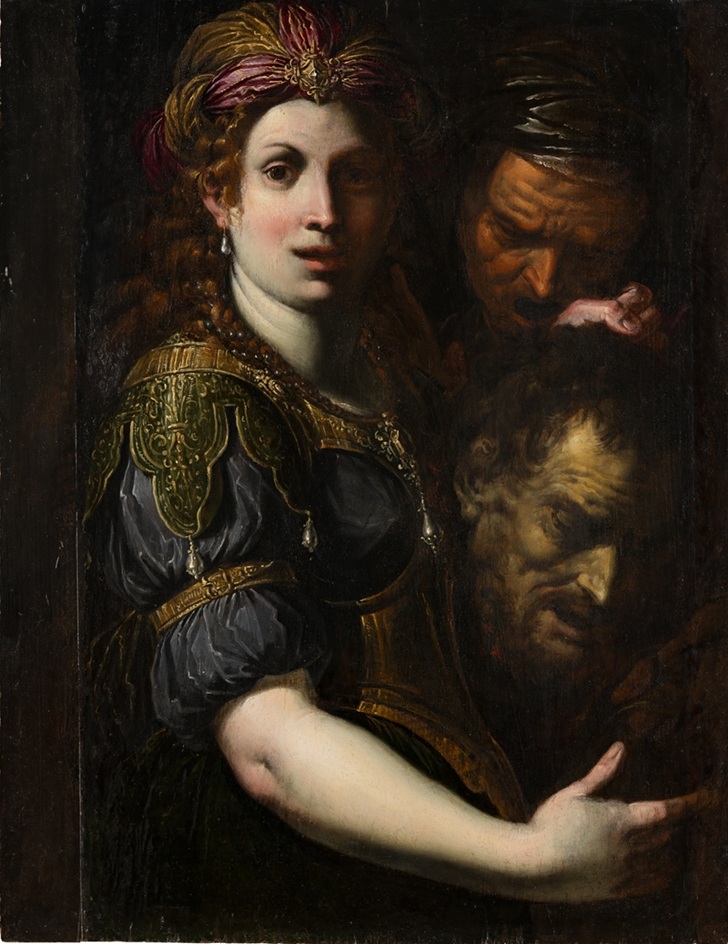
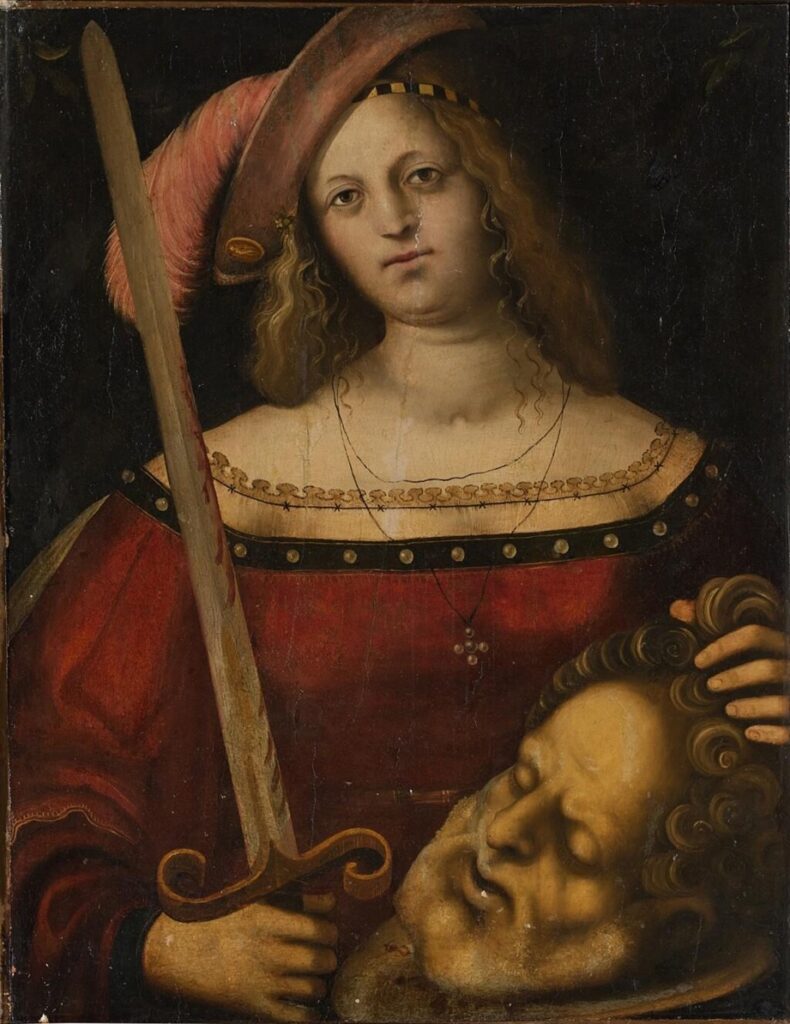
The painting depicts the moment after Judith has beheaded the Assyrian general Holofernes. Richly dressed and shown almost frontally, the young woman holds the severed head close to her body. Behind Holofernes stands an older figure, Judith’s maidservant Abra.
The sword, a prominent attribute in many other depictions of Judith, plays no visible part here. Judith looks directly at the viewer with a remarkably composed expression. Her face betrays scarcely any emotion. Almost all the horror of the subject is concentrated in the head of Holofernes.
The composition consequently has something of a portrait about it. Judith is not merely the protagonist of the biblical story, but a richly adorned young woman presenting herself to our gaze. Over a dark blue dress she wears an elaborately decorated, gold-coloured breastplate and shoulder pieces, an antiquising suit of armour. Small pearl-shaped pendants, jewels and a string of beads add further refinement.
Golden-brown and purplish-red fabrics are arranged into an elaborate headdress, held together by an expensive-looking ornament. This belongs to a much older pictorial tradition in which historical and biblical heroines were dressed in combinations of imaginary costume, contemporary fashion and classical military attributes. Particularly in the first half of the sixteenth century, women such as Judith, Lucretia and Cleopatra were frequently portrayed as richly dressed, almost regal figures.
Judith’s face has been painted with considerable care. Her skin is exceptionally pale, her cheeks are touched with pink and her eyes are precisely outlined. Her lips are slightly parted. Holofernes, by contrast, is handled more broadly. His face is dominated by greenish-brown and ochre tones. Light catches his forehead, nose and cheek, while the rest of his face largely disappears into shadow.
His heavy eyelids, open mouth and strongly modelled nose almost give him more character than Judith herself. The older figure behind him is painted differently again. The painter has established a clear hierarchy: our attention goes first to Judith’s beauty, then to the gruesome consequence of her act.
An Italian Master, But from Which Century?
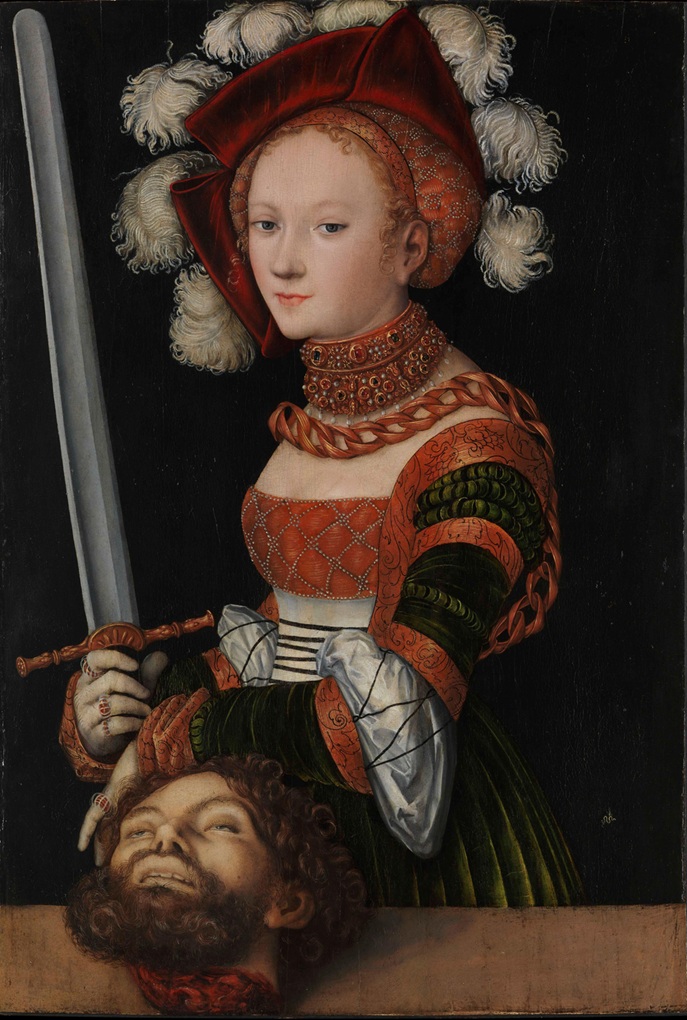
When looking for related works, the first question is whether the seventeenth-century date is really as self-evident as it seems. An unexpected parallel can be found in the work of the Dutch painter Jan Cornelisz. Vermeyen (circa 1502-1559). Vermeyen’s Judith likewise wears richly decorated, pseudo-Roman armour and an extraordinarily elaborate headdress.
Related motifs appear in the so-called Berlin Sketchbook, associated with Jacob Cornelisz. van Oostsanen and his workshop, as well as in other decorative designs from the 1520s and 1530s. They show just how early this visual language was in use. A richly dressed Judith wearing antiquising armour need not have originated in seventeenth-century Italy at all.
The Italian Candidates
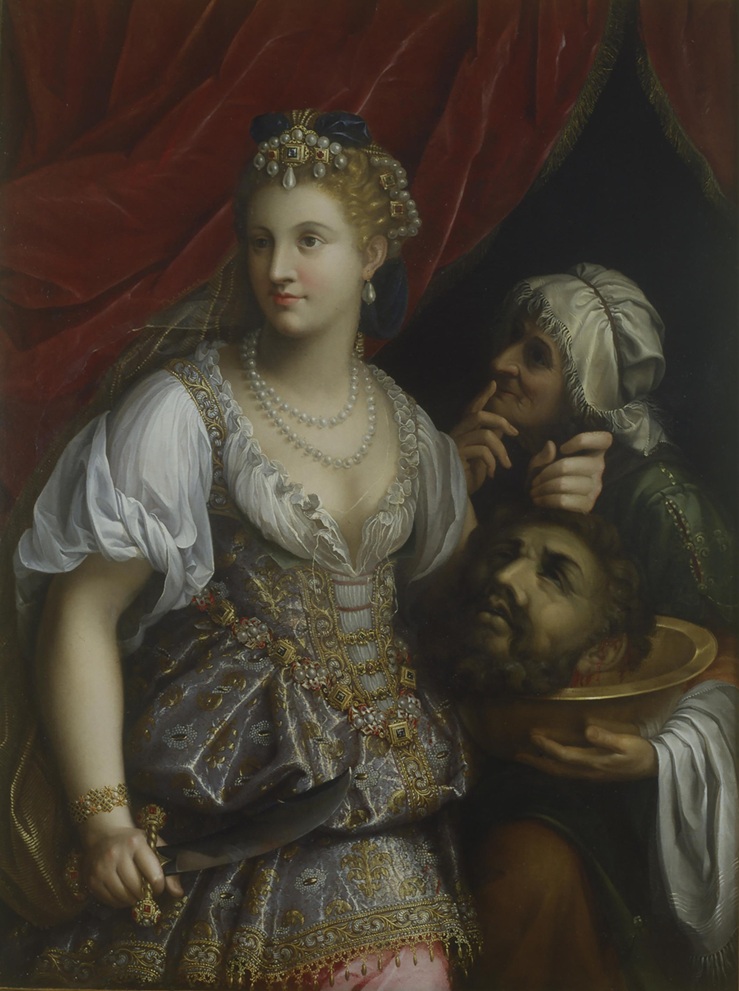
Those who nevertheless look to Italian painting will find several relevant comparisons. Painting from northern Italy around 1600 comes particularly to mind. One important name is Fede Galizia (circa 1578-1630), who worked in Milan and painted several versions of Judith with the Head of Holofernes.
Her signed and dated version of 1601 in the Galleria Borghese in Rome shows a richly dressed Judith presenting the head of Holofernes, assisted by an older maidservant. Judith is beautiful, self-possessed and almost indifferent to the violence that has just taken place. Her costume is rendered with meticulous care, while the severed head offers a stark contrast to her youthful appearance.[2]
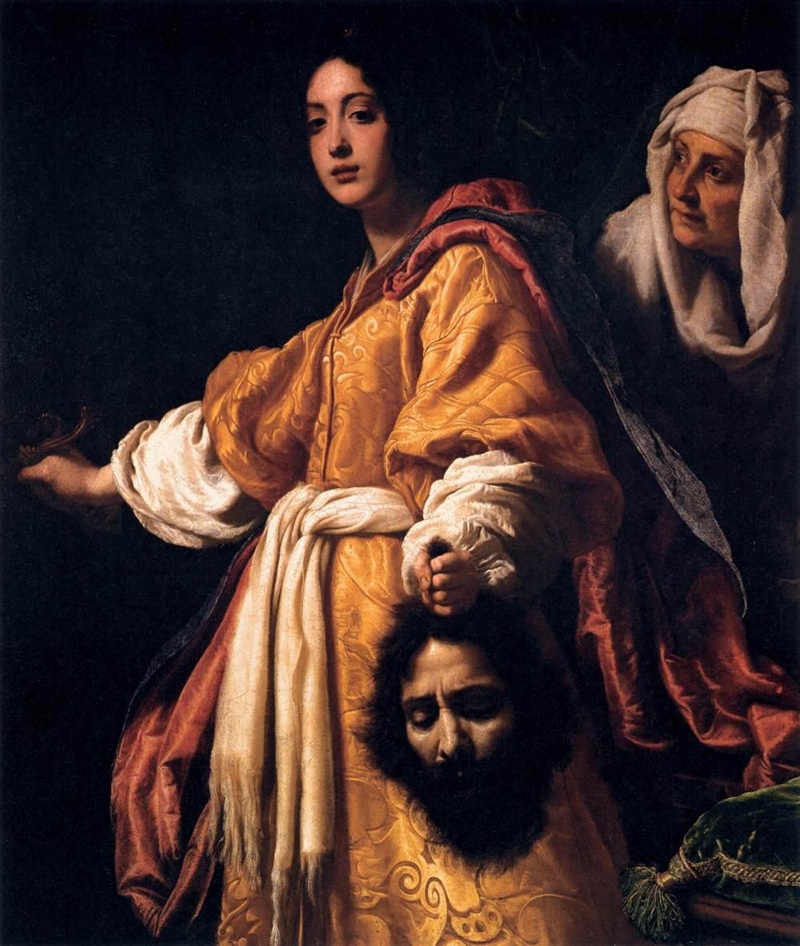
The best-known name, however, remains Cristofano Allori (1577-1621). His Judith with the Head of Holofernes, painted around 1610-1612, became particularly famous and was copied extensively. In Allori’s painting, the richly dressed Judith holds Holofernes’ head by the hair, while an older woman appears beside her. According to tradition, Allori used himself as the model for Holofernes and his lover Mazzafirra for Judith.[3]
For now, then, the search yields several art-historical points of reference, but no particular master who stands out convincingly above the rest. Lombard and northern Italian painting around 1600 remains a possibility. At the same time, an earlier, Northern European origin cannot be ruled out.
What the Market Pays for Paintings of Judith
The uncertain attribution makes the painting interesting from an art-historical perspective. Commercially, that very uncertainty probably helps explain the interest. Things become particularly interesting when a painting can be convincingly assigned to a historical school. At Dorotheum in Vienna in April 2025, a small Judith and Holofernes, catalogued as late sixteenth-century Lombard School, realised €13,000 including buyer’s premium.[4]
An even more relevant comparison in terms of size is a painting offered by Sotheby’s in New York on 1 February 2024. This Judith with the Head of Holofernes was catalogued as Lombard School, early 16th Century. Its estimate was approximately $30,000-50,000.[5]
How Much Difference Can a Name Make?
The art market’s sensitivity to attributions is well known. On 3 May 2023, a signed Judith with the Head of Holofernes by Fede Galizia realised €624,000 at Dorotheum, including buyer’s premium, against an estimate of €200,000-300,000.[6]
In Galizia’s painting, an accepted artist attribution, a visible signature, an important place within a documented series of Judith paintings and specialist research all came together. Almost all of that documentation is missing for the present panel. The enormous price difference therefore illustrates just how much importance the market attaches to convincingly substantiated attributions.
Examples such as these help explain why old, anonymous paintings with less than convincing catalogue descriptions can attract specialist buyers. At the same time, they show how much evidence is needed before an intriguing hypothesis becomes a defensible attribution.
What Are the Bidders Seeing?
It seems likely that different bidders see possibilities beyond what the catalogue description suggests. The combination of a convincing historical-looking composition, richly detailed costume and a very low estimate makes this an attractive prospect for dealers and collectors familiar with anonymous Old Masters.
The present catalogue attribution leaves room for very different interpretations. Bidding can also generate its own momentum. A painting that quickly attracts attention inevitably becomes more visible to other market participants. There is no need to identify a major master behind it straight away. More interesting is the way the painting combines stylistic features that justify a closer investigation of its origins.
Above all, the possibility that its date or geographical origin differs from the catalogue entry makes this a lot worth following. The final result will therefore tell us more than simply how much appeal the subject of Judith and Holofernes still holds. It will show how much buyers are prepared to pay for a painting whose potential seems considerably greater than the available documentation, but whose true origins remain to be established.
Do you have a particular interest in this artist or subject?
Do you own a painting by this artist, have you come across a comparable work, or do you have information that might be relevant to further research? We welcome contact from collectors, art dealers and researchers with an interest in this artist or related subjects.
We regularly research paintings appearing on the art market, exploring questions of attribution, quality, provenance and previous sales. If you have a question about a particular work or would like to share information with us, please feel free to get in touch at info@antonello.art.
Notes and Sources
[1] Düsseldorfer Auktionshaus, 265. Große Kunstauktion / Fine Arts & Antiques, Düsseldorf, 26-28 November 2026, lot 1507, Italienischer Meister 17. Jhdt., Judith mit dem Haupt des Holofernes.
[2] Antonio Iommelli, “Judith with the Head of Holofernes”, Galleria Borghese, Rome, July 2022.
[3] Patrizia Naldini, “Judith with the Head of Holofernes”, Gallerie degli Uffizi, Galleria Palatina, Palazzo Pitti, Florence. Cristofano Allori, circa 1610-1612, oil on canvas, 139 × 116 cm, inventory no. 1912 no. 96.
[4] Dorotheum, Old Masters, Vienna, 29 April 2025, lot 44, Lombard School, late 16th Century, Judith and Holofernes, oil on panel, 31.5 × 24.5 cm. Estimate €10,000-15,000; realised €13,000 including buyer’s premium.
[5] Sotheby’s, Master Paintings Part II, New York, 1 February 2024, lot 455, Lombard School, early 16th Century, Judith with the Head of Holofernes, oil on panel, 62.2 × 48.3 cm. Estimate $30,000-50,000.
[6] Dorotheum, Old Masters, Vienna, 3 May 2023, Fede Galizia, Judith with the Head of Holofernes, oil on canvas, 127 × 95.5 cm. Estimate €200,000-300,000; realised €624,000 including buyer’s premium.