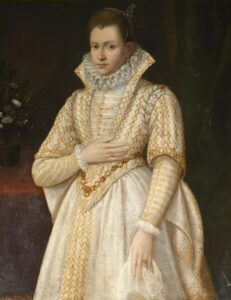
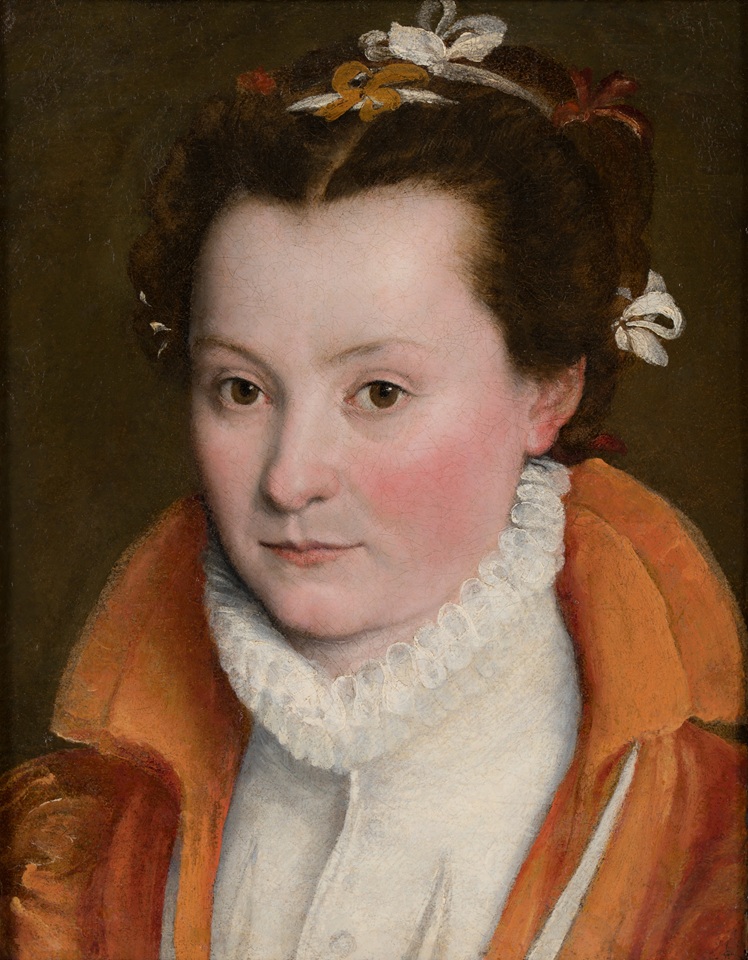
On 28 November 2026, a small portrait of a woman will come up for auction at Düsseldorfer Auktionshaus, catalogued as the work of an Italian master from the 16th or 17th century. The portrait raises intriguing questions about its creator, its age and the remarkable presence of the sitter’s face.
To us, this portrait belongs to a category of paintings that initially suggest the hand of an important Old Master, only for that first impression to become somewhat more complicated on closer inspection. It is above all the face that catches our attention.
The portrait depicts a young woman with dark hair adorned with white, yellow and red ribbons. She wears an orange-red dress with a high collar and a white neckpiece. Her face is softly modelled, her cheeks are pale pink, and her large brown eyes look almost directly at the viewer.
Catalogued as Italienischer Meister 16./17. Jhdt., Damenportrait, the painting is executed in oil on canvas, lined, and measures 38.5 × 31.5 cm. It is offered as lot 1905, with a catalogue price of €400.[1] No named artist, no precise dating, no identified sitter. Nor does the catalogue mention any provenance, signature or previous art-historical publication.
Why This Face Is So Convincing
The nose is softly modelled. Light falls across the forehead and the bridge of the nose, while the transition towards the cheeks is gradual. The mouth is small, with a subtle difference in colour between the upper and lower lips. Above all, the combination of the large eyes and the restrained treatment of the mouth gives the face its distinctive character.
Yet there is another consideration, the face appears more convincing than certain other parts of the painting. The orange clothing is handled more freely. The high, turned-down collar in particular consists of broad areas of colour in which the finer details of the fabric are not always clearly articulated.
The white neckpiece also reveals differences in execution. The small folds along its upper edge are rendered with considerable care, while the larger white area beneath conveys far less information about the material itself. These observations become important when we compare the painting with Florentine portraiture of the late Renaissance.
The Temptation of Alessandro Allori
When looking at a portrait of a woman from the second half of the 16th century, with a carefully modelled face, an elaborate hairstyle and a prominent collar, the Florentine portrait tradition readily comes to mind. Agnolo Bronzino (1503-1572) and his pupil Alessandro Allori (1535-1607) were among its most important representatives.
Their portraits combine controlled compositions with an exceptionally precise rendering of faces, clothing and jewellery. In Allori’s work especially, the relationship between the human figure and the luxurious materials of the sitter’s attire is significant. Fabrics, pearls, embroidery and hair ornaments are not merely decorative accessories, but contribute to the social identity of the sitter.
The portrait under consideration possesses several characteristics reminiscent of this tradition. The dark background, the relatively compact composition and the emphasis on the face all belong to a visual language that was widespread in late 16th-century Italy.
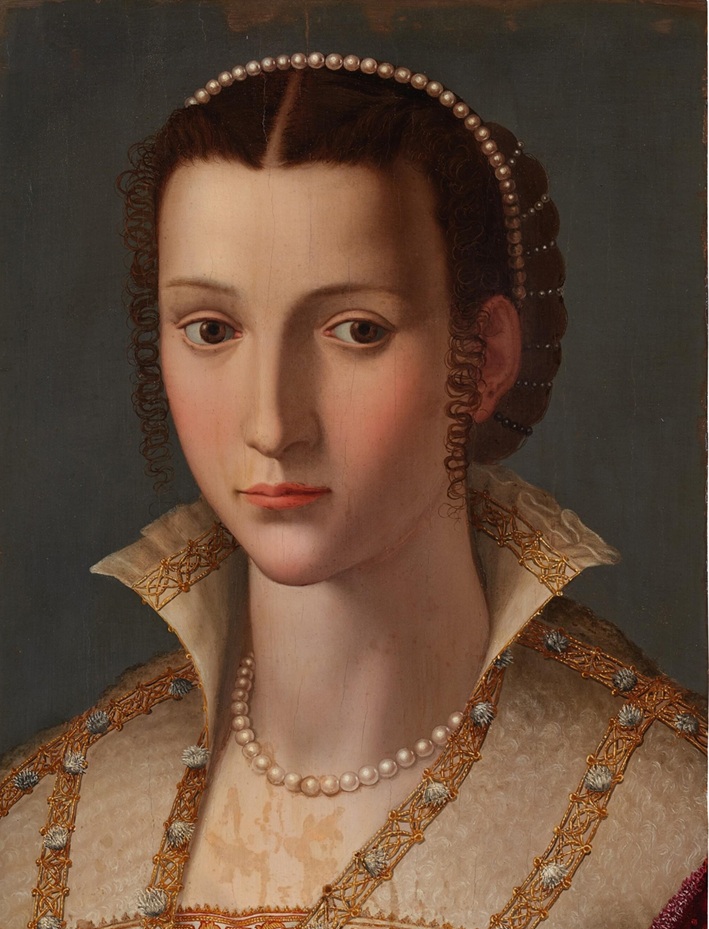
However, the differences between this painting and convincing works by Allori are equally significant. The modelling is softer and less severe. In several areas, the clothing lacks the crisp precision one would expect from Allori. A useful comparison is Portrait of a Florentine Noblewoman, Bust-Length, offered by Sotheby’s in New York on 27 January 2023 as Alessandro Allori and Workshop.
That portrait, painted on panel and measuring just 45.7 × 33 cm, carried an estimate of $40,000-60,000. Its documented history extends back to at least 1890, and it was still sold as a work by Bronzino in 1968. It displays a more detailed and meticulous painting technique.[2]
An Original Renaissance Portrait by an Unknown Artist
The painting may indeed have been created in the late 16th or early 17th century, but by a lesser-known Italian portrait painter. Florentine painting produced a considerable number of portraits that followed the visual language of Bronzino and Allori without attaining their level of accomplishment.
The Museo di Palazzo Davanzati in Florence holds a Ritratto di dama, dated to around 1560-1570 and attributed to the circle of Alessandro Allori. Stylistically, the painting belongs to their artistic environment, but falls short of their refinement. The treatment of materials and the colour contrasts, in particular, are less accomplished.[3]
The artist may therefore have been familiar with Italian portrait conventions without possessing the talent of the most celebrated painters. The differences between the face and the clothing would also be consistent with this explanation. A painter might have concentrated primarily on capturing the sitter’s likeness. The clothing could then have been executed more rapidly or perhaps completed by an assistant.
An Old Copy or a Derivative of a More Important Portrait
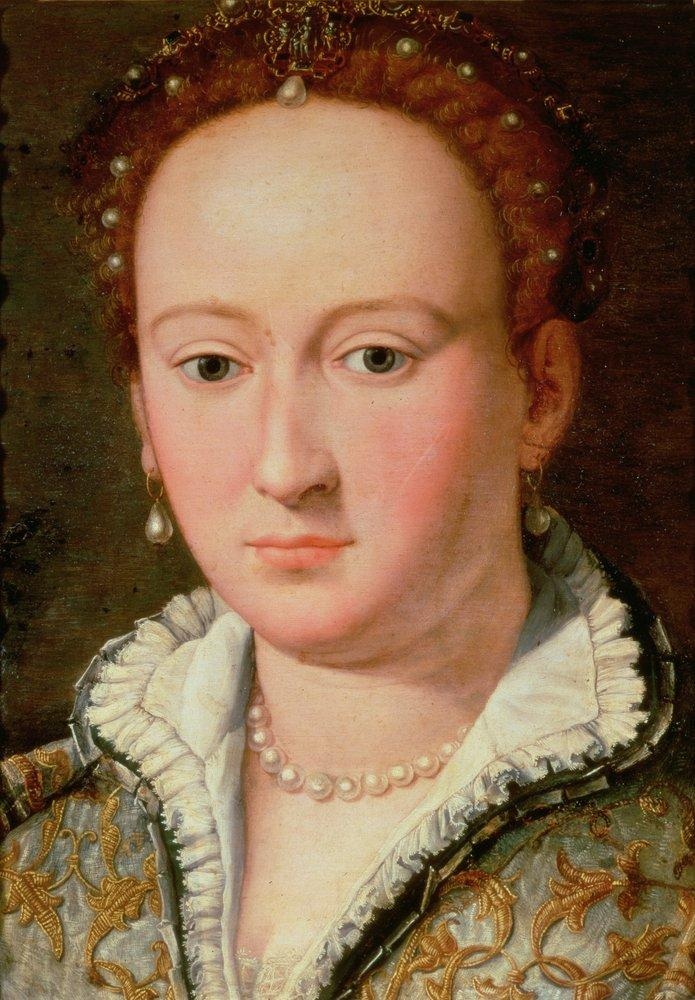
The painting could be a repetition of an existing composition, produced within an artist’s workshop. It might also be an independent copy after an older painting, in which the copyist simplified certain elements. Alternatively, we may be looking at a reduced version of an originally larger portrait.
The painting under discussion is small and strikingly compact in its composition. The head occupies much of the picture surface. The shoulders are partially cut off on both sides, leaving very little room for the clothing.
In that case, it is conceivable that the original painter devoted greater attention to the clothing, the pose and the relationship between the figure and her surroundings. The copyist may have concentrated primarily on the face. The human expression, after all, is the element that needs to be reproduced most accurately in a portrait. The clothing can more easily be simplified without compromising the recognisability of the sitter.
A 19th-Century Interpretation of the Renaissance
The portrait could also date from the 19th century. During that period, historical paintings were copied extensively. This took place in academies, museums, artists’ studios and private collections. Some painters attempted to reproduce existing works as faithfully as possible. Others created free interpretations in the style of earlier masters. A painting could therefore appear convincingly Renaissance in character without actually having been painted during the Renaissance.
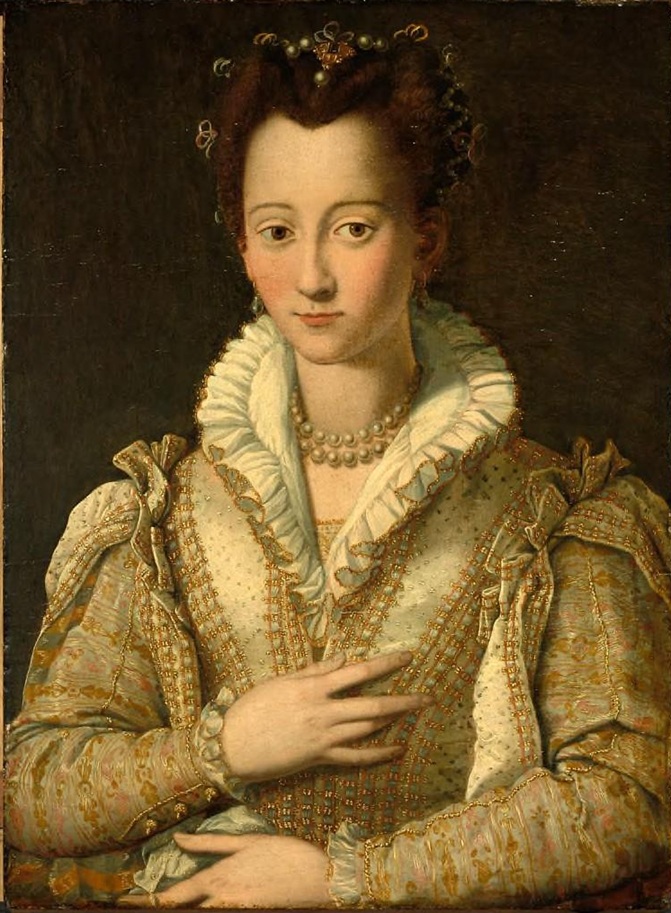
There is another stylistic consideration that makes this possibility worth exploring. The sitter’s face has a strikingly soft, almost approachable quality. The contours are less severe than those found in many formal Florentine portraits from the 16th century.
The combination of lively eyes, soft cheeks and a relatively small mouth also accords with later tastes in historical portraiture. This could point towards a 19th-century interpretation. However, 16th-century Italian painting was far more varied than the best-known examples by Bronzino and Allori might suggest. Not every portrait displayed the same sense of detachment or severity.
What Does the Art Market Tell Us?
The market for Italian portraits of the late Renaissance depends heavily on attribution, quality, size, condition and documentation. A convincing painting by a recognised artist can attract an entirely different level of interest from an anonymous portrait of the same period.
Yet paintings without famous names can also achieve strong results. A good example was sold at Christie’s in London on 21 September 2021. The work was Portrait of a Lady, Three-Quarter-Length, in a Red and White Embroidered Gown, catalogued as Italian School, circa 1600.
The painting carried an estimate of £700-1,000 but realised £20,000 including buyer’s premium. Remarkably, it was not attributed to any known artist.[4] The sale demonstrates that a compelling historical portrait can attract considerable interest even without a famous name.
Why This Painting Still Deserves Our Attention
The face possesses a quality that is far from commonplace in an anonymous painting offered at such a modest catalogue price. The treatment of the eyes, the gentle transitions between light and shadow and the subtle expression give the figure a striking sense of presence. A skilled but unknown portrait painter of the late Renaissance remains a serious possibility.
For us, therefore, the painting’s appeal lies less in the prospect of discovering a forgotten Allori than in the combination of a convincingly painted face and an art-historical attribution that remains difficult to establish. It is precisely this tension that makes the small portrait more intriguing than its brief catalogue description might suggest.
Do you have a particular interest in this artist or subject?
Do you own a painting by this artist, have you come across a comparable work, or do you have information that might be relevant to further research? We welcome contact from collectors, art dealers and researchers with an interest in this artist or related subjects.
We regularly research paintings appearing on the art market, exploring questions of attribution, quality, provenance and previous sales. If you have a question about a particular work or would like to share information with us, please feel free to get in touch at info@antonello.art.
Notes and Sources
[1] Düsseldorfer Auktionshaus, 265. Große Kunstauktion, Düsseldorf, 26-28 November 2026, lot 1905, Italienischer Meister 16./17. Jhdt., Damenportrait. Oil on lined canvas, 38.5 × 31.5 cm. Estimate €400.
[2] Sotheby’s, Master Paintings and Sculpture Part II, New York, 27 January 2023, lot 414, Alessandro Allori and Workshop, Portrait of a Florentine Noblewoman, Bust-Length. Estimate $40,000-60,000.
[3] Ministero della Cultura, Catalogo Generale dei Beni Culturali, catalogue number 0900297496, Ritratto di dama, circa 1560-1570, Circle of Alessandro Allori, Museo di Palazzo Davanzati, Florence.
[4] Christie’s, Jasper Conran: The Collection Part II, London, 21 September 2021, lot 338, Italian School, circa 1600, Portrait of a Lady, Three-Quarter-Length, in a Red and White Embroidered Gown. Oil on canvas, 108 × 83.6 cm. Estimate £700-1,000, price realised £20,000 including buyer’s premium.