On 1 December 2026, Christie’s will offer a monumental flower still life by Jan Brueghel II from the Blaquier-Arrieta Collection in London. Estimated at £300,000-500,000, the painting has remained in the same private collection for almost 23 years. Its composition goes back to one of his father’s most celebrated flower paintings. Will the work pass into the hands of another private collector, or could it find a place in an institutional collection?
A metre-high flower still life by Jan Brueghel II (1601-1678) depicts an exuberant bouquet of tulips, lilies, roses and dozens of other flowers in a simple wooden tub, surrounded by insects and delicate botanical details. The estimate is £300,000-500,000.[1] This is not the first time the painting has appeared on the international auction market.
In December 2003, it sold at Sotheby’s in London for £650,000.[2] Significantly, the painting belongs to a distinctive group of works whose original composition can be traced to Jan Brueghel I (1568-1625), one of the pioneers of the independent flower still life. The most important version is in the Kunsthistorisches Museum in Vienna. Other versions are held in leading museum collections and have been discussed extensively in the art-historical literature.
The composition therefore occupies an established place in European painting, but the quality of each individual version matters. We find ourselves wondering what kind of buyer this painting will attract. A private collector seeking an impressive flower still life by the Brueghel dynasty? Or perhaps a museum looking to strengthen its holdings of Flemish painting?
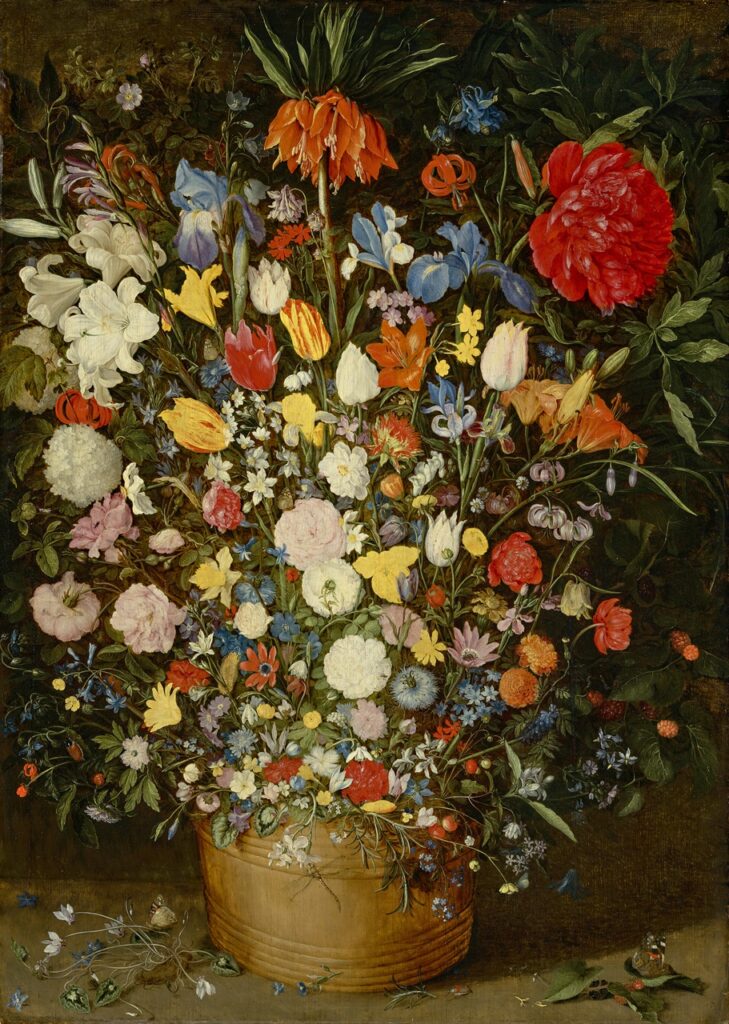
An expansive botanical world on panel
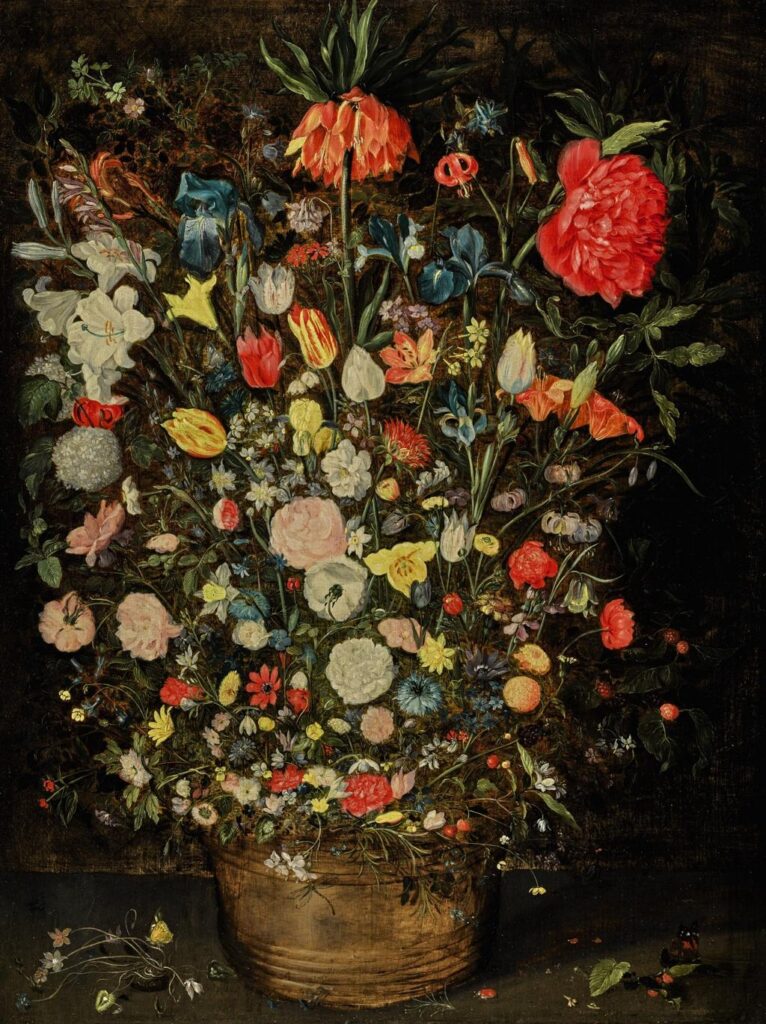
The painting is documented in Klaus Ertz’s catalogue raisonné and is dated to around 1620, when Jan Brueghel II was still at the beginning of his career. Executed on panel, it measures 97.5 × 70.2 centimetres, a substantial size within the artist’s oeuvre.
The composition is dominated by a large orange flower rising above the bouquet. To the right is a large red flower, with white lilies and other paler blooms providing a counterbalance on the left. Between them unfolds a rich array of tulips, narcissi, roses and numerous smaller flowers in a range of colours.
The arrangement is densely packed, yet the dark background remains visible between stems and blooms, allowing individual elements of the bouquet to stand out. The larger flowers establish its structure, while the smaller varieties contribute a wealth of detail. In our view, that interplay is essential to the painting’s effect.
From a distance, the eye is drawn chiefly to the larger flowers and their striking colour contrasts. Up close, attention shifts to the fine details and the insects depicted among and around the flowers. Near the bottom, smaller blooms seem to spill over the edge of the container. A few loose plants and leaves lie in the foreground, while insects and butterflies lend vitality to the carefully ordered composition.
The painting presents a deliberately assembled gathering of flowers, bringing together blooms from different seasons. This approach was characteristic of early Flemish flower painting, which sought above all to display nature’s variety. Rare plants were collected and studied by wealthy enthusiasts. Flowers that in reality bloomed for only a brief period could thus remain permanently available for admiration and study.
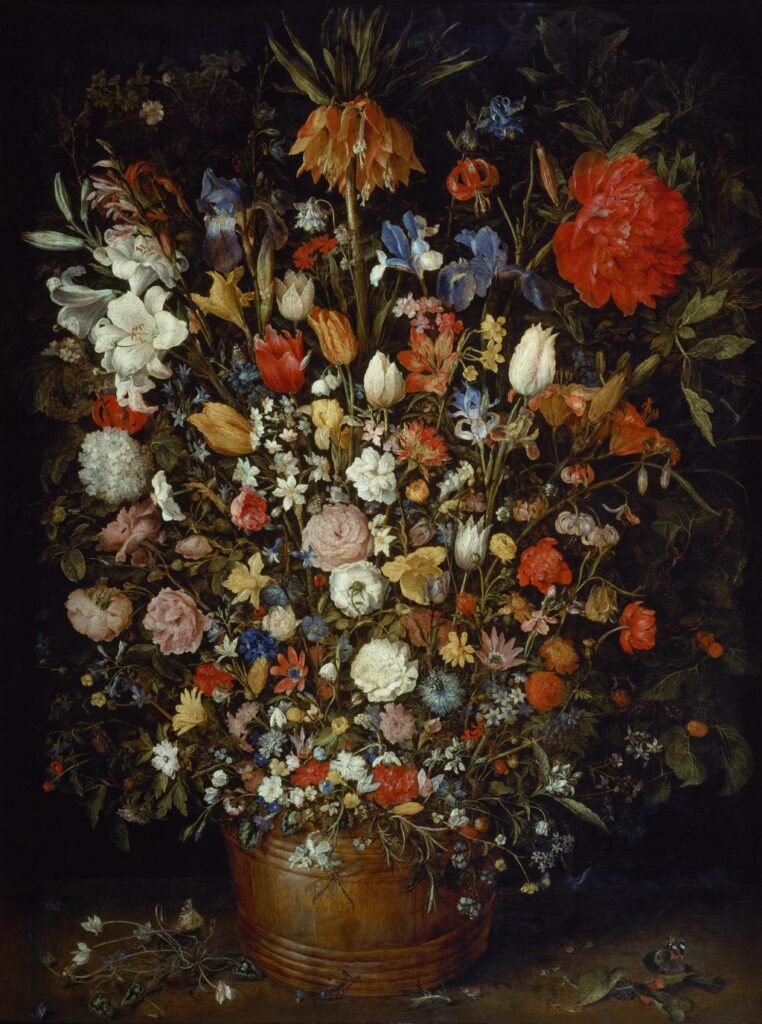
A composition that goes back to Jan Brueghel I
Around 1606, Jan Brueghel I painted a monumental flower still life now known as Flowers in a Wooden Vessel. It is housed in the Kunsthistorisches Museum in Vienna. Measuring 97 × 73 centimetres, the Vienna painting is almost exactly the same size as the version coming to auction. The museum regards it as one of the most celebrated flower paintings in European art.[3]
Flowers had previously appeared primarily as elements of religious paintings. Around 1600, however, artists increasingly began to treat them as subjects in their own right, and Jan Brueghel I played a leading role in that development. Rather than simply placing flowers side by side, he organised their proportions, colours and forms into a convincing whole.
Within the family’s artistic tradition and workshop, several versions closely following the composition were produced. The image consequently became a recognisable part of the Brueghels’ artistic repertoire. In his 1984 catalogue raisonné of Jan Brueghel II, Klaus Ertz identified seven versions of this composition by the younger artist. The painting now coming to auction is among them.[4]
The original Vienna painting represents an artistic invention. The significance of the later versions lies primarily in how that design was adopted, interpreted and executed. In this respect, the possible date of the Christie’s painting makes it particularly interesting.
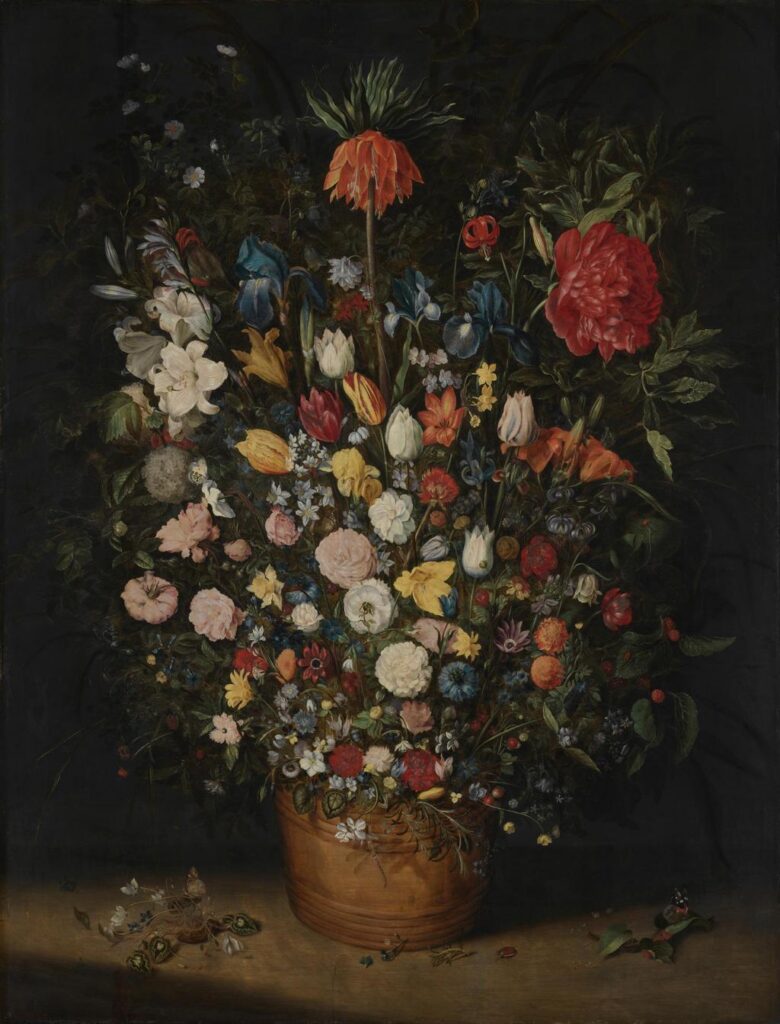
An early Jan Brueghel II?
Jan Brueghel II trained under his father and grew up in one of the most important artistic centres of the Southern Netherlands. In 1622, he travelled to Italy. Following his father’s death in 1625, he returned to Antwerp, where he took over the family workshop. His father’s influence remained apparent throughout his career.
Klaus Ertz dates the present painting to around 1620, shortly before the young artist’s journey to Italy. This dating was explicitly mentioned in Christie’s 1995 catalogue, when the same painting was offered in New York. Ertz had initially attributed it to Jan Brueghel I, but later revised the attribution to Jan Brueghel II, partly because of its close relationship to a version in the Alte Pinakothek in Munich.[5]
That makes the painting an interesting early example of how Jan Brueghel II absorbed his father’s artistic tradition. The composition was inherited, but the execution calls for an assessment of its own. How were the flowers modelled? How carefully were the transitions between light and shadow handled? How do the details and painting technique compare with other known versions and workshop pieces?
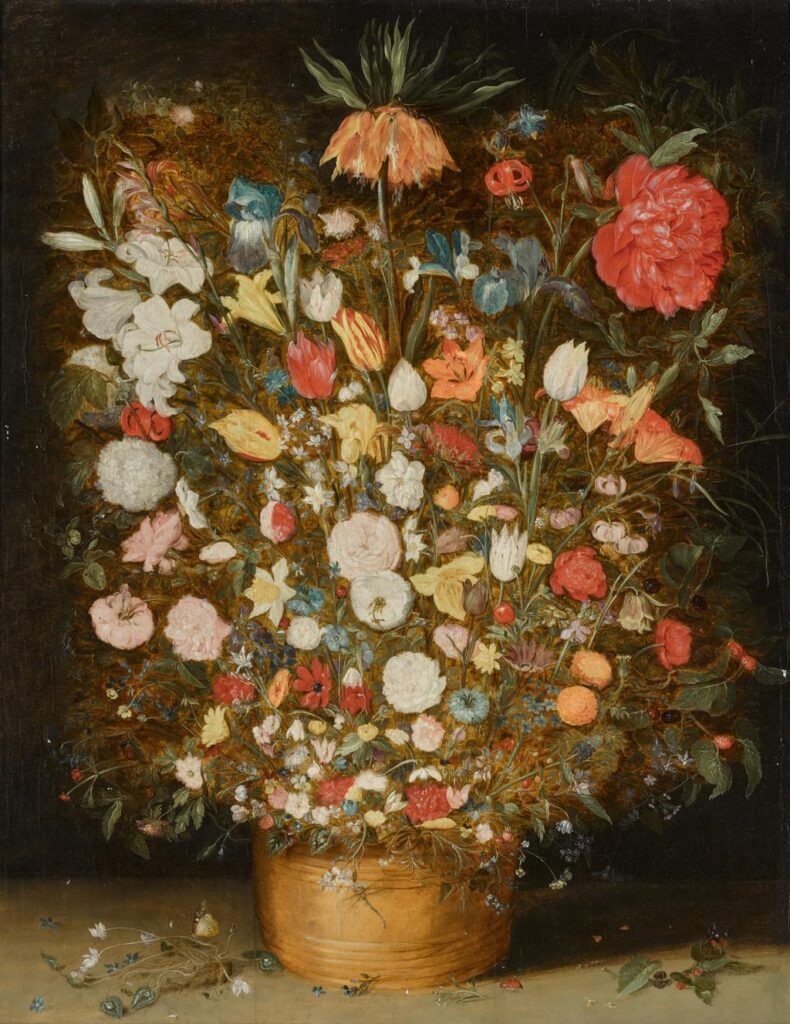
The complex boundary between father, son and workshop
When the painting was offered at Sotheby’s in London on 21 June 1961, it was still catalogued as a work by Jan Brueghel I. Klaus Ertz, however, included it among the works of Jan Brueghel II in 1984. That attribution was subsequently adopted by Christie’s in 1995 and remains in place for the forthcoming sale. A painting may be almost identical in composition to a work by Jan Brueghel I, yet have been executed by his son or members of the workshop.
A telling example can be found in the Alte Pinakothek in Munich. The museum owns a monumental version of the same type, measuring 125 × 96 centimetres. Klaus Ertz catalogued it as a work by Jan Brueghel II. The Bayerische Staatsgemäldesammlungen, however, now attribute it to the workshop of Jan Brueghel I.
Among the reasons given for this assessment, the museum points to a red lily that appears awkwardly squeezed between the surrounding flowers for lack of space. In the museum’s view, the less accomplished handling of such passages suggests workshop production.[6] For prospective bidders, a similarly close examination of the painting now on offer will be an important step.
What makes a Brueghel like this interesting to a museum?
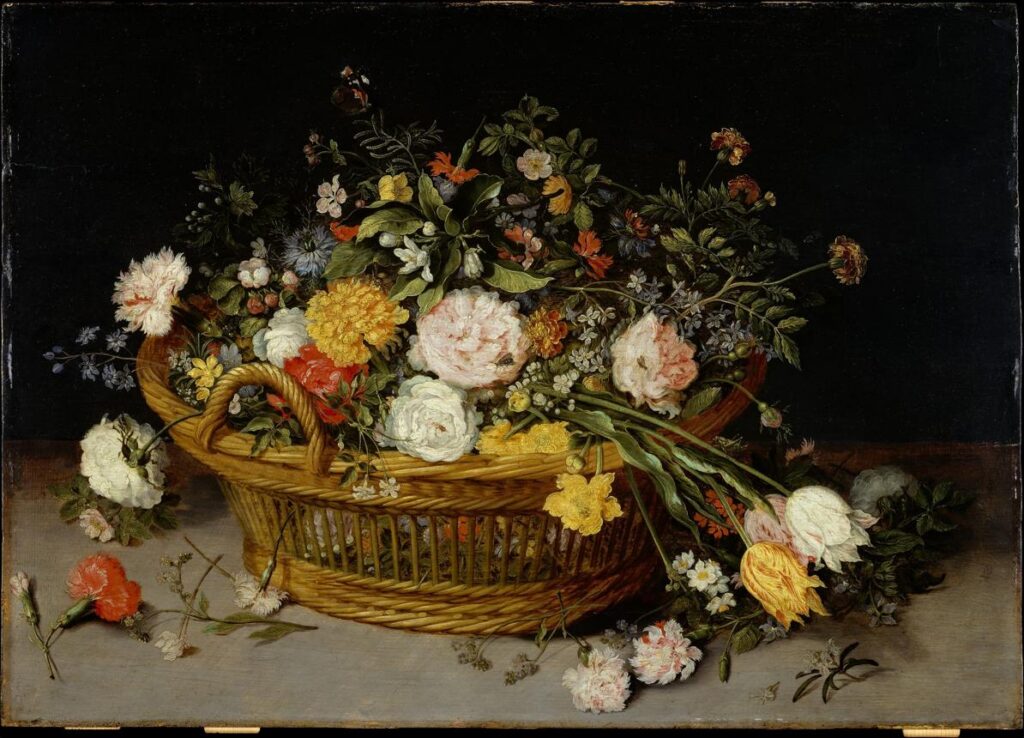
The Kunsthistorisches Museum owns the original Vienna composition, while the Alte Pinakothek holds a large workshop version. The Rijksmuseum also has a monumental flower still life in a wooden tub, attributed to the workshop of Jan Brueghel I. This shows that Jan Brueghel II is collected not merely as a follower of his father.
His work also has a story of its own within the development of Flemish Baroque painting. For a museum wishing to illustrate the artistic development of successive generations, a flower still life by Jan Brueghel II could therefore make a valuable addition. Would it represent a missing period and offer a unique opportunity to trace an artist’s development? Or might its quality be so compelling that it would significantly strengthen an existing collection?
Several of those arguments could be made for this painting. Its early date of around 1620 is intriguing, and its size is substantial. Its relationship to one of Jan Brueghel I’s most famous flower compositions also provides a clear art-historical context.
Museums are still actively collecting seventeenth-century still lifes
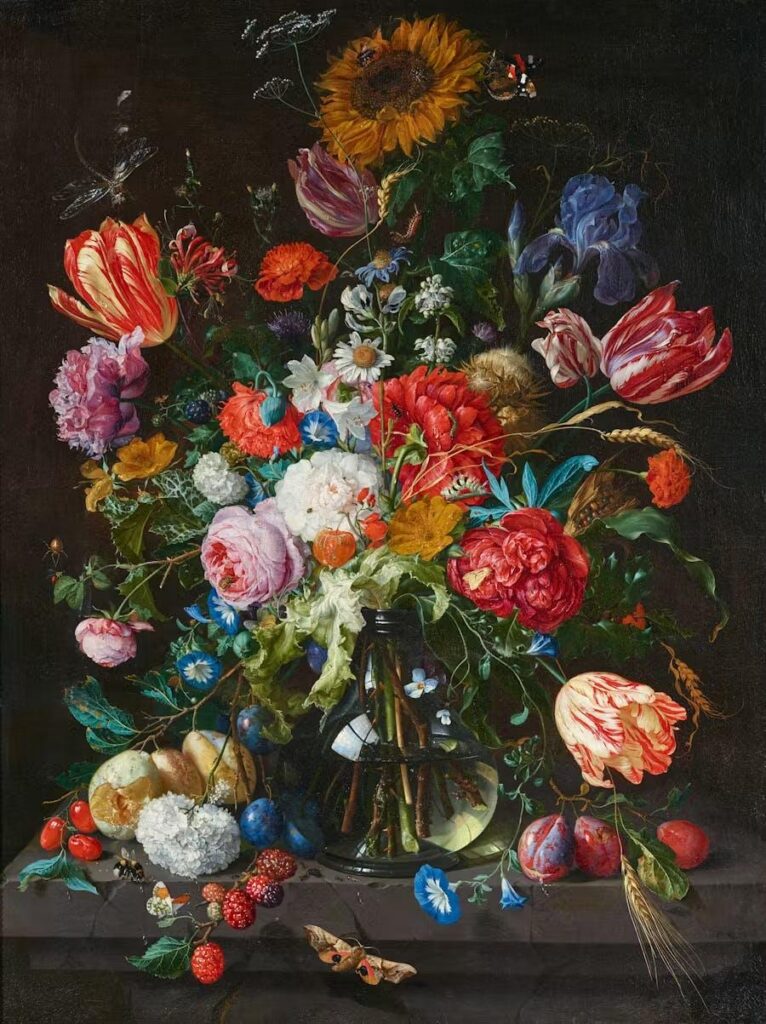
On 31 March 2026, the J. Paul Getty Museum in Los Angeles announced that it had acquired an important seventeenth-century Dutch still life. The work was Glass Vase with Flowers and Fruit by Jan Davidsz. de Heem, painted around 1673-1674. According to Getty, the museum had been searching for more than twenty years for an important flower painting by De Heem. The acquisition was presented as a major addition to its collection of Northern European Baroque painting.[7]
Getty did not simply buy an attractive flower painting. It acquired a work by an artist not previously represented in its paintings collection, whose work it had sought for many years. The purchase therefore addressed a specific institutional need. Something similar is conceivable for the present flower still life by Jan Brueghel II. One could imagine a museum with a strong collection of Flemish painting but without a representative example of Jan Brueghel II’s flower still lifes.
What does the auction history tell us?
The painting has a documented modern provenance. On 21 June 1961, it appeared at Sotheby’s in London as lot 20, then attributed to Jan Brueghel I. In 1981-1982, it was with Deville Galleries in Los Angeles, before entering a private collection.
On 18 May 1995, it was offered at Christie’s in New York as lot 182. It resurfaced at Sotheby’s in London on 11 December 2003 as lot 56, when it was acquired by the Blaquier-Arrieta family. The forthcoming sale therefore marks its first return to the public auction market in almost 23 years.
The painting has long been known in the art-historical literature and has passed through several major international auctions. The most relevant comparison today remains the 2003 sale. In the catalogue for a related composition offered in 2023, Sotheby’s explicitly refers to the present Christie’s painting and records that it sold for £650,000.
An estimate can also reflect the auction house’s selling strategy and its wish to attract sufficient interest. Has the present estimate been deliberately set at a cautious level? Has the market changed? Or is this a segment in which prices depend heavily on individual quality and the degree of certainty surrounding the attribution?
The market distinguishes between different versions
On 10 December 2020, Sotheby’s in London offered a smaller version of the same composition. The panel measured 64 × 49 centimetres and carried an estimate of £80,000-120,000. It sold for £200,000.[8] The painting was smaller than the present Christie’s work but likewise followed Jan Brueghel I’s celebrated design.
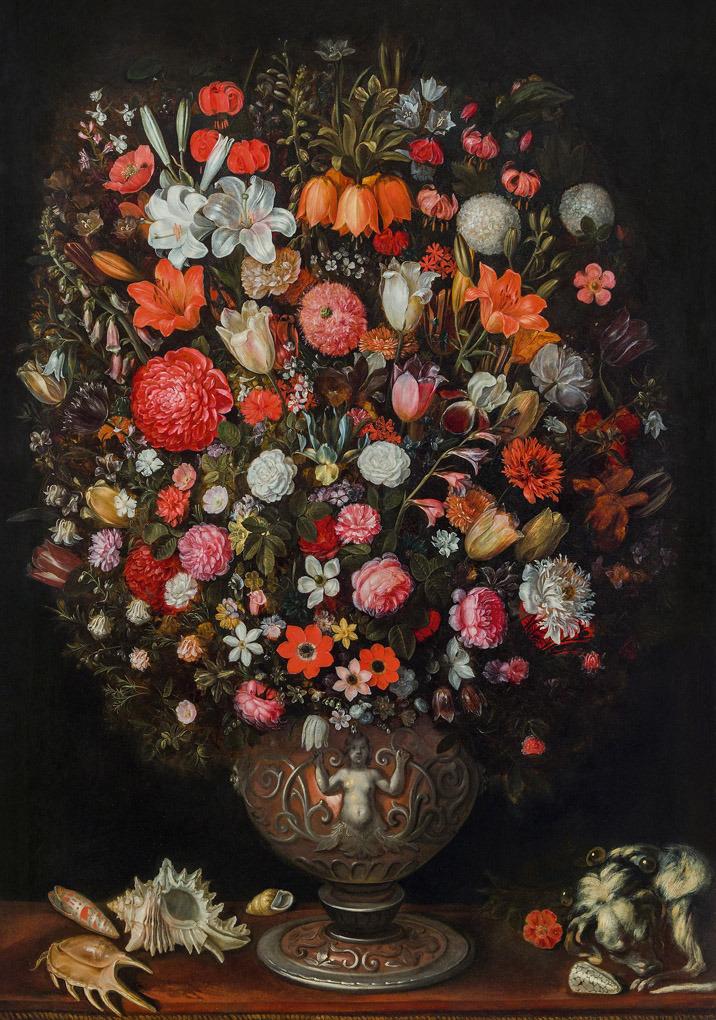
On 16 June 2015, the Viennese auction house im Kinsky sold a monumental flower still life by Jan Brueghel II dating from around 1630. The painting, Still Life with Flowers in a Sculpted Vase, measured 117 × 81 centimetres. Its estimate was correspondingly substantial at €500,000-1,000,000, but bidding drove the hammer price to €2,100,000, or €2,560,000 including the buyer’s premium.[9]
A more recent comparison is the flower still life Christie’s offered in London on 1 July 2025. Depicting flowers in a pewter vase, the painting measures just 47.8 × 36 centimetres. Its estimate was £250,000-350,000. The 2015 result demonstrates that buyers can be willing to pay considerably higher sums for important flower still lifes by Jan Brueghel II. The painting sold in 2015 is a different composition from a different period. Above all, it illustrates how widely prices within the artist’s oeuvre can vary.
Why collectors remain drawn to these flower still lifes
The appeal of the Brueghels’ flower paintings is not solely art historical. A painting filled with dozens of flowers and insects requires no specialist knowledge of religious iconography to make an immediate impression. In today’s world, that can be a welcome quality for collectors.
For those interested in painting techniques, these works offer an exceptionally refined treatment of small forms, colour and light. For art historians, they are connected to the emergence of the independent still life in the early seventeenth century. For collectors, they represent a recognisable aspect of Flemish painting, associated with one of its most famous artistic families.
Moreover, this painting is impressive, not least because of its considerable size. The flowers fill almost the entire panel and seem barely contained within the wooden tub. If individual flowers are less convincingly modelled, or if fine details have been weakened by restoration, a painting can lose a considerable degree of its quality.
A possible museum acquisition, but not an undisputed key work
Whether the painting deserves a place in a museum is ultimately a more complicated question. Jan Brueghel I’s original composition in Vienna belongs to the early history of the monumental flower still life. The version offered by Christie’s is directly related to it and is placed by Ertz within the early career of Jan Brueghel II.
That gives the painting clear art-historical significance. But it does not necessarily mean that this particular version occupies a pivotal position in the oeuvre. Several versions are known, and the attribution history of this group of compositions is complex. For a museum, that could be a reason for caution. At the same time, a painting need not be a key work to deserve a place in a collection. A compelling representative example can illuminate an important chapter of art history.
The present painting could, for example, be particularly well suited to illustrating how a compositional type passed from one generation to the next. Yet the presence of several related versions in existing museum collections makes it less likely that the art-historical community will regard this painting as an unmissable acquisition opportunity.
Will it remain in private hands?
The combination of scale, subject and the artist’s name makes the painting attractive within the market for flower still lifes. The current estimate could attract a broad range of interested buyers. Ultimately, the auction will offer an indication of how today’s market values this particular version of the celebrated Brueghel composition, especially in light of the considerably higher prices sometimes achieved by other large flower still lifes by Jan Brueghel II. The painting will receive a fresh market valuation on 1 December, but whether it then disappears into a private collection or goes on display in a museum remains to be seen.
Do you have a particular interest in this artist or subject?
Do you own a painting by this artist, have you come across a comparable work, or do you have information that might be relevant to further research? We welcome contact from collectors, art dealers and researchers with an interest in this artist or related subjects.
We regularly research paintings appearing on the art market, exploring questions of attribution, quality, provenance and previous sales. If you have a question about a particular work or would like to share information with us, please feel free to get in touch at info@antonello.art.
Notes and sources
[1] Christie’s, The Blaquier-Arrieta Collection, Part I: Masterpieces, London, 1 December 2026, Jan Brueghel II, Roses, tulips, lilies, irises, peonies, forget-me-nots, narcissi, crown imperial, anemone, poppies and other flowers, oil on panel, 97.5 × 70.2 cm, estimate £300,000-500,000.
[2] Sotheby’s, Old Master & 19th Century Paintings Day Auction, Part I, London, 6 July 2023, lot 202, Jan Brueghel II, Still Life of Flowers in a Wooden Tub.
[3] Kunsthistorisches Museum, Vienna, Jan Brueghel I, Flowers in a Wooden Vessel, circa 1606-1607, Gemäldegalerie, inv. no. GG 570.
[4] Klaus Ertz, Jan Breughel the Younger (1601-1678): The Paintings with Oeuvre Catalogue, Freren, 1984, vol. I, pp. 427-431, nos. 264-270. The present painting is listed as no. 267.
[5] Christie’s, Old Master Paintings, New York, 18 May 1995, lot 182, Jan Brueghel II, A Crown Imperial, a Peony, Lilies, Tulips in a Wooden Tub.
[6] Bayerische Staatsgemäldesammlungen, Alte Pinakothek, Munich, Large Bouquet of Flowers, circa 1606-1607, inv. no. 824, attributed to the workshop of Jan Brueghel I.
[7] J. Paul Getty Museum, “Getty Acquires Two 17th-Century Dutch Still Life Paintings”, press release, 31 March 2026.
[8] Sotheby’s, Old Masters Evening Sale, London, 10 December 2020, lot 25, Jan Brueghel II, Still Life with a Large Bouquet of Flowers in a Wooden Bucket, oil on oak panel, 64.4 × 49.5 cm. Estimate £80,000-120,000. Sold for £200,000.
[9] im Kinsky, 107. Kunstauktion, Vienna, 16 June 2015, lot 40, Jan Brueghel II, Still Life with Flowers in a Sculpted Vase, circa 1630, oil on wood, 117 × 81 cm. Estimate €500,000-1,000,000; hammer price €2,100,000.