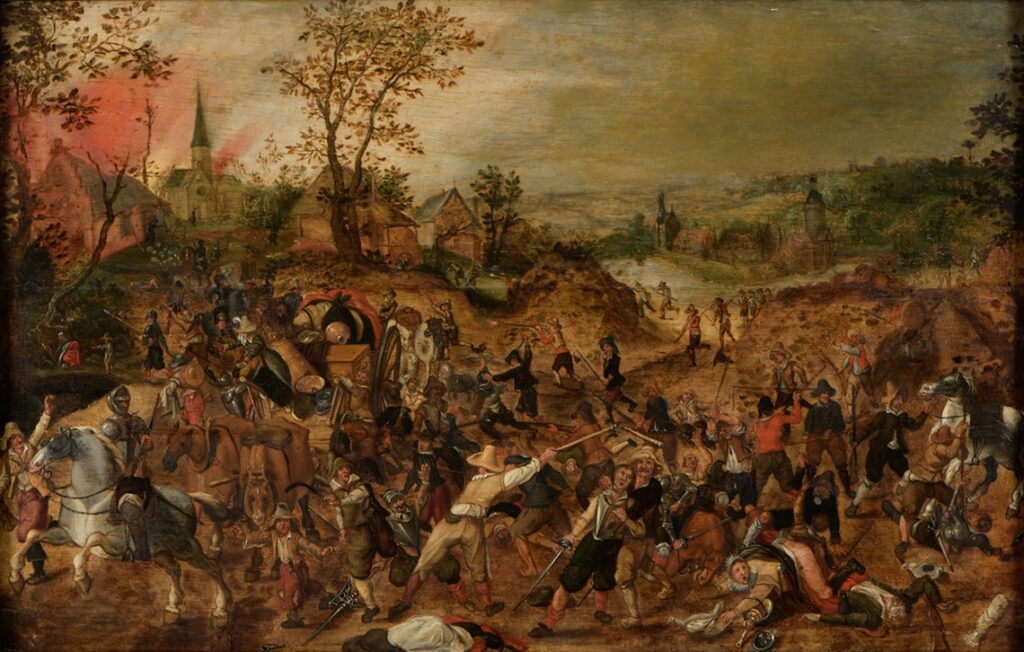
A seventeenth-century painting depicting marauding soldiers, soon to come up for auction, bears striking similarities to the work of Sebastiaen Vrancx (1573-1647). Both the subject and the composition point towards him, and a nearly identical scene is known under his name. The question is whether we are looking at a second autograph version, a workshop painting, or a closely related copy.
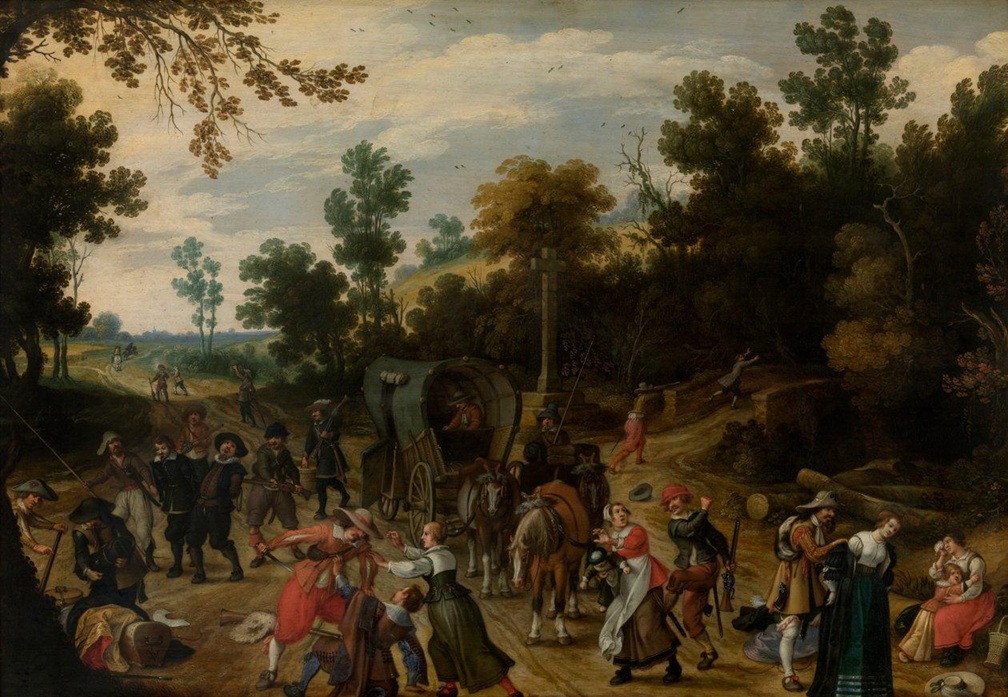
Mounted and foot soldiers crowd among fleeing civilians, wounded men and abandoned possessions. A village with a tall church tower, several farmhouses, large trees and a stretch of water draws the eye towards a city in the distance. The sky glows red from the fires that have broken out. The painting will be offered at the Düsseldorfer Auktionshaus on 28 November 2026, where it is attributed to an anonymous Flemish master of the seventeenth century.[1]
That gives us ample reason to examine the scene more closely. Both its composition and its painterly treatment of the military subject show a strong affinity with Sebastiaen Vrancx, the Antwerp artist who played a significant role in the development of military genre painting in the early seventeenth century.
A Flemish Painter of Wartime Violence
Sebastiaen Vrancx would become one of the first artists in the Southern Netherlands to devote himself almost entirely to depictions of military clashes, attacks on travellers and acts of plunder. His importance lies not so much in painting great battles as in the way he brought the military genre down to a smaller, more narrative scale.
In Vrancx’s paintings, soldiers are not merely participants in historical events. They are shown going about their everyday activities, marching, resting or engaged in violent confrontations with civilians. The attack on a group of travellers or the plundering of a village became one of his most frequently depicted subjects.
During Vrancx’s lifetime, the Netherlands were ravaged by the Eighty Years’ War. His choice of subject was therefore no coincidence. The population faced military occupation, pillaging, roaming troops and violence against civilians.
Carefully Orchestrated Chaos
The large wagon, positioned slightly to the left of centre, forms the visual focal point. It is loaded with household goods, barrels, chests and other belongings. Around this central element, a series of smaller incidents unfolds. Horses and riders overlap, while several figures partly disappear behind the wagon.
The scene gains depth through the careful overlapping of bodies, weapons and horses. To the right, the space opens up. The figures are spread across a wider area, making their movements easier to follow. Some attack, while others try to defend themselves or escape.
The foreground is dominated by the most immediate confrontations. The diagonals of swords, lances and raised arms connect the different groups of figures. Beyond them, the violence gradually recedes into smaller incidents within the landscape. On the left, the dark tree trunks provide a natural frame. On the right, a view opens onto a stretch of water and buildings farther away.
What is striking is the way the painter places different stages of the same violent episode side by side. Fighting is still underway, while elsewhere victims already lie on the ground and possessions are being carried away. As a result, the scene has no single, fixed dramatic centre. The viewer’s gaze moves from one incident to the next. One might even argue that this is a weakness of the painting: it is difficult to find a resting point for the eye.
The Landscape as a Setting for Violence
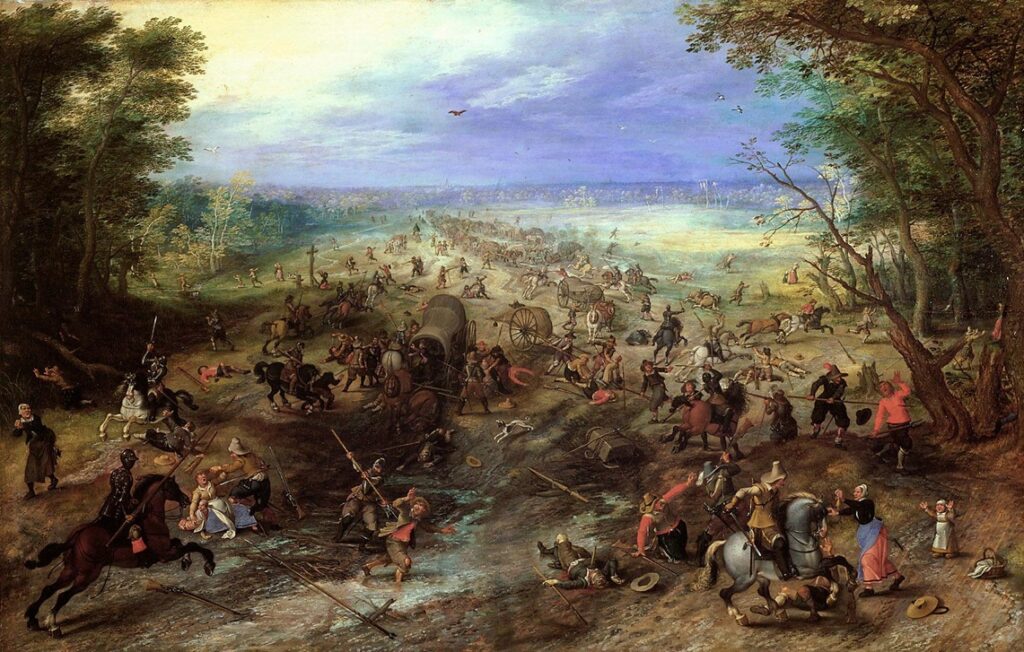
His work was influenced by the landscape painting of artists such as Jan Brueghel the Elder and Joos de Momper. He also collaborated with both artists, painting the figures in their landscapes. The various planes of depth, the decorative trees and the contrast between a detailed foreground and an atmospheric distance are features that reflect this tradition.
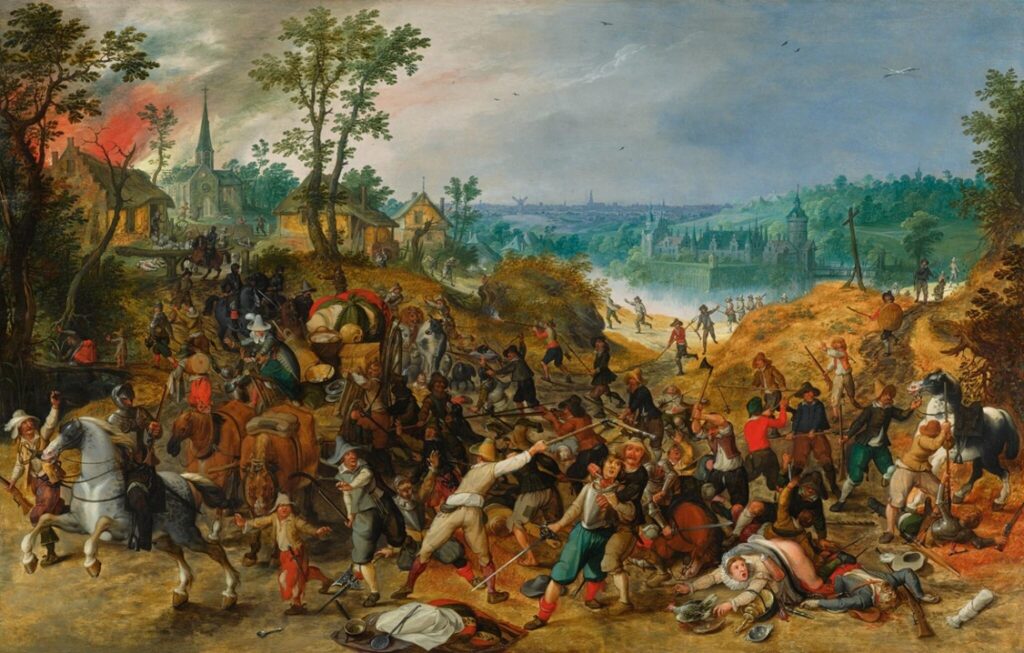
The most important clue to a possible attribution is the existence of a second painting showing an almost identical scene. This composition was auctioned as a work by Sebastiaen Vrancx under the title An extensive landscape with marauders hijacking wagon, a moated castle and the city of Antwerp beyond.[2]
Not only the overall arrangement but also the placement of the large wagon, the principal groups of figures, the trees, the church tower and the landscape background correspond. Even the dimensions are almost identical. One painting may be a copy after the other. But it is also possible that an artist painted his own successful composition more than once.
Within Vrancx’s oeuvre, there are several known instances in which a composition survives in more than one version, with multiple examples considered autograph.[3] The question, then, is whether the painterly execution of the present panel corresponds closely enough to his autograph works.
The Problem of Copies and Workshop Repetitions
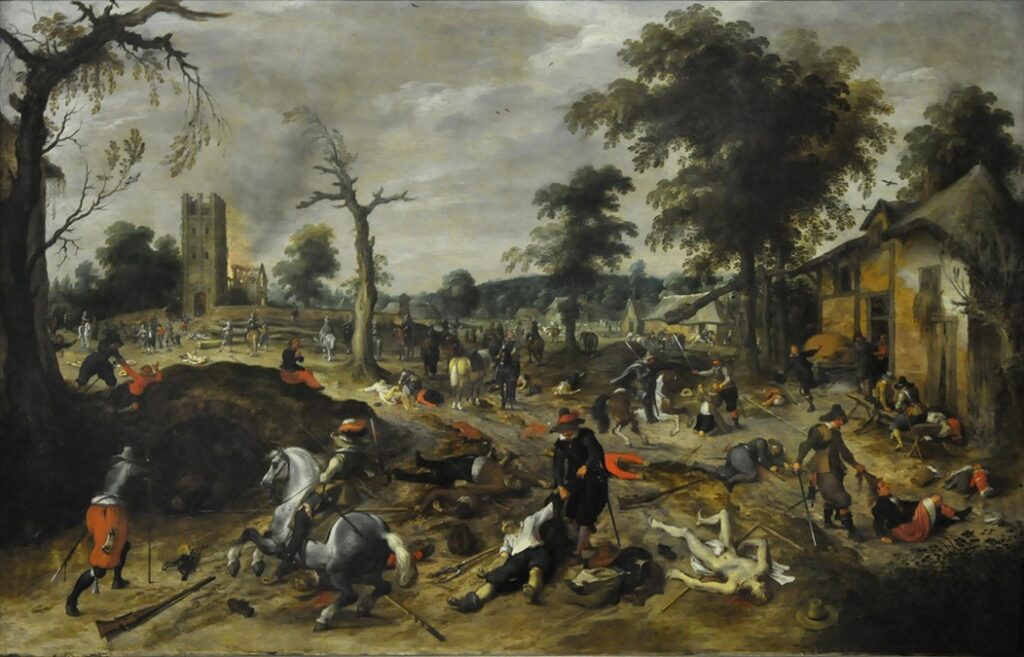
Vrancx’s work was influential, and his military scenes were widely imitated. Museum Boijmans Van Beuningen holds a seventeenth-century drawing entitled The Plundering of a Village, formerly attributed to Vrancx. The drawing is now considered anonymous and placed within his workshop or immediate circle.
The grid drawn across the sheet suggests that the composition was probably intended to be transferred to a painting. Several drawn and painted versions of this scene are known. Such compositions could be preserved and repeated within the workshop, resulting in multiple versions of the same subject.
A convincing Vrancx composition may, after all, have been executed by another painter. Moreover, certain figures and motifs were repeatedly reused within his oeuvre. David Vinckboons and artists in his circle also worked with similar compositions.
The distinction between an autograph version and a workshop repetition must therefore be sought primarily in the quality of execution. An artist who copies an existing composition can reproduce the figures, gestures and architecture accurately. The rhythm of the brushwork, the subtleties of the modelling and the handling of small details, however, are more difficult to reproduce.
What Does the Execution Tell Us?
The figures in the foreground are rendered with sharply defined contours. The horses, helmets and military clothing in particular are clearly distinguished from one another. The light-coloured horses on the left provide an important visual accent. Their bodies are modelled in relatively bright colours, while the darker figures behind them create a sense of depth.
The arrangement around the wagon is also interesting. The accumulation of objects, horses and people creates a dense ensemble, but the wagon wheels and variations in colour bring structure to this complex group. Farther to the right, the treatment of the figures becomes less consistent. Some faces and hands appear rather schematically rendered.
The trees and buildings on the left are relatively detailed, while the background on the right is treated with softer contours. The distant buildings partially dissolve into the atmosphere. This contrast between the relatively precise figures in the foreground and the looser treatment of the background is consistent with the manner of painting seen in several works by Vrancx. The combination of a crowded foreground, an expansive landscape, sharply outlined figures and the decorative treatment of trees and buildings thus accords with the artist’s mature style.
A Composition by Vrancx, but Painted by Whom?
The subject belongs to his characteristic repertoire, and the composition displays his typical combination of military figures and a carefully constructed landscape. The scene possesses the spatial complexity, varied figures and landscape treatment we would expect from Vrancx.
The panel therefore offers a valuable opportunity to re-examine a known composition and distinguish more precisely which features genuinely point to the master’s own hand. Not because Vrancx’s name can simply be attached to the panel, but because the painting offers enough evidence to make that possibility worthy of serious investigation.
Do you have a particular interest in this artist or subject?
Do you own a painting by this artist, have you come across a comparable work, or do you have information that might be relevant to further research? We welcome contact from collectors, art dealers and researchers with an interest in this artist or related subjects.
We regularly research paintings appearing on the art market, exploring questions of attribution, quality, provenance and previous sales. If you have a question about a particular work or would like to share information with us, please feel free to get in touch at info@antonello.art.
Notes and Sources
[1] Düsseldorfer Auktionshaus, Große Kunstauktion, Düsseldorf, 28 November 2026, lot 1763, Flämischer Meister 17. Jhdt., Marodierende Söldner, oil on panel, 51 × 80 cm.
[2] Sotheby’s, Old Masters Evening Sale, London, 4 December 2019, lot 20, Sebastiaen Vrancx, An extensive landscape with marauders hijacking wagon, a moated castle and the city of Antwerp beyond, oil on panel, 50.8 × 79.8 cm.
[3] Joost Vander Auwera, “Sebastiaen Vrancx’s Crossing of the Red Sea”, Art Bulletin of Victoria, no. 30, 1989, pp. 4-17.