A painting after Raphael’s Madonna of the Rose, initially catalogued as a 17th-century Dutch copy, is now being linked to the Italian Renaissance master’s own workshop. Auction house Boissinot & Tailliez in Poitiers has postponed the sale scheduled for 7 November 2026 until early 2027 to allow further research. The original estimate was €8,000-12,000. Behind this change lies an intriguing art-historical question.
A painting offered at a regional French auction with an estimate of €8,000-12,000 would not normally attract international attention as a matter of course. But when that same painting is reclassified before the sale, from a 17th-century Dutch copy to an early 16th-century Italian work from Raphael’s workshop, it is a different matter.[1]
That is what we are seeing with this work, originally announced as lot 120 in a sale scheduled for 7 November 2026. Painted in oil on a cradled panel measuring 104 × 82 cm, it follows the celebrated composition by Raffaello Sanzio (1483-1520). The original is in the Museo del Prado in Madrid.
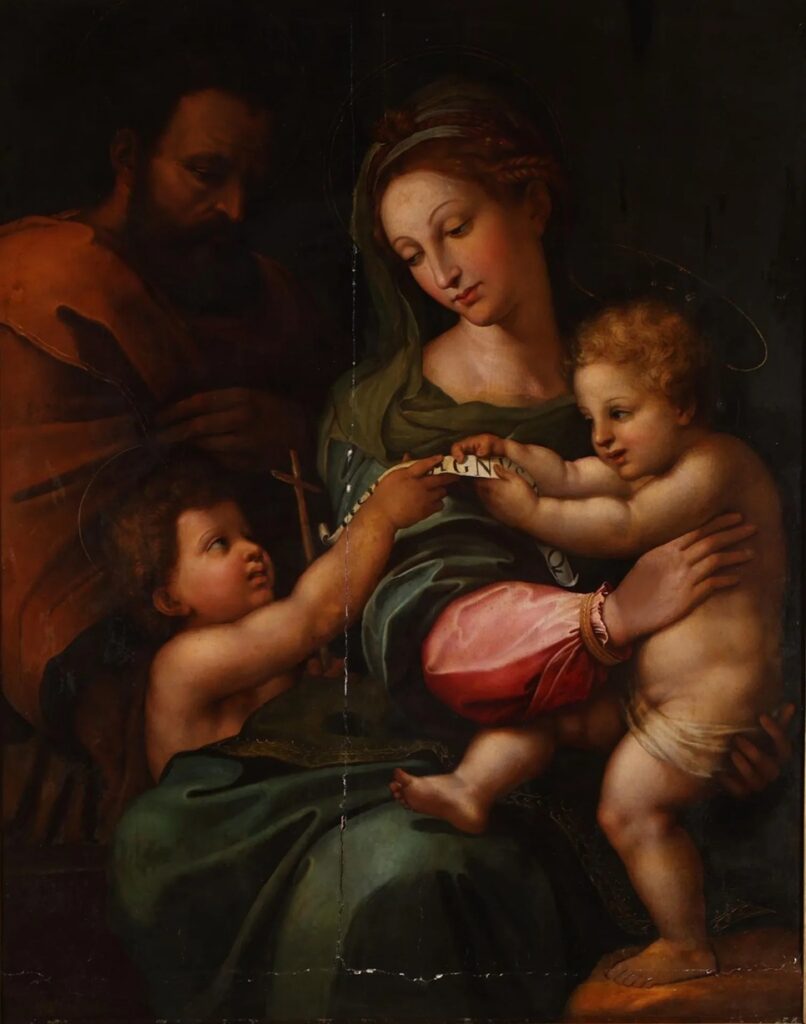
The painting was initially described as a 17th-century work of the Dutch School, after Raphael. It was then described as being from Raphael’s circle, and subsequently as Italian School, early 16th century, workshop of Raphael and after his composition. A Dutch copyist reproducing a famous Renaissance painting around 1650 was working at a considerable historical remove from the original artist. A painting genuinely produced in Raphael’s workshop, by contrast, belongs to the immediate working environment of one of the most important artists of the Italian Renaissance.
The French auction has now given way to a rescheduled sale announced for early 2027. According to the revised catalogue, the sale has been postponed for further research. The postponement is not evidence that a new Raphael has been discovered. It does suggest, however, that technical examinations are likely to be carried out and specialists consulted. For us, the shift in date and attribution is reason enough to take a closer look.
A familiar composition, but no straightforward copy
The painting offered for sale shows the Virgin Mary with the Christ Child on her lap. To the right stands the young Saint John the Baptist, offering a scroll inscribed with the words Agnus Dei. To the left, largely enveloped in darkness, is Saint Joseph. Joseph occupies a curious position. He is physically present, yet seems almost to withdraw from the scene. His dark figure counterbalances the lighter faces and bodies of Mary and the children.
The painter has placed the figures close together, leaving scarcely any space between them. Mary’s green garment forms a broad, unifying area of colour. Against it stand the warm flesh tones, the pink sleeve and the dark background.
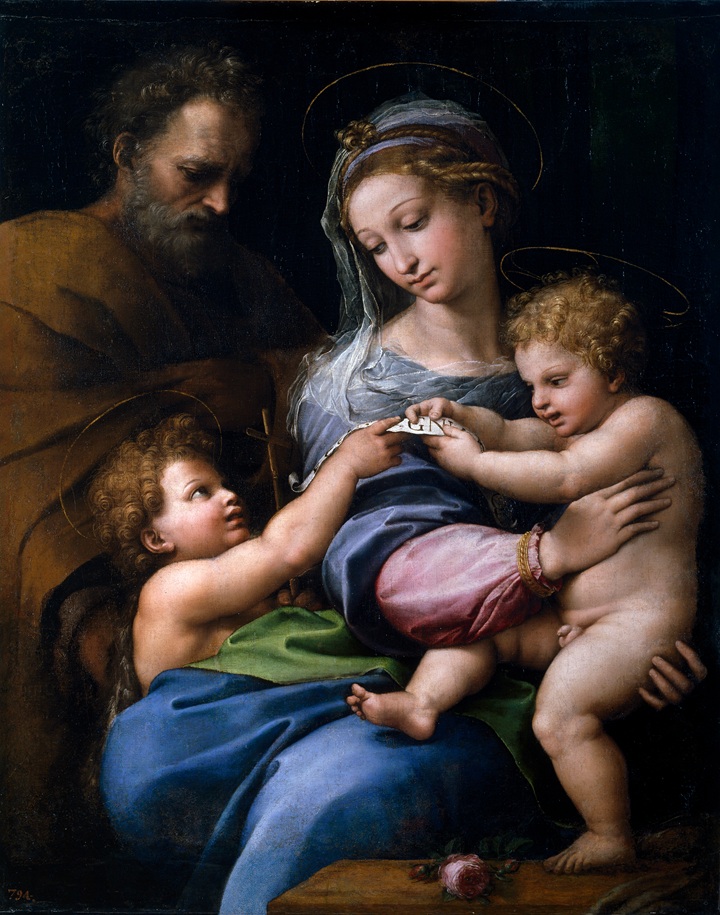
Mary’s face is carefully modelled, but its outlines are more strongly defined than in the original. The children’s faces are fuller and, in certain passages, less subtly executed. Joseph is treated much more sketchily in the shadows. That need not be entirely the work of the original painter. Old retouching and areas of paint loss can make a reliable assessment difficult. Several distracting lines run across the surface, including a conspicuous vertical seam through the middle of the composition.
The rose that was not originally there
The prototype is currently catalogued by the Prado as a work by Raphael himself, probably painted around 1517. Originally executed on panel, it was probably transferred to canvas in the first half of the 19th century, at which point its dimensions were also altered.
Furthermore, the lower section containing the rose that gives the painting its familiar name is probably a later addition.[2] This complicates the history of the various versions. The rose is absent from the painting now offered for sale. That might suggest that its painter knew an early state of Raphael’s composition, before the image was extended in the 19th century.
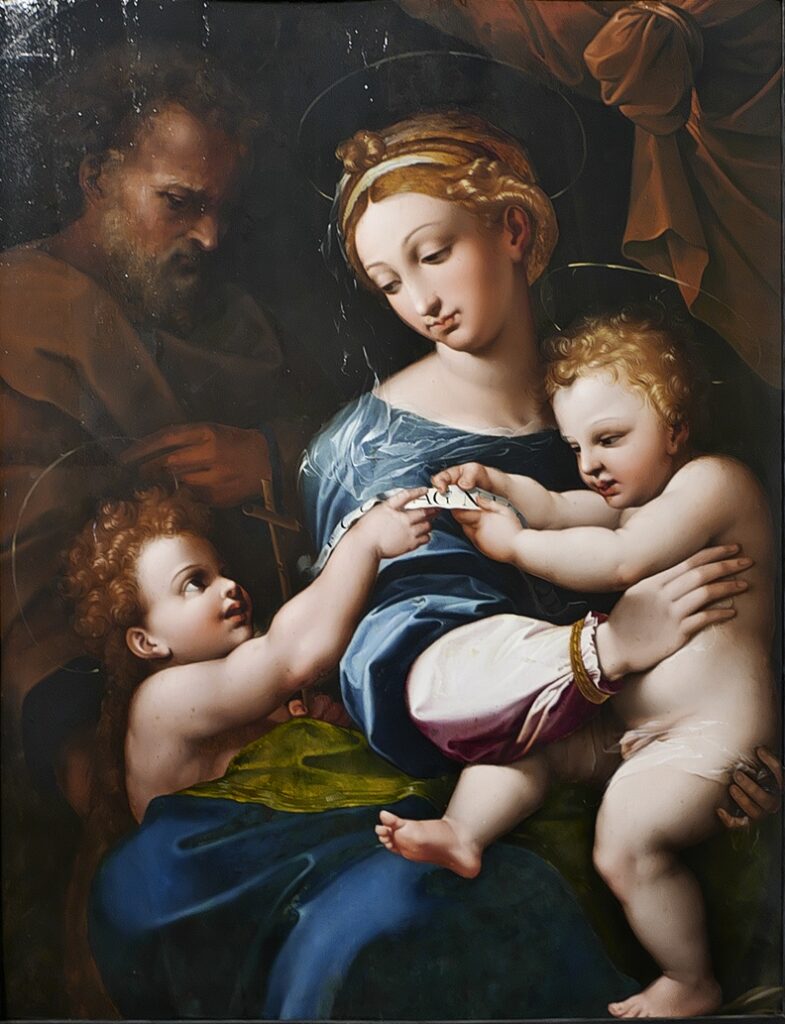
The Prado notes that copies of the composition were already circulating in the 16th century. The 1589 will of the Florentine painter Benedetto Rabuyate, who worked in Valladolid, mentions no fewer than six examples. Later versions, too, could therefore preserve an earlier state of the composition.
A particularly relevant comparison can be found at the Museo Nacional de Escultura in Valladolid. The museum holds an anonymous Sagrada Familia con San Juanito, also known as Virgen de la Rosa. Painted in oil on panel, it measures 101 × 82 cm and is dated to 1576-1600. The museum explicitly catalogues it as a copy after Raphael.[3]
The absence of the rose is not convincing evidence of a direct connection with Raphael’s workshop. A 16th-century copy could reproduce the same composition without ever having been made in the master’s immediate circle.
Raphael and the work of his studio
During Raphael’s final years in Rome, his workshop was among the most important artistic studios in Europe. His pupils helped execute and disseminate his designs, and continued certain projects after his death in 1520.
The boundaries between works painted by the master himself, workshop production and later imitation are therefore not always easy to draw. Even the original has a history of differing assessments. The Prado maintains the attribution to Raphael, although some art historians suspect the involvement of assistants in certain passages.
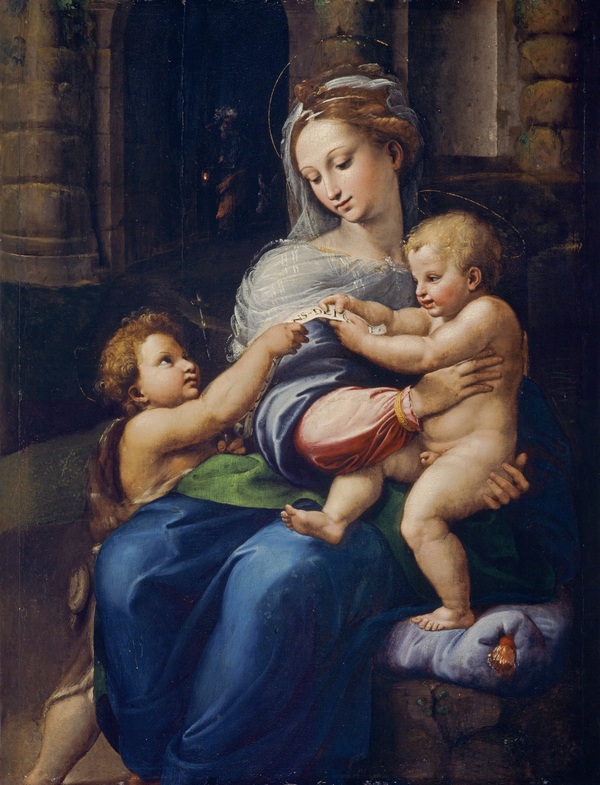
Another important painting is in Edinburgh. The National Galleries of Scotland holds Giulio Romano’s The Holy Family with the Infant Saint John the Baptist. In it, Raphael’s pupil took the same group of figures as his starting point, but placed them in a different setting, with an architectural framework and a landscape. The figures refer directly to the prototype, while their surroundings acquire a character of their own.[4]
This comparison shows how the composition could already be reused within Raphael’s immediate circle. That is different from the practice of a later copyist who seeks to reproduce an existing painting as faithfully as possible. According to the auction catalogue, the painting now offered for sale is also said to have formerly belonged to the collection of a Prince de Rohan. It was subsequently reportedly auctioned by Tajan on 13 June 1978.
What does the market tell us about comparable works?
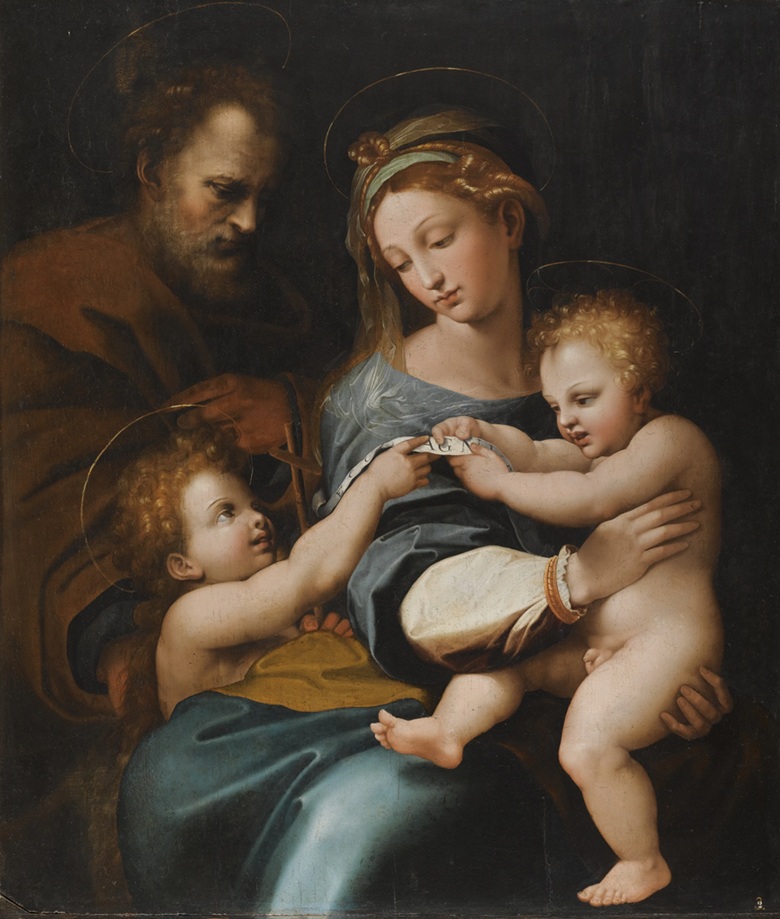
The original estimate of €8,000-12,000 takes on a different significance when we look at paintings actually offered as works from Raphael’s workshop. A particularly relevant comparison appeared at Sotheby’s in London on 8 December 2011.
Another version of the same composition was auctioned on that occasion. Sotheby’s catalogued it as Workshop of Raffaello Sanzio, called Raphael. The estimate was £40,000-60,000. The painting realised approximately £100,000 including buyer’s premium.[5] It had undergone restoration and suffered paint loss, but important parts of the image were relatively well preserved. More importantly, the London painting was already attributed to Raphael’s workshop when it was offered. In the case of the painting now under discussion, that very classification is the subject of further investigation.
In July 2013, Sotheby’s offered a Madonna and Child with the Infant Saint John the Baptist as Circle of Raffaello Sanzio, with an estimate of £30,000-50,000. The work had a provenance tracing back to the collection of the Duchess of Berry and had already appeared at a Paris auction in 1865. It was, moreover, an independent composition in Raphael’s style, not a close copy of the Madonna of the Rose.[6]
Another panel, The Madonna and Child with the Infant Saint John in a Landscape, was offered at Sotheby’s in December 2016, also as Circle of Raphael, with an estimate of £40,000-60,000. That painting had an extensive 19th-century collecting history and had been exhibited at the Royal Academy in London in 1885. Its attribution had changed several times over the centuries.[7]
These examples nevertheless show how strongly a painting’s market position can depend on the precise attribution, the quality of its execution and the reliability of its historical documentation. A work after Raphael may have been made centuries after his death. A painting from his circle is generally understood to be closer to his artistic sphere of influence.
What might further research reveal?
The decision to postpone the sale naturally raises the question of what the specialists still intend to investigate, and what they may be able to establish. An analysis of the wood species, panel construction and any old joins could help determine whether the support is consistent with the proposed date and geographical origin.
Infrared reflectography can reveal preparatory lines concealed beneath the paint. Raphael and artists in his circle used cartoons, among other methods, to transfer compositions. One technique was spolvero, in which outlines were transferred using pricked holes and powder.
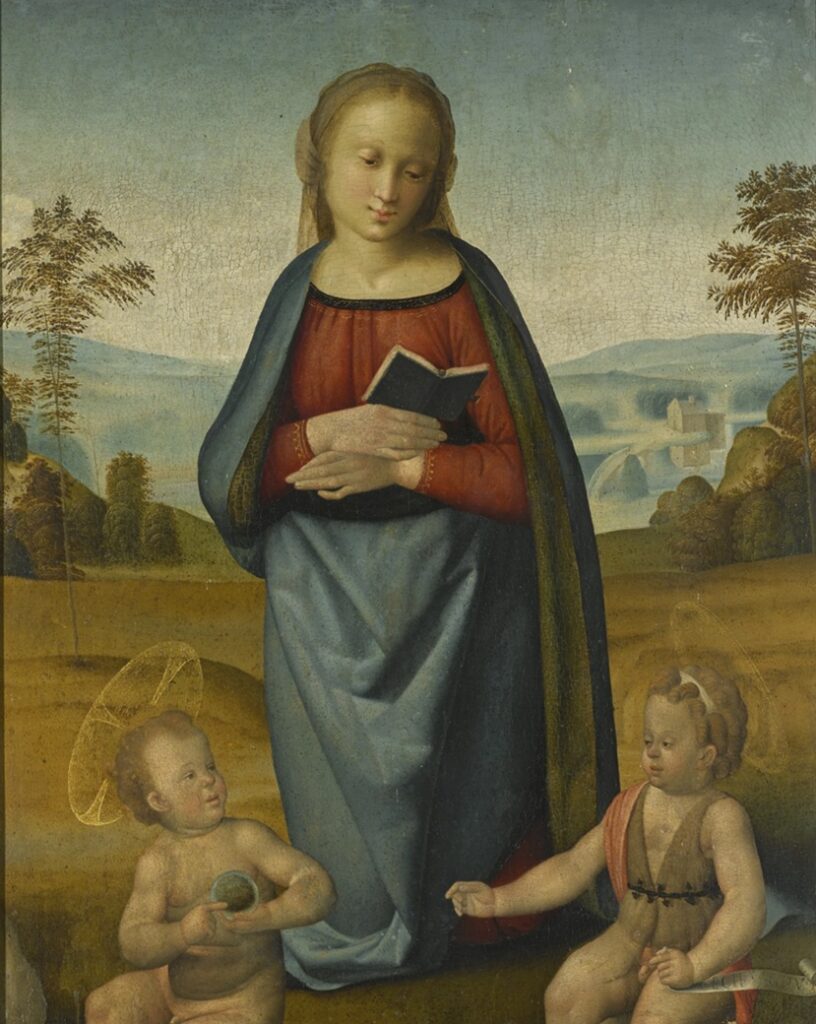
An underdrawing closely matching known 16th-century workshop practices could provide valuable information. But copyists, too, could employ techniques closely resembling those used in the original Renaissance workshops. The presence of a transferred design does not, therefore, automatically prove that a painting was made in Raphael’s workshop. X-radiography can, in turn, reveal information about the painting’s structure, the construction of its support and any alterations concealed beneath the visible paint layer.
Pigment analysis can help establish whether the materials used are consistent with an early 16th-century date. A pigment that only became available much later could cast doubt on an early date. Conversely, the presence of pigments used in Raphael’s lifetime tells us very little about authorship. Such materials were available to many artists and sometimes remained in use for centuries.
But any conclusion that a painting came directly from Raphael’s workshop ultimately requires technical, stylistic and historical evidence to be considered together. Is this a carefully executed copy? Are there changes beneath the surface that point to an independent interpretation? And how do the paint layers and panel construction compare with those of known early versions?
Why the postponement deserves attention
Our interest lies less in the possibility that the painting might achieve a much higher price. More interesting is what a careful comparison with the known body of versions after Raphael’s Madonna of the Rose might reveal. Its near-original dimensions, the absence of the later-added rose and its possible provenance offer several avenues for investigation.
The absence of the rose is not rare. And the most relevant market comparison, the workshop panel sold by Sotheby’s in 2011, shows just how much a sound attribution can matter. Further research could establish a more precise place for the panel within the history of Raphael’s workshop and the dissemination of his compositions. The question, then, is whether the new attribution to Raphael’s workshop can ultimately be sustained by sufficiently convincing evidence.
Do you have a particular interest in this artist or subject?
Do you own a painting by this artist, have you come across a comparable work, or do you have information that might be relevant to further research? We welcome contact from collectors, art dealers and researchers with an interest in this artist or related subjects.
We regularly research paintings appearing on the art market, exploring questions of attribution, quality, provenance and previous sales. If you have a question about a particular work or would like to share information with us, please feel free to get in touch at info@antonello.art.
Notes and sources
[1] Hôtel des Ventes de Poitiers Boissinot & Tailliez, Bel ameublement & objets d’art, originally scheduled for 7 November 2026, lot 120, Vierge à la rose.
[2] Museo Nacional del Prado, “The Holy Family with the Infant Saint John the Baptist, or Madonna of the Rose”, Raffaello Sanzio, c. 1517.
[3] Museo Nacional de Escultura, Valladolid, Sagrada Familia con San Juanito; Virgen de la Rosa, anonymous, 1576-1600, oil on panel, 101 × 82 cm.
[4] National Galleries of Scotland, Giulio Romano, The Holy Family with the Infant Saint John the Baptist, c. 1518-1520, oil and gold on panel, 82.5 × 63.2 cm, inventory no. NG 2398.
[5] Sotheby’s, Old Master & British Paintings Day Sale, London, 8 December 2011, lot 107, Workshop of Raffaello Sanzio, Holy Family with the Infant St. John the Baptist, or Madonna della Rosa. Oil on panel, 105.5 × 89.5 cm, estimate £40,000-60,000.
[6] Sotheby’s, Old Master & British Paintings Day Sale, London, 4 July 2013, sale L13034, lot 210, Circle of Raffaello Sanzio, Madonna and Child with the Infant Saint John the Baptist. Estimate £30,000-50,000.
[7] Sotheby’s, Old Masters Evening Sale, London, December 2016, lot 4, Circle of Raffaello Sanzio, The Madonna and Child with the Infant Saint John in a Landscape. Estimate £40,000-60,000.