On 11 November 2026, STAIR auction house in Hudson, New York, will offer two portraits of Alexander van der Capellen and his wife, Emilia van Zuylen van Nyevelt, attributed in the auction catalogue to Jan Anthonisz. van Ravesteyn. With individual estimates of $15,000-25,000, the paintings deserve attention. Not only for their quality, but also for an intriguing history of portraiture dating back to the years shortly after the couple’s marriage.
[Update 11-11-2026: The lots have been sold for $28,000 each.]
At first glance, they are appealing examples of Dutch portraiture around 1630. On closer examination, we find their history even more interesting. The sitters are not simply unidentified members of the wealthy bourgeoisie. They are Alexander van der Capellen, a nobleman from Gelderland who played a role in the political history of the Dutch Republic, and his wife, Emilia van Zuylen van Nyevelt.
Jan Anthonisz. van Ravesteyn (1572-1657) was among the leading portrait painters in The Hague during the first half of the seventeenth century. His clientele included courtiers, military officers, administrators and members of prominent families. How should we value an identifiable, historically connected pair of portraits by Van Ravesteyn when comparable individual portraits sell for relatively modest sums, while well-documented pendants can sometimes command very different prices?
Two Portraits, Two Different Approaches
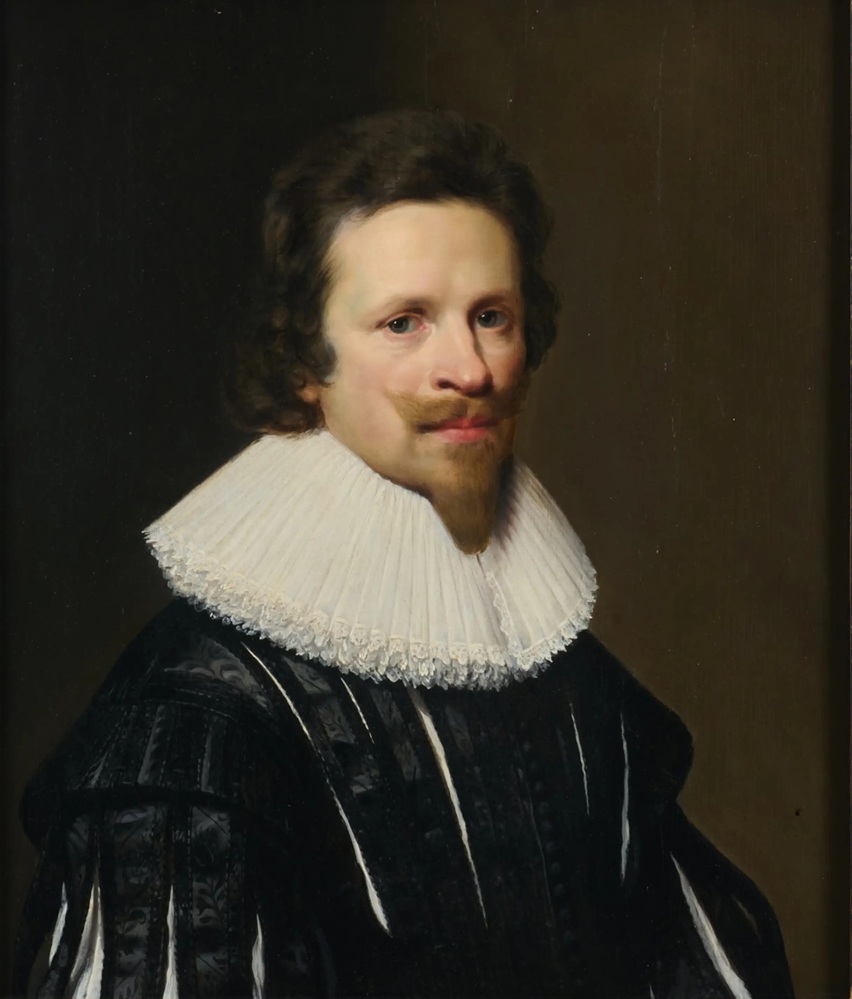
Alexander van der Capellen is depicted with considerable restraint. His black clothing occupies most of the composition, interrupted only here and there by reflections of light on the fabric. His face emerges from the dark background, framed by a broad, finely pleated white ruff.
The slightly asymmetrical mouth, narrow moustache and gentle modelling around the eyes give the face a distinctive character. He looks directly at the viewer, without theatrical gestures or attributes intended to proclaim his status.
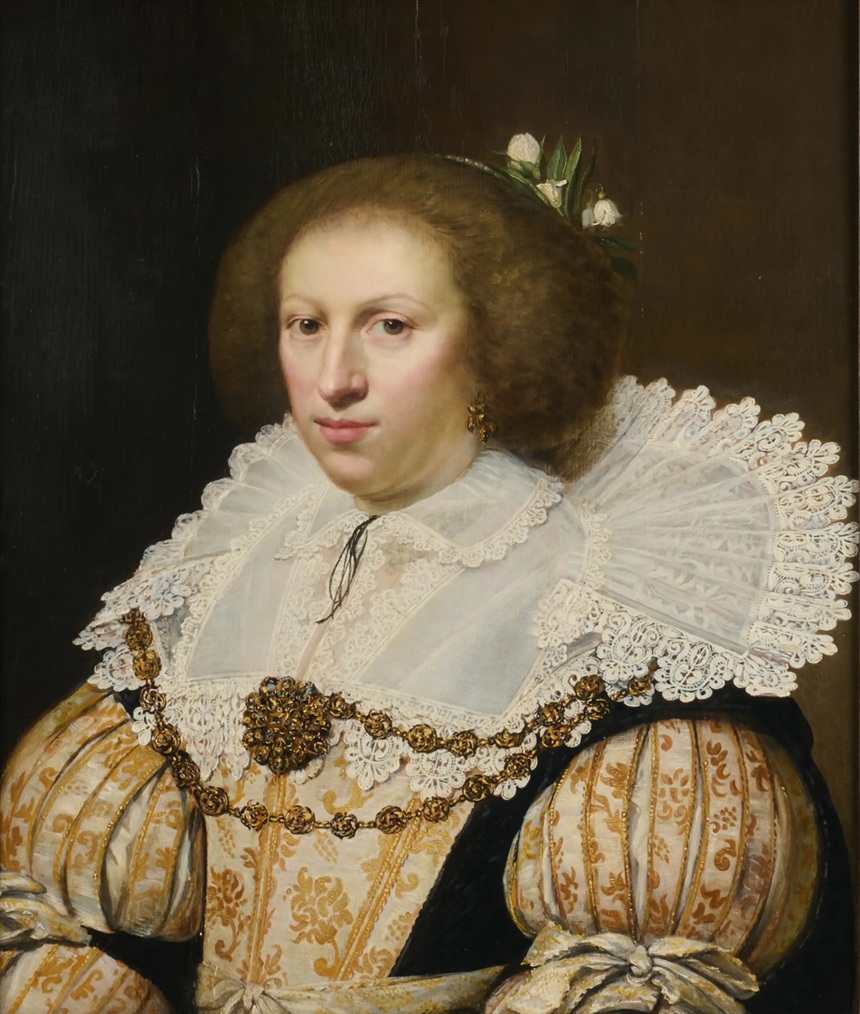
Emilia’s portrait is far more elaborate. The painter devoted considerably more attention to her costume. Her pale gown is decorated with gold-coloured patterns. The voluminous sleeves are interrupted by decorative bands and bows, while a heavy gold chain with a large ornament hangs across her bodice.
The most striking feature is the lace collar. The face is modelled with relatively subtle transitions, giving it a gentle quality. The two paintings are similar in size. Their backgrounds, the scale of the faces and the overall arrangements also support the view that the portraits were intended as pendants.
Alexander van der Capellen and the Nobility of Gelderland
The identity of the sitters gives these paintings a significance that anonymous portraits lack. Alexander van der Capellen belonged to an influential noble family from Gelderland. He was lord of Boedelhof and Mervelt, among other estates, and a member of the nobility of the Quarter of Zutphen. He also held administrative offices and was involved in the national politics of the Dutch Republic.
Van der Capellen moved in circles where noble birth, public office and personal connections were closely intertwined. His marriage to Emilia van Zuylen van Nyevelt in 1626 was entirely in keeping with that world. Emilia came from an old noble family in Utrecht and brought the lordship of Aartsbergen into the family, among other possessions.
The portraits are dated to around 1628. If that dating is correct, they would have been painted approximately two years after the marriage. This provides a plausible context for commissioning pendant portraits. A recent marriage could prompt the creation of a pair of portraits to represent both families and their social standing. The paintings might have been intended for a town house, a country estate or a wider family collection.
The Same Couple Was Also Painted by Pieter Soutman
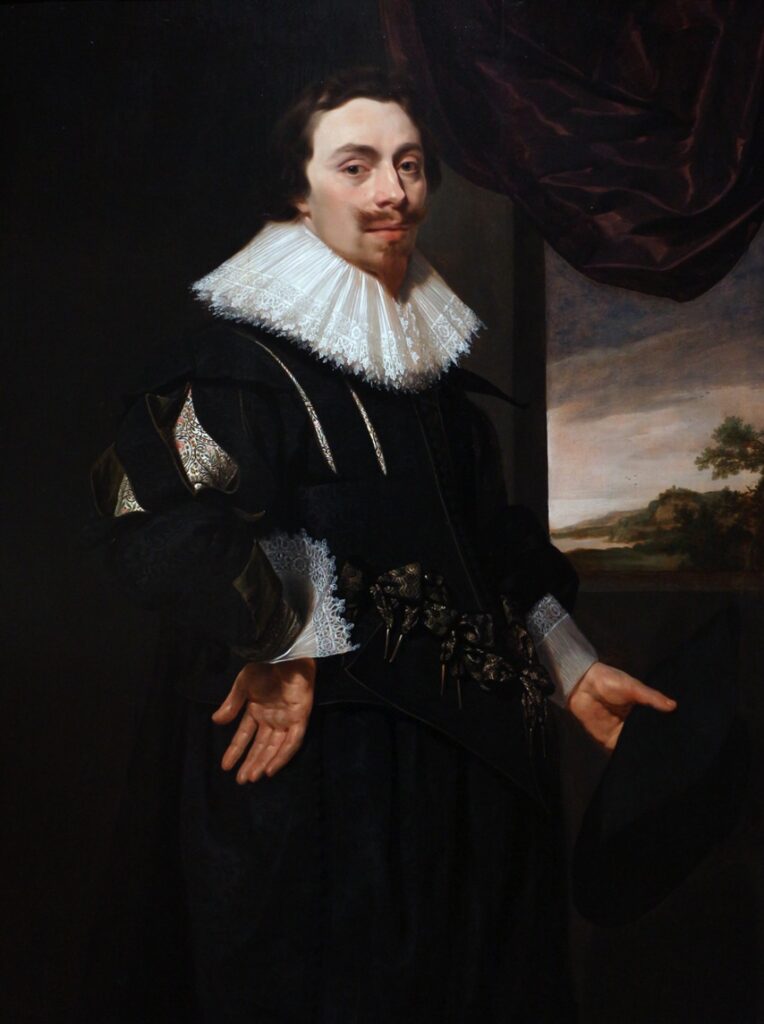
Alexander and Emilia had already been portrayed by another painter in 1626. Pieter Claesz. Soutman, who had worked in Antwerp in the circle of Peter Paul Rubens, painted a portrait of Alexander van der Capellen that year, along with a companion portrait of Emilia. The portrait of Alexander belongs to the collection of the Milwaukee Art Museum.
The portrait of Emilia is described as a promised future gift to the same museum. If the two paintings now being offered were indeed made around 1628, Alexander and Emilia were portrayed by at least two different artists within just a few years. This is not an everyday occurrence.
This suggests that portraiture played a significant role in the couple’s social representation. It also offers a rare opportunity to compare two different artistic interpretations of the same sitters. Did the couple want portraits for different residences? Were the paintings intended for separate branches of the family? Or were they simply two commissions within an aristocratic milieu in which portraiture was an established form of representation?
Possibly Auctioned Together as Early as 1997
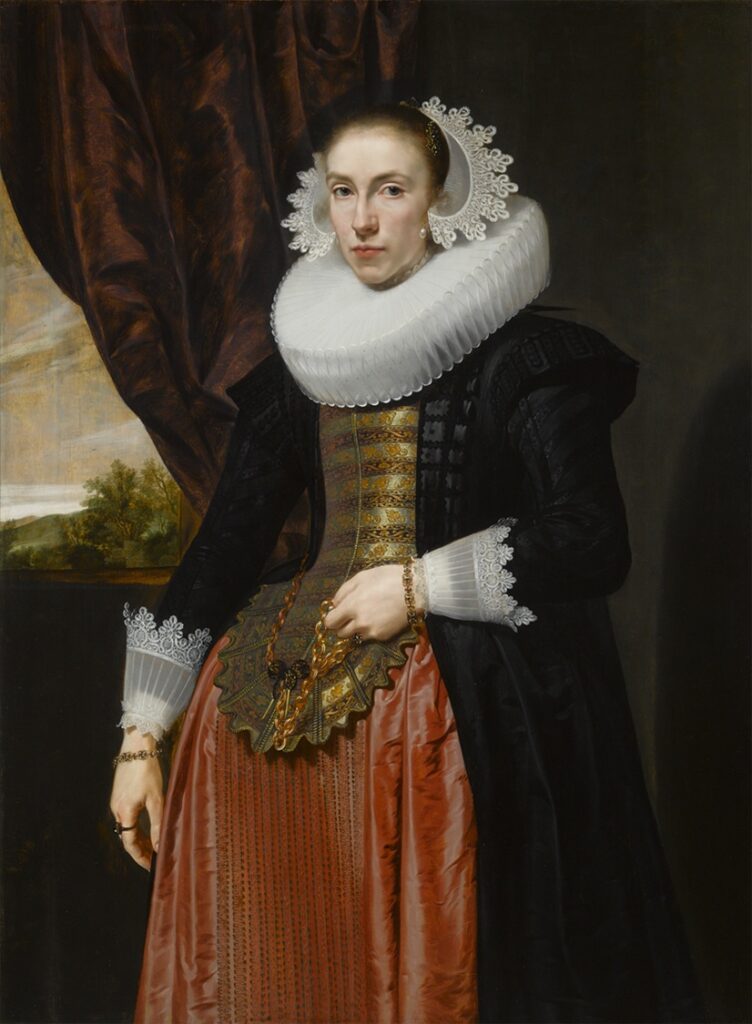
Alongside this art-historical background, the paintings’ market history deserves attention. On 3 December 1997, Sotheby’s in London offered a work by Jan Anthonisz. van Ravesteyn as lot 151, under the title Alexander van der Capellen, Heer van de Boedelhog; his Wife, with an estimate of £30,000-50,000.[1]
The entry shows how the two paintings were positioned on the market at the time: as a single, coherent lot. The auction house handling the current sale has catalogued the paintings separately. Their combined estimates amount to $30,000-50,000.
How Do the Estimates Compare with the Market?
The market for Van Ravesteyn cannot be reduced to a single price level. Some portraits fetch less than €20,000, while others achieve considerably higher sums. Differences in size, quality, date, provenance and certainty of attribution have a substantial impact.
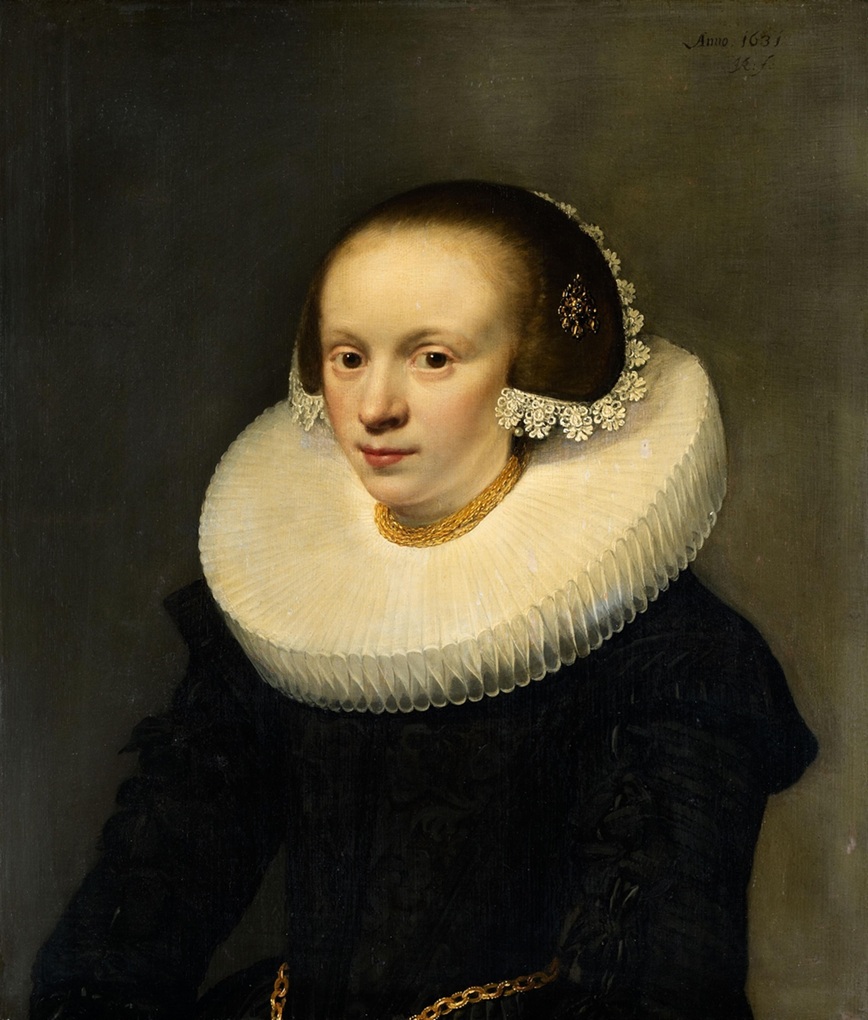
For the two panels offered here, the most useful starting point is individual portraits of similar size. One relevant example is Portrait of a Lady of the De Pinto Family, offered by Lempertz in Cologne on 20 May 2023. The painting, an oil on panel from 1641 measuring 69 × 56 cm, carried an estimate of €12,000-14,000 and realised €15,000 including buyer’s premium.[2]
Its dimensions are almost identical to those of Emilia’s portrait. The painterly approach is also comparable: a relatively straightforward composition in which the face and the treatment of clothing and jewellery take centre stage. Notably, the De Pinto portrait also had a documented provenance and exhibition history. That documentation did not translate into an exceptionally high price.
A second comparison is Portrait of a Young Lady, auctioned by Lempertz on 19 November 2016. This signed and dated panel of 1631 measures 63 × 58 cm, almost the same size as Emilia’s portrait. Estimated at €22,000-28,000, it realised €35,000 including buyer’s premium.[3]
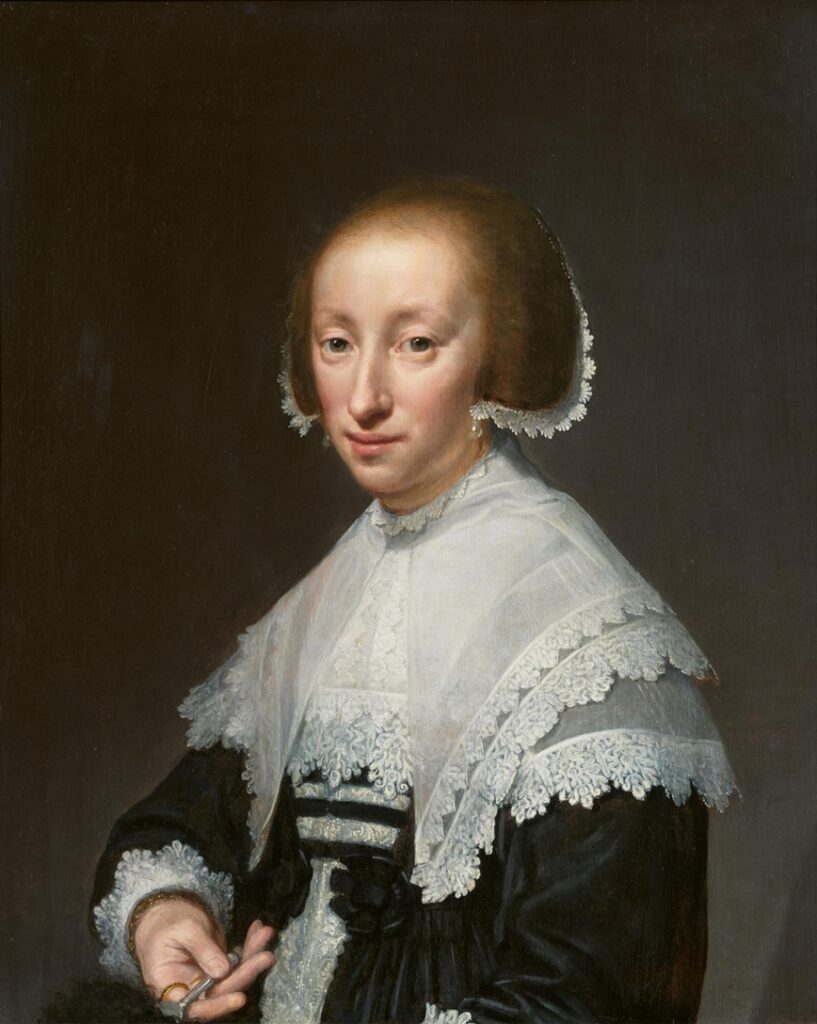
Unlike the sitters in the present pair, the young woman could not be identified with certainty. Its provenance, however, was well documented, including an earlier appearance in the collection of Viscount Cowdray. The sale confirms that attractive, well-executed female portraits by Van Ravesteyn of this size can achieve prices above €30,000.
In Emilia’s case, the richly detailed costume and the sitter’s identification may attract additional interest. For Alexander, the appeal probably lies more strongly in his historical identity and the painting’s status as a pendant.
A Pendant Pair Is Not Automatically Worth Twice as Much
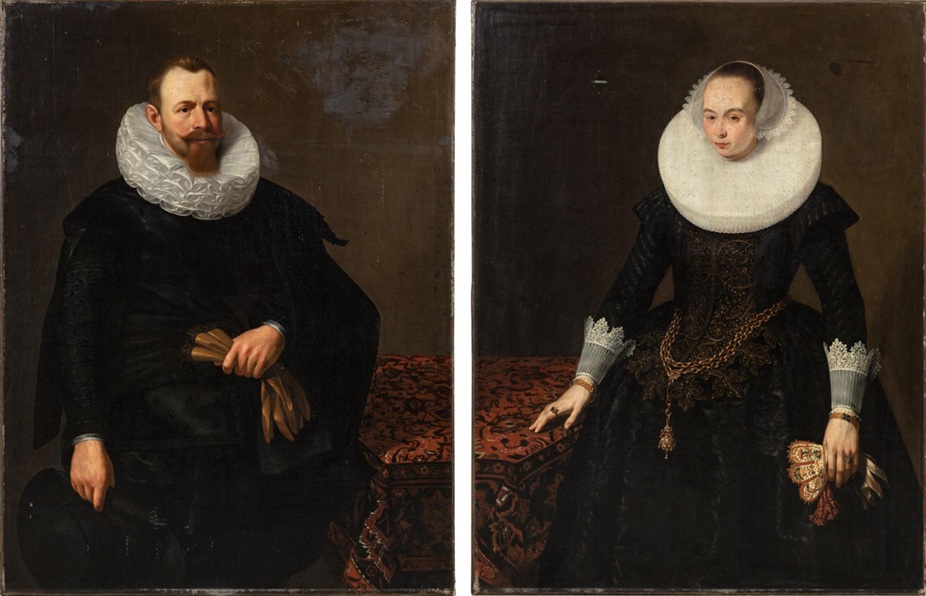
The question becomes more complicated when we assess the paintings as a pair. On 22 June 2006, Christie’s in Paris offered two portraits signed and dated 1632 by Van Ravesteyn, under the title Portrait de dame; et Portrait d’homme.
Each panel measures 68.2 × 58.5 cm, and the pair had a combined estimate of €30,000-50,000.[4] These were two portraits by the same artist, of almost identical size and in the same medium, with a date close to the presumed period of execution of the panels now being offered.
Another pair, Portraits of a Man and of a Lady, appeared at Sotheby’s in Paris on 13 June 2023. These paintings were significantly larger, measuring approximately 140 × 106 cm. Sotheby’s nevertheless estimated the pair at just €15,000-20,000.[5] A larger pair of portraits is therefore not necessarily worth more than two smaller, appealing panels.
At the upper end of the market is an even more striking example. In April 2007, Christie’s in New York offered two large pendant portraits by Van Ravesteyn from the collection of Jacques Goudstikker. The paintings had a particularly significant provenance and restitution history. Estimated at $100,000-150,000, the pair realised $700,000.[6]
The result illustrates just how wide the price gap can be between an ordinary portrait and a pendant pair with an exceptional documented history. In the case of the present paintings, the significance of the pair rests primarily on the sitters’ identities and their history, rather than on any comparably distinguished provenance that can currently be established.
The Attribution Deserves Further Investigation
A painting accepted as an entirely autograph work by an artist generally occupies a different position in the market from one whose attribution is less certain. For example, the Mauritshuis catalogues a Portrait of an Officer from 1611 as a work by Jan Anthonisz. van Ravesteyn and his workshop.[7]
Within his oeuvre, the distinction between the artist’s own hand and workshop participation is therefore more than a theoretical matter. It also makes clear that the quality of the paintings depicted here, however appealing, is not the only factor on which a serious buyer will base their judgement.
What Makes These Two Paintings Worth a Closer Look?
The immediate appeal of the portraits is visual. Alexander has a direct, convincing expression. Emilia’s portrait is more elaborately executed, particularly in the costume and lace collar, showing an ambition that sets it apart from a routine portrait.
Will Alexander and Emilia be judged as two individual portraits within Van Ravesteyn’s usual price range? Or will their connection as a pair, the identities of the sitters and the remarkable history of the family’s portraits carry additional weight?
The two paintings are being offered separately, yet their art-historical significance seems to rest to a considerable extent on the fact that they belong together. The quality of Emilia’s portrait, the directness of Alexander’s likeness and the historical documentation all deserve serious attention. Whether that combination will also be rewarded in the saleroom is another question.
Do you have a particular interest in this artist or subject?
Do you own a painting by this artist, have you come across a comparable work, or do you have information that might be relevant to further research? We welcome contact from collectors, art dealers and researchers with an interest in this artist or related subjects.
We regularly research paintings appearing on the art market, exploring questions of attribution, quality, provenance and previous sales. If you have a question about a particular work or would like to share information with us, please feel free to get in touch at info@antonello.art.
Notes and Sources
[1] Sotheby’s, Old Master Paintings, London, 3 December 1997, lot 151, Jan Anthonisz. van Ravesteyn, Alexander van der Capellen, Heer van de Boedelhog; his Wife. Estimate £30,000-50,000.
[2] Lempertz, Old Masters, Cologne, 20 May 2023, sale 1221, lot 2043, Jan Anthonisz. van Ravesteyn, Portrait of a Lady of the De Pinto Family, oil on panel, 69 × 56 cm, estimate €12,000-14,000, result €15,120 including buyer’s premium.
[3] Lempertz, Old Master Paintings and Drawings, Sculpture, Cologne, 19 November 2016, sale 1076, lot 1039, Jan Anthonisz. van Ravesteyn, Portrait of a Young Lady, 1631, oil on panel, 63 × 58 cm, estimate €22,000-28,000, result €34,720 including buyer’s premium.
[4] Christie’s, Tableaux Anciens et du XIXe Siècle, Paris, 22 June 2006, lot 20, Jan Anthonisz. van Ravesteyn, Portrait de dame; et Portrait d’homme, two signed and dated portraits from 1632, oil on panel, each 68.2 × 58.5 cm. Estimate €30,000-50,000.
[5] Sotheby’s, Tableaux et Dessins 1300-1900 – Session I, Paris, 13 June 2023, lot 15, Jan Anthonisz. van Ravesteyn, Portraits of a Man and of a Lady, oil on canvas, two paintings, 140 × 106 and 137 × 106 cm. Estimate €15,000-20,000 for the pair.
[6] Christie’s, New York, 19 April 2007, lot 33, Jan Anthonisz. van Ravesteyn, two large pendant portraits formerly in the Goudstikker collection. Estimate $100,000-150,000, result $712,000.
[7] Mauritshuis, The Hague, Portrait of an Officer, 1611, inventory no. 416, attributed to Jan Anthonisz. van Ravesteyn and his workshop, oil on canvas, 114.6 × 96.5 cm.