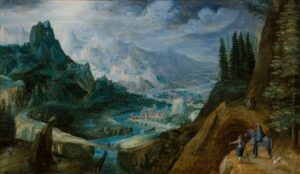
In April 2025, this winter landscape appeared at auction in Basel as an anonymous seventeenth-century Dutch work, estimated at approximately €8,500–12,800. Eighteen months later, Koller is offering the same panel as a work by Christoffel van den Berghe, now with an estimate of around €130,000–190,000.
[Update 18-09-2026: the lot was sold for CHF 110.000 / €115,000.]
On 2 April 2025, an appealing but anonymous winter scene came under the hammer at Artcurial Beurret Bailly Widmer in Basel. The cataloguing was cautious: Dutch School, 17th century. The panel, measuring approximately 35 by 60 centimetres, carried an estimate equivalent to around €8,500–12,800 ($10,000–15,000) and sold for 50.000 euros.[1] On 18 September, the same painting will return to the market. This time it is being offered by Koller in Zurich under a much more precise art-historical name: Christoffel van den Berghe. The estimate is approximately €130,000–190,000 ($150,000–225,000).[2]
That alone would be enough to make this an intriguing auction story. More interesting, however, is the question of what happened to the painting in the intervening period. This is not simply an unknown work to which an attractive artist’s name has suddenly been attached. The panel has a documented history stretching back more than a century.

A winter landscape that convinces even without a name
Even before the question of attribution arises, the painting itself explains why it attracts attention. The artist builds the composition from a busy, dark foreground at left towards an almost unobstructed winter landscape in the distance. Along the bank are snow-covered wooden houses, bare trees, barrels and boats. Figures are engaged in everyday activities. Beyond them rises a fortified townscape.
From there, the landscape opens out. The frozen water stretches almost to the horizon. Skaters, walkers and players of kolf become progressively smaller as they recede, until they almost dissolve into the silvery-grey atmosphere. The vast winter sky occupies more than half the panel.
In the foreground, a horse-drawn sleigh provides the principal accent of colour. Red, yellow, green and black stand out sharply against the subdued tones of snow, ice and sky. The elegantly dressed passengers and figures on the ice also contrast with the more everyday activity taking place along the bank. This difference between labour and leisure gives the scene both space and social variety. This is not an empty winter setting to which a few figures have simply been added. Something is happening throughout the composition.
The painting is also convincingly organised on a compositional level. The dense mass at left, houses, trees, boats and the town wall, is balanced by the broad open space to the right. The trees function almost like theatrical wings, directing the eye out onto the ice. The sleigh then carries that movement deeper into the scene. At around 35 × 60 centimetres, it is also a work of considerable presence, particularly when compared with several well-known winter landscapes by Van den Berghe that are scarcely larger than a postcard.[2]

In 1908, the artist was still called Esaias van de Velde
The documented history of the panel begins not in 2025, but more than a century earlier. According to both Koller and the Basel catalogue, the painting was formerly in the Hoogendyck collection in Amsterdam. On 28 and 29 April 1908, it was auctioned by Frederik Muller as a painting by Esaias van de Velde.[1][2] That attribution did not endure.
George S. Keyes included the work among the rejected attributions in his 1984 monograph Esaias van de Velde 1587–1630.[3] When the painting reappeared in Basel in April 2025, this history was recorded in the catalogue. The auction house therefore no longer presented it as a Van de Velde, but as a seventeenth-century Dutch School painting.[1]
The buyer in 2025 did not have to discover that the painting had once been sold as an Esaias van de Velde. The Hoogendyck provenance and Keyes’s rejection of the old attribution were also already published in the auction catalogue. That information was available to every bidder. The genuinely interesting step came afterwards: not determining who had not painted it, but making a convincing case for who had.
Why Christoffel van den Berghe?
Koller now catalogues the panel without qualification as a work by Christoffel van den Berghe and refers to a scholarly analysis by a specialist.[2] Comparison with already accepted works makes the new attribution understandable.
Christoffel van den Berghe was born around 1590 and worked in Middelburg, where he is recorded in the Guild of Saint Luke in 1619. His oeuvre is small. For a long time, it was unclear which artist stood behind the monogram CVB or CvB found on a number of paintings. In 1956, Laurens J. Bol connected these works with Christoffel van den Berghe in his study of a group of Middelburg painters influenced by Brueghel.[4][5]

The museum comparisons
Koller itself points to two monogrammed winter landscapes: one in the Mauritshuis in The Hague and another in Museum Mayer van den Bergh in Antwerp.[2] The Winter Landscape in the Mauritshuis is dated to around 1615–1620. Painted on copper, it measures just 11.5 × 16.5 centimetres and bears the monogram CVB.[6] Here too we find a frozen waterway populated with small figures, kolf players and winter activity. A bare tree in the foreground helps direct the eye into the distance.
Museum Mayer van den Bergh likewise owns a small, monogrammed winter landscape on copper, measuring approximately 10.7 × 15.5 centimetres.[4][7] Perhaps even more relevant to the painting now being offered is a work in the Metropolitan Museum of Art in New York. A Winter Landscape with Ice Skaters and an Imaginary Castle, dated to around 1615–1620, is, like the present lot, painted on wood and, at approximately 27.3 × 45.7 centimetres, is considerably larger than the small copper panels.[8] Here again we find bare trees structuring the composition, architecture bordering the ice, colourful figures and a landscape that unfolds through successive planes towards a distant horizon.
An estimate approaching €200,000
This brings us back to the market. An estimate of approximately €130,000–190,000 ($150,000–225,000) is not a figure that can readily be derived from recent public auction results for Van den Berghe. The market is too thin, and the works that do appear are too varied.
In 2007, for example, Lempertz sold a small landscape on copper measuring 15.7 × 24.5 centimetres for €24,000 ($28,000), including buyer’s premium.[9] At Dorotheum in 2016, a monogrammed landscape on copper measuring 10.8 × 16.5 centimetres sold for €7,500 ($8,800), including buyer’s premium.[10]
The present painting is not directly comparable with either of these works. It is larger, the winter subject is appealing, its provenance can be traced back at least to the beginning of the twentieth century, and it is being offered as a fully autograph work.
The real test comes on 18 September
This painting has not moved directly from complete anonymity to Christoffel van den Berghe. It began the twentieth century as an Esaias van de Velde, lost that name following art-historical research, appeared in 2025 as Dutch School and is now being placed once again within a specific artist’s oeuvre.
And that new attribution is not implausible. Visually, the work relates to a small group of accepted winter landscapes in The Hague, Antwerp and New York. It is precisely this combination that makes the forthcoming sale interesting. The result will show to what extent the market is prepared to value the combination of quality, provenance and the new attribution at a substantially higher level than it did eighteen months ago.
Do you have a particular interest in this artist or in this subject?
Do you follow this artist, or have you come across a work you would like to know more about? We regularly research works appearing on the market and are always happy to exchange views on quality, provenance, art-historical context and previous auction results. You can contact us directly via info@antonello.art.
Notes and sources
[1] Artcurial Beurret Bailly Widmer, Internationale Kunst bis 1900, Basel, 2 April 2025, lot 214, Dutch School, 17th century, Eisvergnügen, oil on panel, 35 × 59.5 cm; converted estimate approximately €8,500–12,800 ($10,000–15,000). Provenance: Hoogendyck collection, Frederik Muller 1908 and Swiss private collection.
[2] Koller Auktionen, A218 Gemälde Alter Meister, Zurich, 18 September 2026, lot 3017, Christoffel van den Berghe, Winterlandschaft mit Eisvergnügen, oil on panel, 34.6 × 59.8 cm; converted estimate approximately €130,000–190,000 ($150,000–225,000). Koller refers to a scholarly analysis by a specialist dated 15 May 2026.
[3] George S. Keyes, Esaias van de Velde 1587–1630, Doornspijk: Davaco, 1984, p. 201.
[4] RKD, “Christoffel van den Berghe”, with biographical information, guild records, monograms and a discussion of the oeuvre.
[5] L.J. Bol, “Een Middelburgse Breughel-groep”, Oud Holland 71 (1956), pp. 183–203.
[6] Mauritshuis, The Hague, Christoffel van den Berghe, Winter Landscape, c. 1615–1620, oil on copper, 11.5 × 16.5 cm, inv. 671.
[7] Museum Mayer van den Bergh, Antwerp, Christoffel van den Berghe, Winter Landscape with Amusements on the Ice, MMB.0117; monogrammed work on copper, c. 10.7 × 15.5 cm.
[8] The Metropolitan Museum of Art, New York, Christoffel van den Berghe, A Winter Landscape with Ice Skaters and an Imaginary Castle, c. 1615–1620, oil on panel, c. 27.3 × 45.7 cm, inv. 2005.331.1.
[9] Kunsthaus Lempertz, Alte Kunst, Cologne, 17 November 2007, lot 1118, Christoffel van den Berghe, Flusslandschaft mit Reiter und Kutsche, oil on copper, 15.7 × 24.5 cm; result €24,000 ($28,000), including buyer’s premium.
[10] Dorotheum, Old Master Paintings, Vienna, 19 December 2016, lot 23, Christoffel van den Berghe, landscape with travellers and horseman, oil on copper, 10.8 × 16.5 cm; result €7,500 ($8,800), including buyer’s premium.