On 28 June 2019, Schuler Auktionen in Zurich offered a small Florentine portrait of a young man with an estimate of just CHF 5,000-7,000. The auction house explicitly did not attribute it to Sandro Botticelli, instead cataloguing it as “in der Art”. The hammer came down at CHF 6.4 million. Seven years later, in our view, the attribution question remains more intriguing than the spectacular price.
A Botticelli estimated at CHF 7,000 and ultimately hammered at CHF 6.4 million sounds like the classic auction story of an overlooked masterpiece discovered by a handful of sharp-eyed connoisseurs.
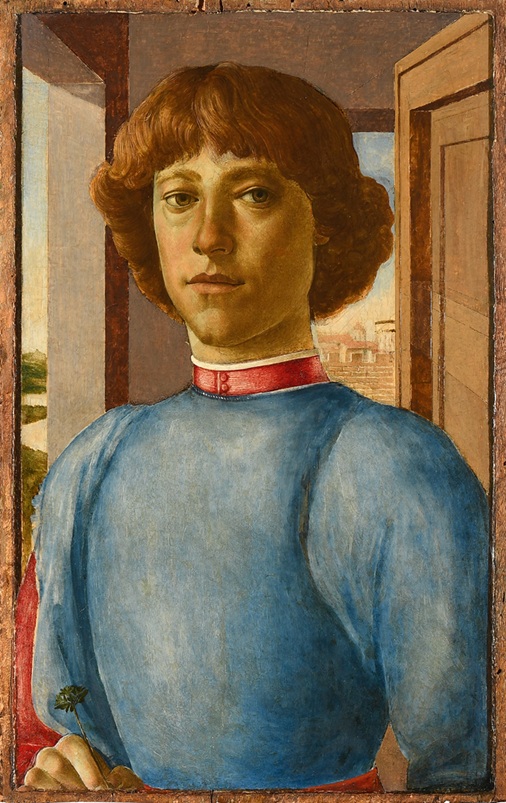
The auction house sold a panel for which the attribution to Botticelli was precisely what was in dispute. The auction house catalogued Bildnis eines jungen Mannes, oil on panel, 53 × 33.5 centimetres, as “Botticelli, Sandro, in der Art”. The estimate was CHF 5,000-7,000 and the hammer price was CHF 6.4 million, approximately €5.8 million.[1]
The low estimate was tied to an extremely cautious cataloguing and a technical dossier that was not entirely reassuring. The market paid millions not for what the auction house claimed the painting was, but for what some bidders evidently believed it might be.
An Appealing Portrait with a Difficult Technical Dossier
The portrait possesses precisely the kind of visual qualities that make a Botticelli hypothesis immediately attractive. A young man looks out from the picture almost frontally. His face is clearly modelled, his brown curls form a pronounced contour around his head, and the bold blue of his clothing is punctuated by a narrow red collar. Behind him, architecture divides the composition into strong vertical planes, while openings on either side offer glimpses of landscape and buildings.
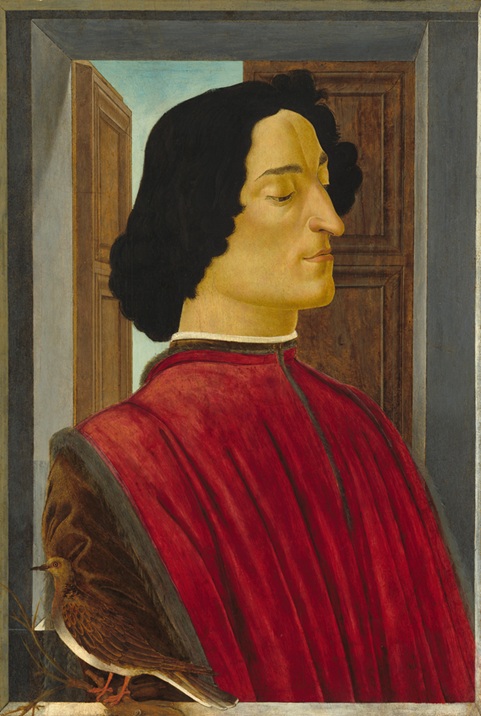
This composition makes comparison with Florentine portraits of the late fifteenth century understandable. Botticelli’s Giuliano de’ Medici of circa 1478-80 in the National Gallery of Art in Washington similarly places the sitter against an architectural background with a window and shutters.[2]
A similarity in type or composition does not establish authorship, and the current panel presents another problem. How much of what we see today actually belongs to the original painting?
At the time of the sale, an extensive research report by the Schweizerisches Institut für Kunstwissenschaft was available. According to the report, technical examination confirmed that the core of the object was a late medieval or early modern panel painting. At the same time, extensive interventions were identified in important areas of the sitter, along with a post-1961 restoration that appears to have substantially altered its appearance. Earlier overpainting may not have been undertaken solely for conservation purposes, but possibly with the intention of making a particular attribution appear more plausible.[1]
That finding changes the way we must look at the face, the modelling and even supposedly Botticellian features. Connoisseurship normally proceeds from the visible object. Here, the technical investigation warned that the visible object cannot simply be equated with its original state.
Bode Was Convinced
The Botticelli attribution already had a history stretching back almost a century by 2019. The painting first enters the documented record around 1924. Wilhelm von Bode, the influential Berlin museum director and connoisseur of Italian Renaissance art, published it that same year. The title of his article left little room for doubt: Ein neu aufgetauchtes Bildnis von Botticellis Hand und die Abhängigkeit des Künstlers als Portraitmaler von Fra Filippo Lippi.[3]
Bode again included the painting as a Botticelli in 1926, dating it to around 1475. Raimond van Marle listed it in 1931 as attributed to Botticelli and Roberto Salvini did the same in 1958. And Ronald Lightbown did not include the painting in his extensive Botticelli catalogue of 1978.[1]
A Provenance That Only Becomes Secure Around 1924
The provenance requires the same degree of caution. Schuler cited a possible provenance from the Grassi collection in Florence until around 1924, based on a letter from Julius Böhler dated 22 November 1927 and an “LG” monogram on the reverse. The auction house explicitly added that this provenance was doubtful.
Around 1924, the painting appears on the market and is published by Bode. It subsequently entered a private collection in Zurich, where, according to the auction house, it remained within the same family until the 2019 sale.[1]
The painting had been published, illustrated, discussed and included in various art-historical corpora. The question was not whether it existed, but who had painted it and how much of the original painting remained intact.
CHF 6.4 Million at the Hammer
The most important benchmark was Christie’s sale of the so-called Rockefeller Madonna in New York in January 2013. Fully catalogued as a work by Botticelli, the panel carried an estimate of $5-7 million and realised $10,500,000 including buyer’s premium. At the time, it was a world auction record for Botticelli.[4]
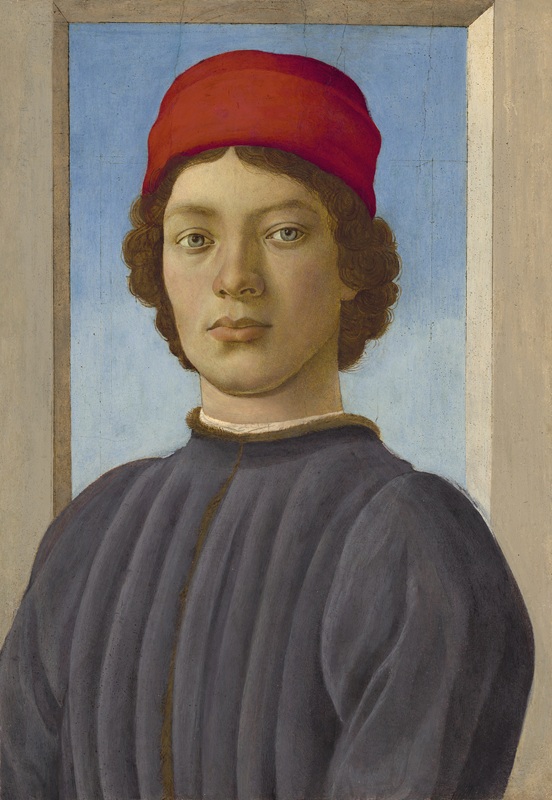
In 2017, Sotheby’s offered a Portrait of a young man, dated circa 1480-85, as the work of a “Florentine artist, close to Sandro Botticelli”, with an estimate of $600,000-800,000. That painting, too, had a long history of shifting Botticelli attributions. In 1997 it had still been auctioned as a Botticelli, and the auction house also pointed to the possible proximity of the young Filippino Lippi.[5]
That makes it difficult to maintain that buyers in Zurich were paying CHF 6.4 million for an attractive but anonymous Florentine follower. The price level suggests something else, namely that at least some market participants were pricing in a substantially higher position in the attribution hierarchy.
The Market Changed Radically Thereafter
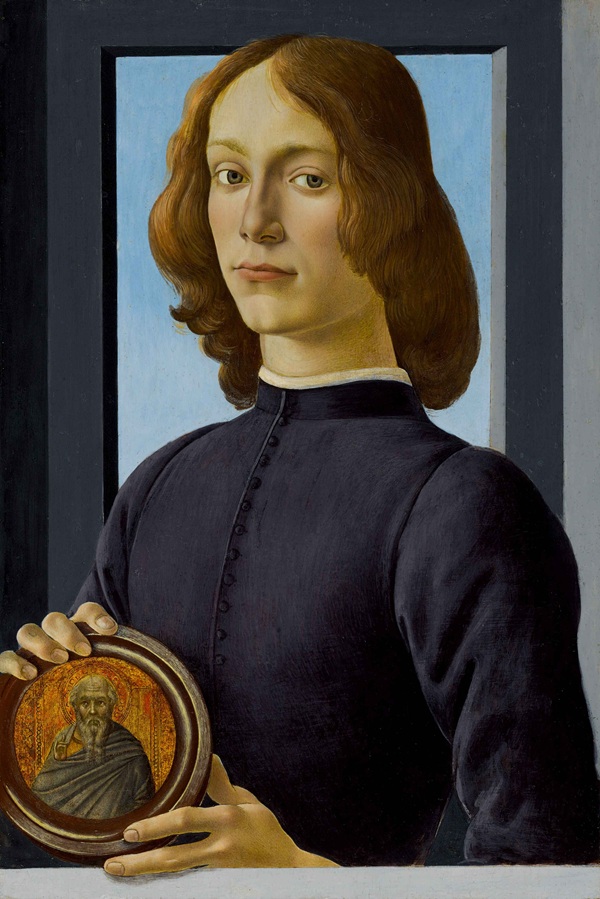
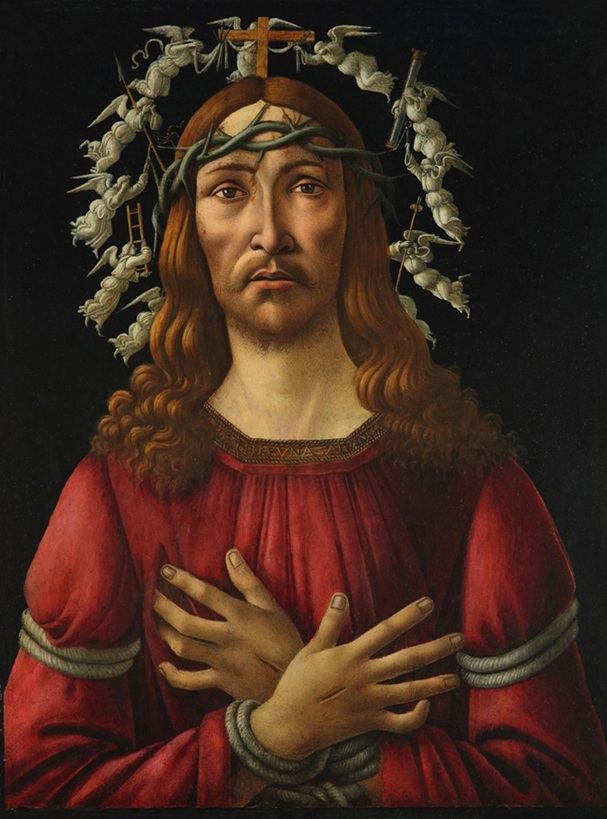
In January 2021, Sotheby’s sold Portrait of a Young Man Holding a Roundel for the enormous sum of $92,000,000 including buyer’s premium. It thereby became the new auction record for Botticelli.[6] A year later, The Man of Sorrows realised $45,500,000. The second sale is even more interesting from an attributional perspective, because Ronald Lightbown had included the painting in 1978 under “Workshop and school pictures”, whereas the catalogue of the Botticelli exhibition at the Städel Museum in 2009 presented it as a Botticelli.[7]
That shows how much commercial weight a revised and subsequently widely accepted attribution can carry in this segment. With Botticelli, the difference between “circle of”, “workshop” and a convincingly autograph painting is therefore no small matter. The same physical object can, after convincing technical and art-historical research, enter an entirely different market. If that reattribution does not materialise, a price that anticipated that possibility becomes much more complex and perhaps too much was paid.
Seven Years Later, the Price Is Still Not an Attribution
The CHF 6.4 million bid in Zurich and Bode’s historical Botticelli attribution are facts, but so is the critical technical report. An auction price can demonstrate that at least two parties were prepared to go very far for a hypothesis. It cannot establish authorship. The hammer price was a forceful judgement on the probability the market assigned to Botticelli. It was not a statement about who actually painted the panel.
Do you have a particular interest in this artist or in this subject?
Do you follow this artist, or have you come across a work you would like to know more about? We regularly research works appearing on the market and are always happy to exchange views on quality, provenance, art-historical context and previous auction results. You can contact us directly via info@antonello.art.
Notes and Sources
[1] Schuler Auktionen, Zurich, June 2019, 28 June 2019, lot 3200, “Botticelli, Sandro, in der Art”, Bildnis eines jungen Mannes. Estimate CHF 5,000-7,000 and hammer price CHF 6,400,000.
[2] National Gallery of Art, Washington, Sandro Botticelli, Giuliano de’ Medici, c. 1478/1480, tempera on panel, 75.5 × 52.5 cm, inv. 1952.5.56; National Gallery of Art.
[3] Staatliche Museen zu Berlin, Zentralarchiv, Findbuch Nachlass Wilhelm von Bode, inv. 6575: Wilhelm von Bode, “Ein neu aufgetauchtes Bildnis von Botticellis Hand und die Abhängigkeit des Künstlers als Portraitmaler von Fra Filippo Lippi”, Jahrbuch der Preußischen Kunstsammlungen, 45, 1924, pp. 113–116.
[4] Christie’s, Renaissance, New York, 30 January 2013, sale 2673, lot 148, Sandro Botticelli, ‘The Rockefeller Madonna’: Madonna and Child with Young Saint John the Baptist. Estimate $5-7 million; realised $10,500,000 including buyer’s premium.
[5] Sotheby’s, Master Paintings, New York, 26 January 2017, lot 13, “Florentine artist, circa 1480–85, close to Sandro Botticelli”, Portrait of a young man, bust length, in a red cap. Estimate $600,000-800,000.
[6] Sotheby’s, Master Paintings & Sculpture Part I, New York, 28 January 2021, lot 15, Sandro Botticelli, Portrait of a Young Man Holding a Roundel. Realised $92,000,000 including buyer’s premium.
[7] Sotheby’s, Master Paintings & Sculpture Part I, New York, 27 January 2022, lot 14, Sandro Botticelli, The Man of Sorrows. Realised $45,500,000 including buyer’s premium.