A monumental Adoration of the Magi, catalogued as Italian, circa 1500, will be offered at Düsseldorfer Auktionshaus on 28 November 2026 with an estimate of €4,000. Its painter is unknown, and no provenance has been published. Yet the composition, elaborate costumes and landscape suggest a more specific art-historical context. The painting of Ferrara and Bologna, in particular, warrants closer examination.
To our eyes, it is a curious painting. In the foreground, the Christ Child lies on an elaborately embroidered cushion, surrounded by Mary, Joseph and the three kings. Behind them, courtiers, horses and attendants crowd together. Further back, a procession of riders makes its way through a hilly landscape towards a fortified town. The entire scene is tightly compressed.
At 140 by 80 centimetres, the painting is also considerably larger than many of the small religious panels from the same period that appear at auction. Yet the catalogue of Düsseldorfer Auktionshaus offers only the briefest description, Italian Master, circa 1500, Adoration of the Magi. The work will be offered on Saturday, 28 November 2026, as lot 1903, with a catalogue price of €4,000.[1]
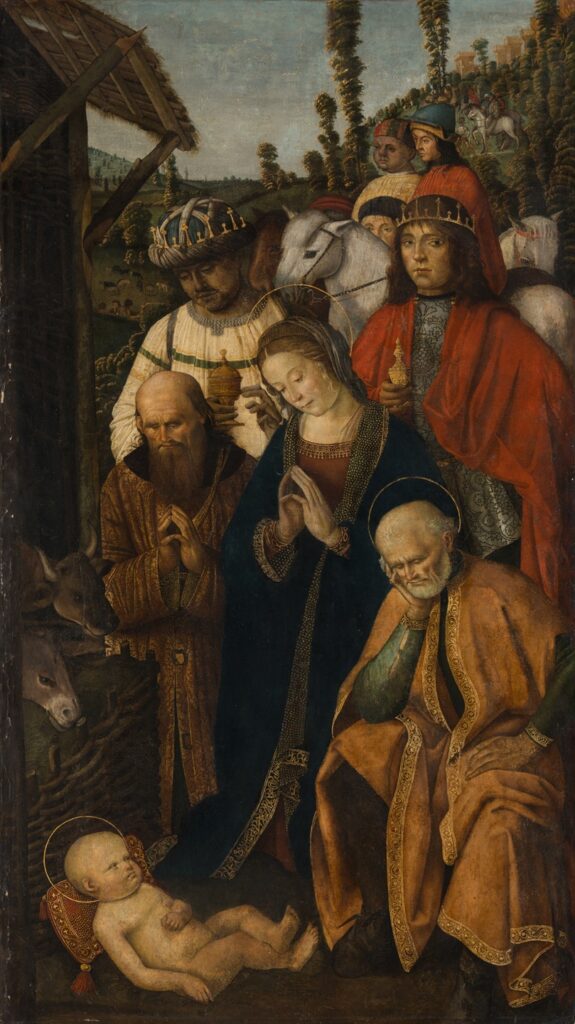
The painting has several stylistic characteristics that may allow for a more specific attribution than the broad description ‘Italian, circa 1500’. At the same time, we see serious questions concerning its material history and the quality of its execution. The painting of Ferrara and Bologna around 1495-1510 is particularly relevant, especially the circle of Lorenzo Costa.
A religious subject with the character of a courtly scene
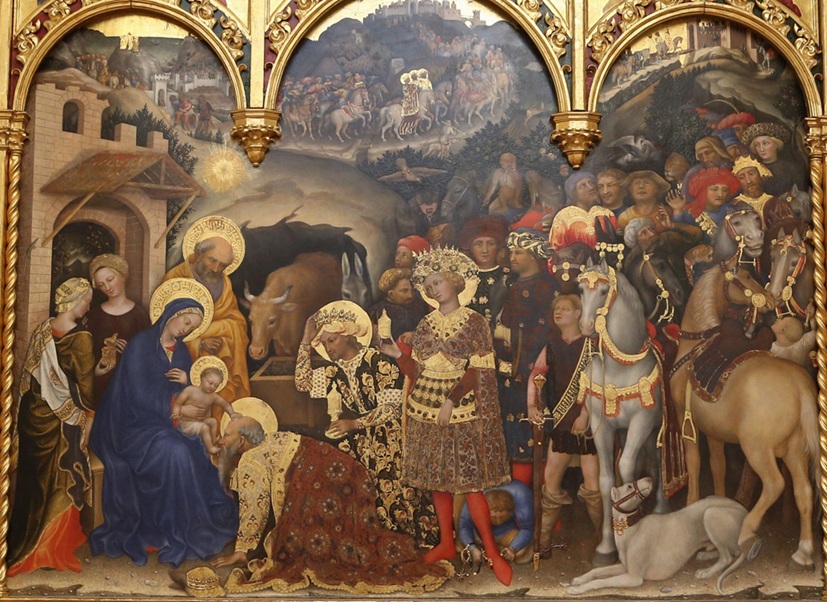
In many Italian depictions of the Adoration of the Magi, the encounter between the kings and the Christ Child is arranged horizontally. The architecture of the stable, the figures and the accompanying procession are distributed side by side across the picture plane. Here, the central event takes place at the bottom, while the royal entourage is stacked above it.
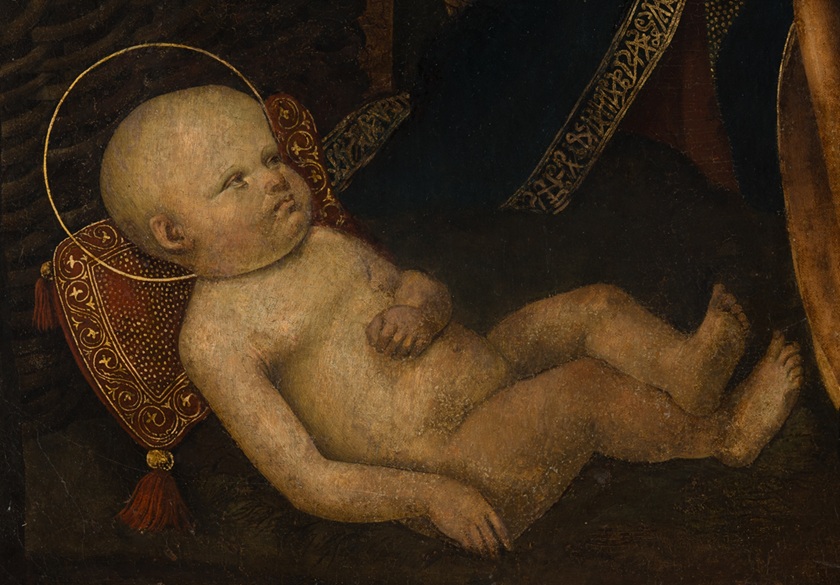
The hierarchy is carefully constructed. The naked Christ Child lies low in the composition, almost on the ground. A narrow golden halo sets his body apart from its dark surroundings. The embroidered red fabric beneath his head, with its delicate gold-coloured ornaments and tassels, is a particularly rich detail.
Mary bends over him with her hands joined in prayer. Her face is softly modelled, with an elongated nose, a small mouth and downcast eyes. Her dark cloak is edged with a narrow, elaborately decorated gold border. To the left, an elderly king with a long beard kneels. His clasped hands echo Mary’s gesture.
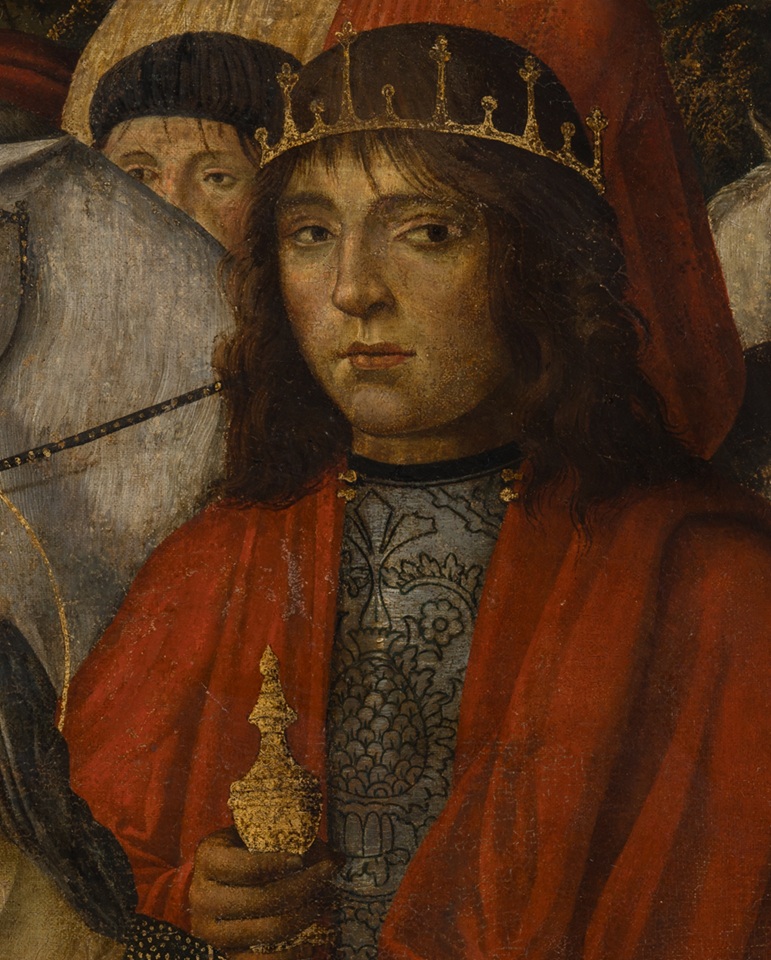
On the right sits Joseph, wrapped in an ochre-coloured cloak. He rests his head on one hand and appears lost in thought. Above these three figures stand the other kings and their retinue. One of the most striking figures wears an elaborate turban-like headdress. His white garment, decorated with horizontal green bands, contrasts with the red cloak of the young king on the right.
His face is narrow and sharply modelled, with long dark hair and a gaze that is not directed towards the Christ Child. In Italian quattrocento painting, the Adoration of the Magi provided an ideal subject for combining religious devotion with the display of wealth, power and courtly elegance.
The kings were understood not only as biblical figures but also as rulers accompanied by an extensive retinue. Their costumes and gifts gave painters an opportunity to depict costly fabrics, jewellery, horses and exotic-looking headdresses. In the present painting, this interest is so pronounced that the religious heart of the scene is almost overshadowed by the entourage.
The small figures in the landscape
In the upper right, a long procession of horsemen moves through the landscape. Further back still, the towers of a fortified town appear. The painter attempts to suggest depth by gradually reducing the size of the figures, but the transition between foreground and background remains abrupt.
The scene also brings together two moments from the same biblical story. In the foreground, the kings have reached their destination, yet in the landscape their journey is still under way. This kind of simultaneous narrative occurs frequently in late medieval and early Renaissance painting.
The combination of an extensive courtly entourage, carefully rendered costumes and small narrative figures in a highly stylised landscape points to a painter still firmly rooted in the traditions of the late fifteenth century.
Lorenzo Costa and painting in Bologna
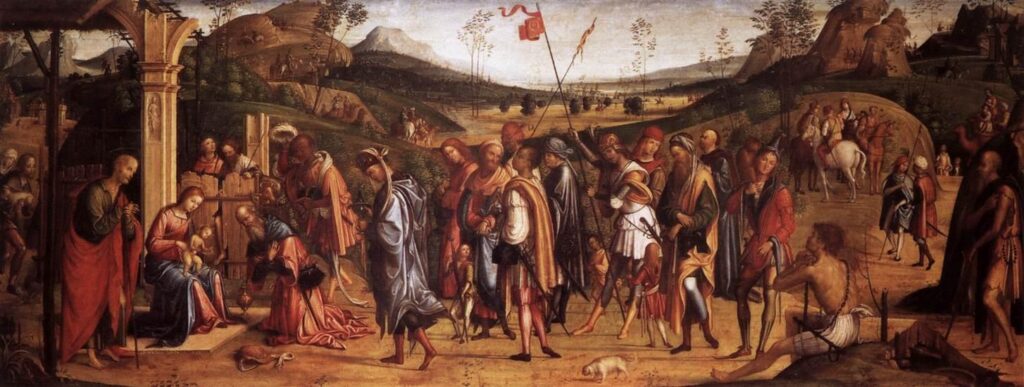
Lorenzo Costa, born around 1460 in Ferrara and deceased in Mantua in 1535, was among the leading painters who bridged the Ferrarese quattrocento tradition and the early Renaissance in Bologna. His Adoration of the Magi in the Brera shows an extended royal procession, richly dressed figures and a wealth of detail.[2]
The associated altarpiece by Francesco Francia was commissioned by Anton Galeazzo Bentivoglio to mark his return from the Holy Land. The interest in knights, horses and an extensive royal entourage therefore had a direct connection with the world of the patron.
The present painting differs in its composition and in the arrangement of its figures. Nevertheless, there is an intriguing affinity in the treatment of the subject. For Costa, too, the Adoration is not merely an intimate religious event. The journey of the kings becomes an opportunity to depict an entire courtly world.
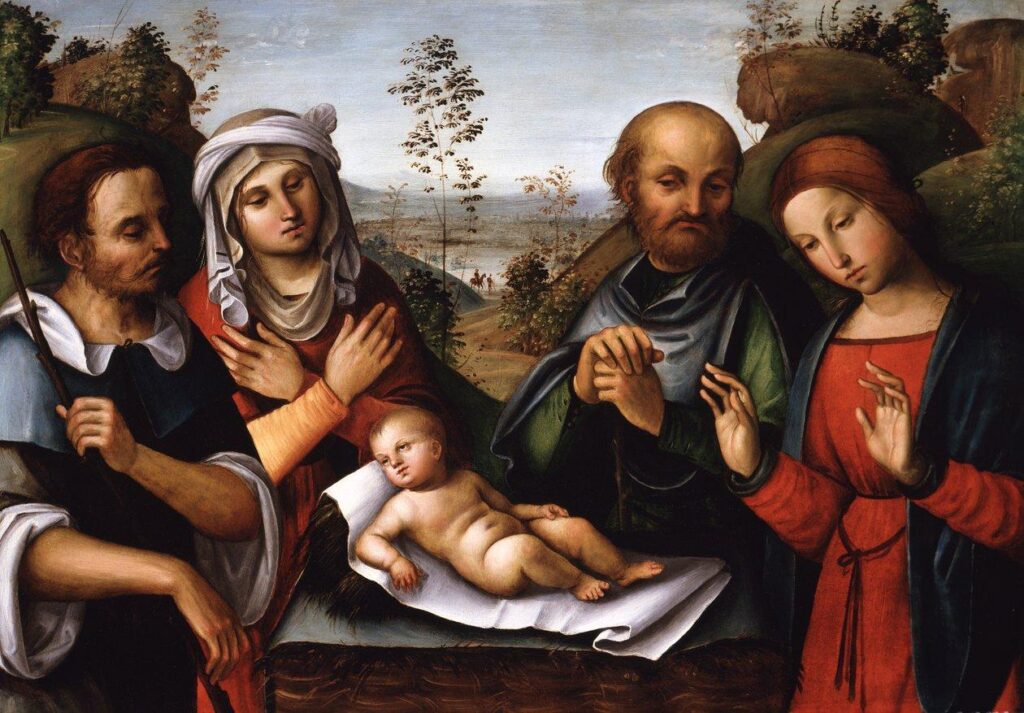
That is precisely what makes the anonymous painting so appealing. A second comparison within Costa’s oeuvre is even more relevant. His Adoration of the Child with the Magi in the Distance, dated to around 1503-1506, shows Mary and Joseph gathered around the Christ Child, with a landscape in which the kings appear as small figures.[3] The larger figures are carefully outlined and modelled, while the small riders and trees are handled more freely.
Why an attribution to Costa goes too far
It would be tempting to suggest Lorenzo Costa as a possible painter. Yet in his accepted works from around 1500, Costa’s figures are generally integrated into the composition more fluidly. His faces show softer transitions between light and shadow, while the anatomy is usually more convincing. The Christ Child in the Düsseldorf painting, for example, appears rather stiff. His legs and hands are less refined than the kings’ costumes.
In places, the painter seems more interested in detail than in the overall coherence of the composition. This need not imply a lack of artistic quality. It may instead point to a painter still closely tied to the older Ferrarese tradition. For now, a regional attribution is more plausible than an attribution to a named artist.
The reverse raises just as many questions
One major obstacle to assessing the painting is its support. The auction house describes it as oil on canvas and wood. This is not a conventional description for an original Italian panel painting from around 1500. An older painting on canvas may have been mounted onto a wooden support at a later date. Alternatively, there may have been a more extensive restoration in which a painting originally executed on panel was transferred to another support.
The distinction matters. A canvas glued to wood, an original panel painting transferred onto canvas, and a later painting on canvas may look similar from the back, even though their art-historical implications are quite different.
What does the auction market tell us?
The market for Italian painting around 1500 depends heavily on how confidently a work can be placed. A painting convincingly attributed to a known artist occupies an entirely different commercial category from an anonymous work of the same period. The market distinguishes between convincing Old Master paintings, mediocre workshop production, problematic works and later paintings after Renaissance models.
That difference is illustrated by a Virgin and Child by Lorenzo Costa offered at Sotheby’s in Paris on 9 June 2026. The panel, measuring 52.5 by 46 centimetres, carried an estimate of €50,000-70,000.[4] Sotheby’s described the painting as an important addition to Costa’s oeuvre and pointed to its long history in a French family collection. That is a fundamentally different starting point from the Düsseldorf painting. The latter has neither an attribution to a named artist nor a documented provenance.
A missing history
The catalogue gives no previous owner, collection, exhibition history or literature. Nor does it refer to an expert opinion or an earlier auction. The history of Italian Renaissance painting includes numerous works that, over the course of the twentieth century, were successively attributed to a recognised master, his workshop, a follower and finally an anonymous regional painter. The auction house’s cataloguing is therefore only a starting point.
Where does the quality lie?
In our view, the painting’s strongest passages are not evenly distributed across the composition. The faces of Mary and the young king have a refinement that is lacking in some of the other figures. The dark-skinned king is rendered with particular care, especially in his headdress and the decoration of his clothing.
The tall trees and small horsemen are painted convincingly enough to be more than mere background decoration. The combination of red, green, ochre and dark blue is also effective. Despite the densely packed figures, the composition remains legible.
Yet the Christ Child’s anatomy is less convincing. Some of the hands are stiff, and the spatial relationships between certain figures and horses remain problematic. These are not minor details when considering an attribution to a major Renaissance painter.
A painting that calls for a more specific attribution
The combination of courtly costumes, strongly individualised faces, decorative landscapes and an extensive royal retinue makes a Northern Italian origin around 1500 plausible. Painting in Ferrara and Bologna offers the most promising direction for comparison. Lorenzo Costa is relevant for his treatment of the Adoration of the Magi and the way he combined landscape narrative with religious figures.
The auction on 28 November will above all reveal how much confidence buyers are prepared to place in this uncertain combination of dating, visible quality and condition. The most interesting outcome would not necessarily be a high sale price. A convincing art-historical attribution could be just as significant.
Do you have a particular interest in this artist or subject?
Do you own a painting by this artist, have you come across a comparable work, or do you have information that might be relevant to further research? We welcome contact from collectors, art dealers and researchers with an interest in this artist or related subjects.
We regularly research paintings appearing on the art market, exploring questions of attribution, quality, provenance and previous sales. If you have a question about a particular work or would like to share information with us, please feel free to get in touch at info@antonello.art.
Notes and sources
[1] Düsseldorfer Auktionshaus, Katalog 02/2026, lot 1903, “Italienischer Meister um 1500, Anbetung der Heiligen Drei Könige”, Düsseldorf, auction held on 28 November 2026.
[2] Pinacoteca di Brera, Milan, Lorenzo Costa, Adoration of the Magi, 1499, oil on panel, 75 × 181.3 cm, inventory no. 354.
[3] Pinacoteca Nazionale di Bologna, Lorenzo Costa, Adoration of the Child with the Magi in the Distance, circa 1503-1506, oil on panel, 153.5 × 124.5 cm, inventory no. 557.
[4] Sotheby’s, Tableaux 1400-1900, Paris, 9 June 2026, lot 3, Lorenzo Costa, Virgin and Child, 52.5 × 46 cm, estimate €50,000-70,000.