A striking card player in a red coat, an ambiguous scene and two experts who do not entirely agree on the artist. On 9 December 2026, Olympia Auctions in London will offer The Young Card Players, a painting dated to around 1630 and closely related to the work of Jan Miense Molenaer. The estimate is £4,000-6,000. But is the painting wholly or partly by Molenaer’s own hand, or is it a fine seventeenth-century copy?
A young man in a vivid red coat and a hat adorned with a long white feather has momentarily turned his attention away from the card game. He turns his face towards us, looking as though we have caught him at an unexpected moment. Opposite him stands a young woman holding a fan of playing cards. A small wooden stool serves as an improvised card table.
On the left, a boy sits smoking a pipe by the fire, while on the right a maid watches the company from a doorway. Among the objects on the floor is a discarded shoe. The scene is carefully composed, offering enough clues to suggest a story. The man in red commands our attention, and his gaze makes us witnesses to the game.
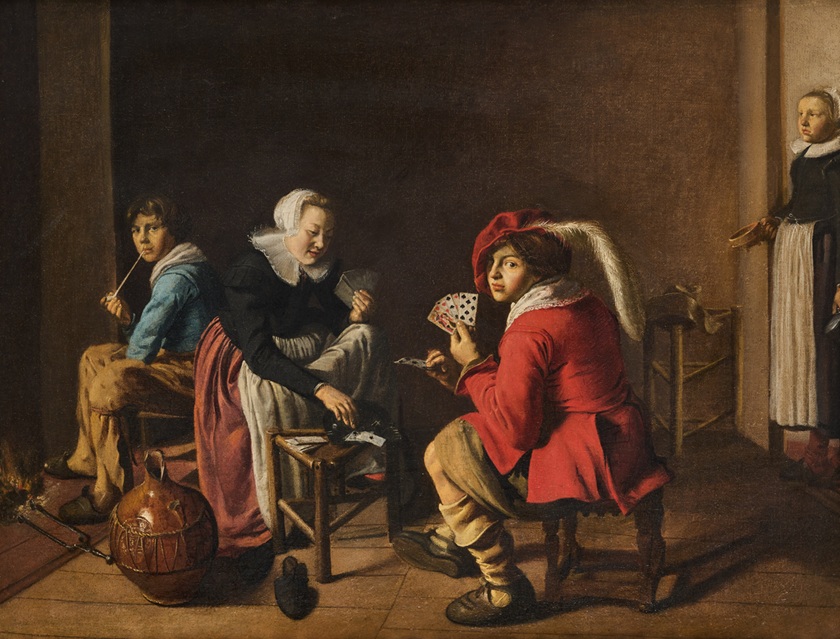
The painting will be offered at Olympia Auctions in London on 9 December. Executed in oil on canvas and measuring 49 × 64 centimetres, it is catalogued as Jan Miense Molenaer and Studio, with an estimate of £4,000-6,000.[1] The auction house consulted two experts who, interestingly, reached somewhat different conclusions.
One is preparing a catalogue raisonné of the artist and considers the painting to be a work by Molenaer and his studio. He recognises the artist’s hand in various figures and objects, although he does not rule out the involvement of a second painter in its execution. The other also dates the painting to around 1630 but regards it as a fine seventeenth-century copy by a follower of Molenaer.
Both experts recognise the same pictorial language and place the scene in the same period. Yet while one sees the work of Molenaer’s own hand, the other sees a painter who followed his example. The question, then, is not so much whether the composition fits Molenaer’s artistic world. It clearly does. The question is whether he actually painted it.
A Scene from Molenaer’s Early Years
Jan Miense Molenaer (1610-1668) was still a young painter working in Haarlem around 1630. His earliest dated paintings are from 1629. During this period, he was influenced by Haarlem genre painting, particularly the work of Dirck Hals and his elder brother Frans Hals. Molenaer painted children making music, merry companies and card players. His figures wear striking costumes, occupy modest interiors and often look out at the viewer with remarkable directness.
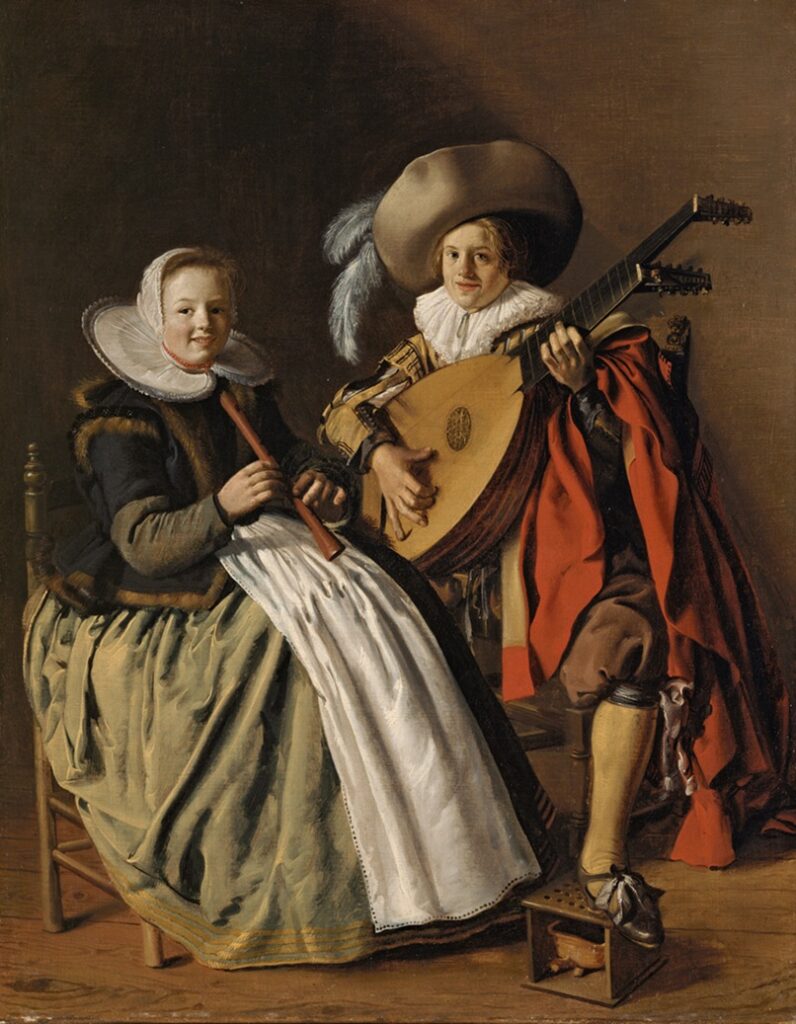
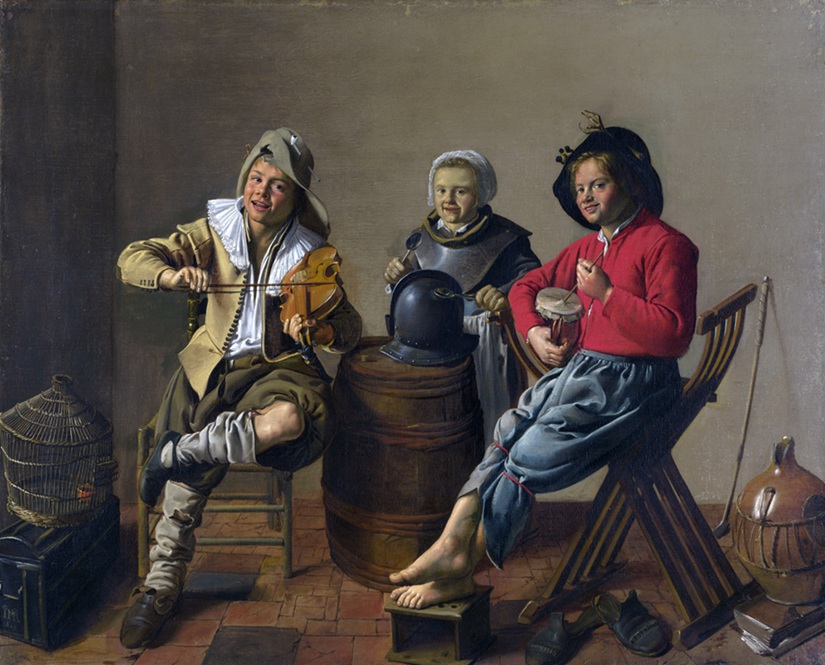
A useful comparison is Two Boys and a Girl making Music of 1629. Three children make music in a modest room. Their clothes are worn, but their faces have a certain liveliness.[2] The Duet, dating from around 1629 and now in the Seattle Art Museum, is equally interesting. Here, too, a man and a woman wear striking clothes in an interior. The man wears red and a large feathered hat, while the woman wears a white headdress. Molenaer used similar garments in different paintings and probably kept such items as studio props.[3]
This is certainly relevant to The Young Card Players. The red coat and feathered hat belong to the repertoire from which Molenaer drew when composing his paintings during these years. The way the man in red looks out at us is comparable, too. The Rijksmuseum, for example, holds Molenaer’s later Cheating at Cards, in which a card player is deceived with the aid of a mirror. The device draws us, as viewers, into the deception taking place within the painting.[4]
A similar device appears in The Young Card Players. While the young woman concentrates on her cards, her opponent turns towards us. The pipe-smoking boy on the left also looks in our direction, and the interior is barely decorated. The red coat provides the strongest accent of colour, while the white headdresses and collars distribute the light across the scene. The woman focuses on the game, the young man engages directly with us, and the maid on the right remains at a distance. The scene is consequently less exuberant than many of Molenaer’s other early genre paintings.
The Cards, the Shoe and a Game That Defies Easy Interpretation
What we see is a scene of seduction. A well-to-do young man has entered the servants’ quarters to play cards with a young woman. The maid on the right is shocked, while the pipe-smoking boy on the left remains indifferent. The playing cards and the discarded shoe, in particular, take on symbolic significance.
The ace of clubs lying on the stool is said to symbolise fidelity in love, while the woman’s discarded shoe suggests sexual availability. An erotic reading is certainly consistent with seventeenth-century genre painting. The ace of hearts, for example, is a recognised symbol of romantic involvement. In the Rijksmuseum’s Cheating at Cards, meanwhile, an ace of clubs forms part of a deceptive card game.[4][5]
The shoe on the floor provides the strongest clue to a romantic interpretation. In Molenaer’s A Young Man and Woman making Music, painted between 1630 and 1632, a discarded shoe also lies on the floor. Yet that painting includes objects that symbolise fidelity and virtue. Molenaer allows different meanings to coexist. The cards, the shoe and the reactions of the bystanders may therefore invite more than one interpretation.[6]
That uncertainty adds to the painting’s appeal. Molenaer’s genre scenes often give us, as viewers, enough clues to suspect that a story is unfolding, but not always enough to settle its meaning. That ambiguity is part of their attraction.
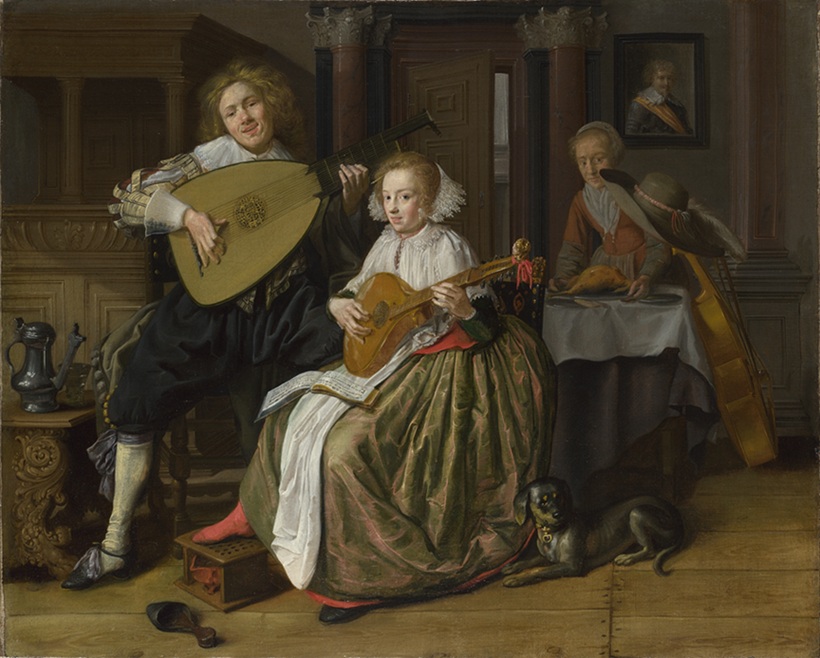
Why One Expert Recognises Molenaer’s Own Hand
The man in red has a carefully modelled face. His eyes and mouth, and the transition from his face to his neck, give him a compelling presence. The white feather and voluminous red coat are also rendered in detail. The young woman has a calmer expression. Her white cap, collar and hands provide important accents of light, but her face is less commanding.
The pipe-smoking boy on the left, and particularly the maid on the right, seem more simply painted. The maid stands almost motionless in the doorway and lacks the same liveliness as the principal figure. This might point to more than one hand, but it could equally reflect deliberate differences in execution, the figures’ positions within the composition, or the painting’s condition.
The reuse of figures and motifs was a recurring feature of Molenaer’s working method. He drew on earlier drawings, models, prints and studio materials to assemble new compositions. Yet the reuse of costumes and compositions proves little on its own, since a skilled follower could employ the same sources. Molenaer was only about twenty years old around 1630, and his earliest dated paintings are from 1629. The fact that he worked with family members and other painters in later years does not prove that he already had assistants carrying out work for him in 1630.
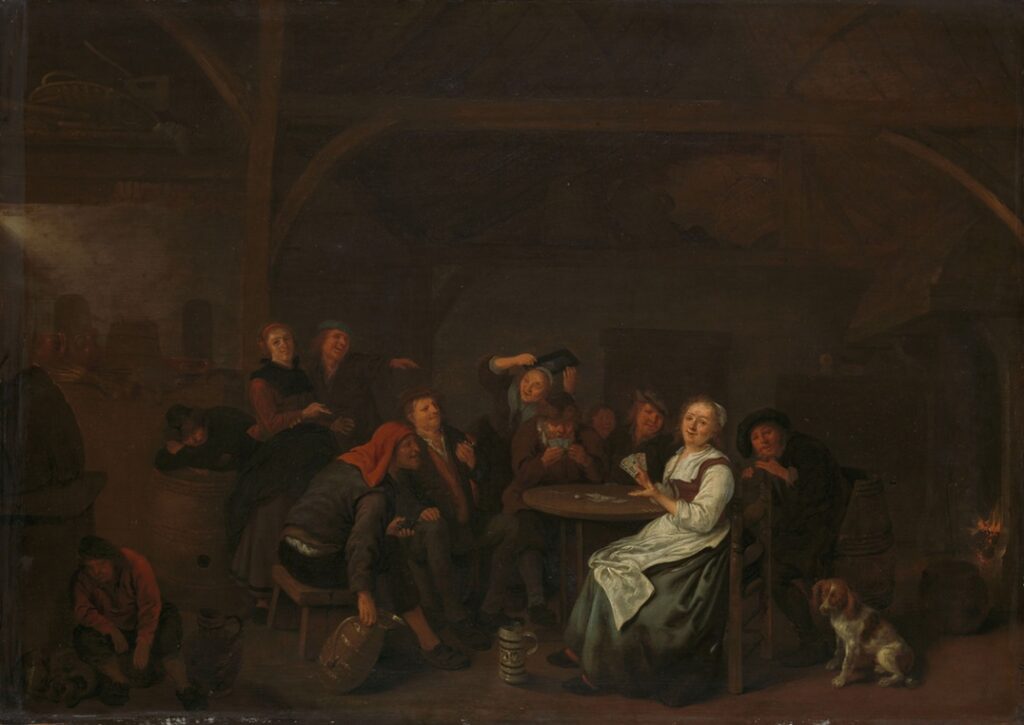
Why the Other Expert Sees a Seventeenth-Century Copy
The other expert likewise dates the painting to around 1630 but calls it a fine seventeenth-century copy by a follower of Molenaer. He is therefore not dismissing it as a later imitation or a clumsy reproduction. He sees it as a painting made in Molenaer’s own century, closely aligned with his artistic production, but not executed by the master himself.
A composition may originate with an artist without every painting based on it being by that artist’s hand. Recognising a composition is therefore not the same as establishing its autograph status. A familiar composition can survive in several seventeenth-century versions. Figures may be added, omitted or altered. Even when the original composition fits Molenaer convincingly, the execution of an individual version may point to another painter.
A Provenance Through Edward Speelman
According to the auction house, The Young Card Players was formerly owned by Colonel Hudson of Pershore, Worcestershire. It subsequently passed through the London art dealership Edward Speelman Ltd, where it was present by 1960. The grandfather of the current owner purchased the painting before 1970. According to the stated provenance, it has since remained in the same family. The Speelman name is significant. Edward Speelman was among London’s leading dealers in Dutch and Flemish Old Master paintings.
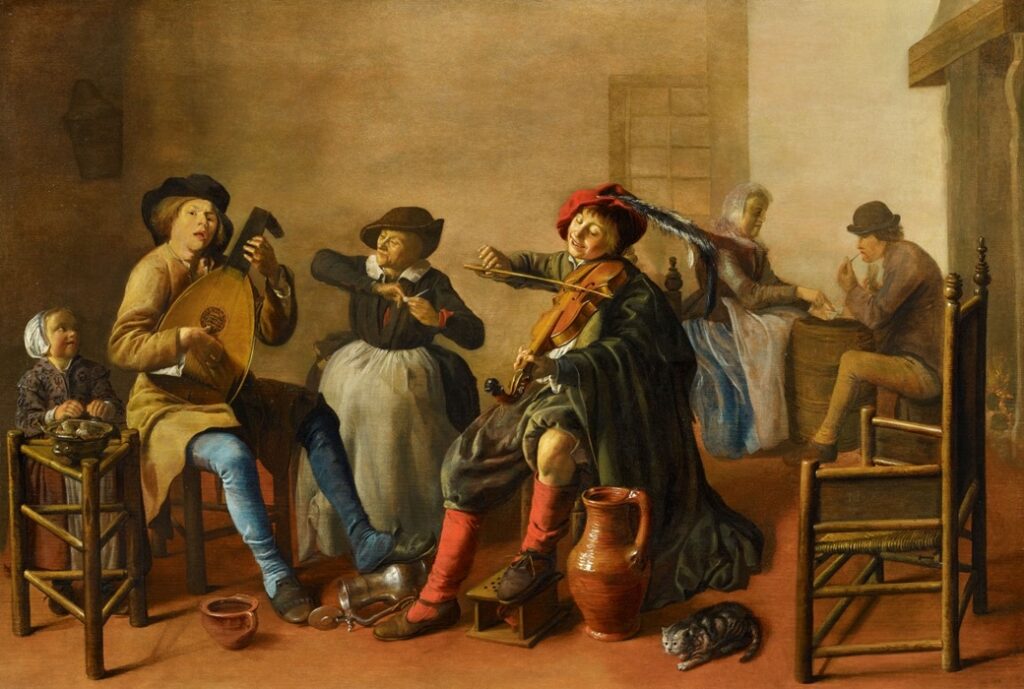
What Does the Market Pay for a Molenaer?
Olympia Auctions estimates the painting at £4,000-6,000. For an appealing composition with four figures, dated to around 1630, that may initially seem modest. But auction results show just how wide the differences between individual works can be. In May 2025, Lempertz in Cologne sold a small painting entitled Farmers Drinking. The work was signed, and an expert from the RKD had confirmed it as autograph. It realised €4,400 including buyer’s premium, against an estimate of €4,000-6,000.[7]
The sale of Company Making Music at the same auction house in November 2015 was a very different story. Painted in oil on panel and measuring 45 × 66.5 centimetres, it belongs to Molenaer’s early Haarlem period. Its dimensions are closely comparable with those of The Young Card Players, and the subject also relates to his output of those years. The work also had an extensive provenance.
Against an estimate of €30,000-50,000, it realised €47,000 including buyer’s premium.[8] One painting is a small, relatively simple scene, the other a larger early genre painting with extensive documentation. Subject, period, size, quality and confidence in the attribution all play a part.
In November 2021, Lempertz offered a small Allegorie des Geruchsinns. The auction house stated that an expert had confirmed its attribution to Molenaer, and the painting subsequently realised €5,000 including buyer’s premium.[9] A painting in which the master himself had a hand is generally assessed differently from a copy by a follower. The estimate for the present lot probably reflects, above all, the uncertainty surrounding its attribution.
The Man in Red
The man in red is a remarkably effective figure. His striking costume, the long white feather and, above all, his direct gaze immediately draw us into the scene. The other figures contribute to a tableau in which it is never entirely clear who is playing what game. The composition fits convincingly within Molenaer’s early oeuvre. The theatrical costumes, the ambiguous exchanges between young men and women, and the direct engagement with the viewer are all recognisable features.
A skilled seventeenth-century copyist could reproduce the same composition, costumes and dramatic relationships. In one scenario, we are looking at an early painting to which Molenaer himself contributed, perhaps with the help of a second hand. In the other, we see the work of a talented contemporary who borrowed a composition from Molenaer’s artistic world. That distinction makes a considerable difference to the painting’s art-historical standing and market value, but far less to the appeal of the scene itself.
Do you have a particular interest in this artist or subject?
Do you own a painting by this artist, have you come across a comparable work, or do you have information that might be relevant to further research? We welcome contact from collectors, art dealers and researchers with an interest in this artist or related subjects.
We regularly research paintings appearing on the art market, exploring questions of attribution, quality, provenance and previous sales. If you have a question about a particular work or would like to share information with us, please feel free to get in touch at info@antonello.art.
Notes and Sources
[1] Olympia Auctions, London, Fine Paintings, Works on Paper and Sculpture, 9 December 2026, lot 4, Jan Miense Molenaer and Studio, The Young Card Players, oil on canvas, 49 × 64 cm. Estimate £4,000-6,000.
[2] The National Gallery, London, Jan Miense Molenaer, Two Boys and a Girl making Music, 1629, inv. no. NG5416.
[3] Seattle Art Museum, Jan Miense Molenaer, The Duet, c. 1629, inv. no. 61.162.
[4] Jonathan Bikker, “Jan Miense Molenaer, Cheating at Cards, c. 1650-1668”, in Dutch Paintings of the Seventeenth Century in the Rijksmuseum, online collection catalogue, Amsterdam, 2022, inv. no. SK-A-3023.
[5] E. de Jongh, Tot lering en vermaak: Betekenissen van Hollandse genrevoorstellingen uit de zeventiende eeuw, Amsterdam, Rijksmuseum, 1976, catalogue no. 35, Kornelis de Man, De kaartspelers, pp. 150-152.
[6] The National Gallery, London, Jan Miense Molenaer, A Young Man and Woman making Music, 1630-1632, inv. no. NG1293.
[7] Lempertz, Cologne, Old Masters and 19th Century Part II, 17 May 2025, lot 1216, Jan Miense Molenaer, Farmers Drinking, oil on panel, 30.5 × 24 cm. Estimate €4,000-6,000, realised €4,500 including buyer’s premium.
[8] Lempertz, Cologne, Old Master and 19th Century Paintings and Drawings, 14 November 2015, lot 1465, Jan Miense Molenaer, Company Making Music, oil on panel, 45 × 66.5 cm. Estimate €30,000-50,000, realised €47,000 including buyer’s premium.
[9] Lempertz, Cologne, Gemälde, Zeichnungen, Skulpturen 14.-19. Jh., 20 November 2021, lot 1561, Jan Miense Molenaer, Allegorie des Geruchsinns, oil on panel, 19.5 × 16 cm. Realised €5,000 including buyer’s premium.