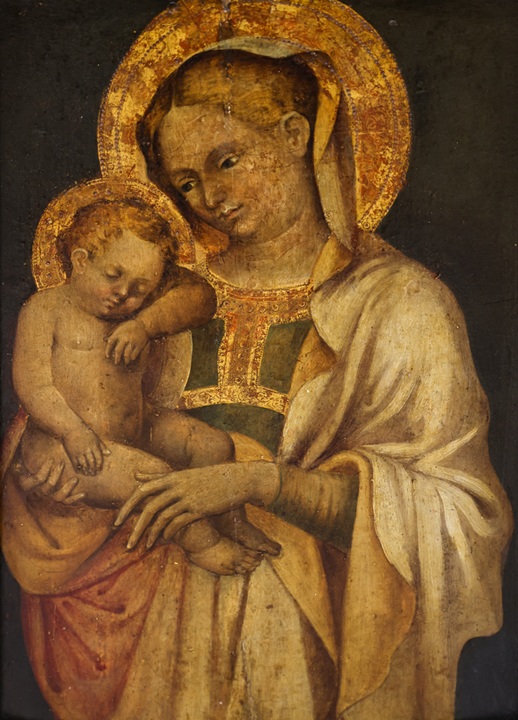
An anonymous Italian Madonna and Child on panel is coming up for auction on 2 October at an American auction house with an estimate of just $1,000-2,000. Bidders have already pushed past the upper estimate before the sale. At first glance, this seems largely to be a bet on its age, encouraged in part by an auction label on the reverse that leads back to a 1913 sale in New York.
[Update 02-10-2026: the lot was sold for $40,000.]
What is missing from the catalogue? An actual attribution. The auction house is offering the work as “Italian School 15th Cent.” It is a panel measuring approximately 53 × 37 cm, depicting a Madonna and Child with gilded halos. It carries an estimate of $1,000-2,000.[1] That estimate has already been overtaken by the bidding, which at the time of writing has reached $5,500.
Buyers are clearly willing to pay more than the auction house’s original estimate. But why? There is still no firm basis for an attribution. Yet this rather briefly catalogued Madonna appears to already have a much longer history behind it.
An auction label from 1913
On the reverse is a paper label that appears to refer to a sale held by The Anderson Auction Company, New York, where the painting seems to have been catalogued as lot 144. The sale in question was the Art Collection of the late Col. Henry Thomas Chapman of Brooklyn, auctioned by Anderson in New York from 27 to 29 January 1913. The catalogue describes an unknown painter, Italian School, 15th century, Madonna and Child. The dimensions also appear to correspond.[2]
The panel therefore appears to have existed by at least January 1913, when it belonged to an established New York collection and was already being presented as a 15th-century Italian painting. That makes it less plausible that we are looking at an object artificially aged at some point in recent decades and subsequently catalogued as Quattrocento. Other paintings from the same sale can also be traced. Two portraits, for example, are now in the National Gallery of Art in Washington.[3]

The painting itself is harder to read
On the front, we see the Virgin set against an almost entirely dark background. The nude Christ Child lies horizontally across her arms and appears to be asleep. Mary inclines her head towards him. Her mantle and veil are white, contrasting with the green and red of the other garments and tunic. The two large golden halos are particularly prominent.
The auction house describes it as a “Byzantine period composition”.[1] The painting certainly draws on a tradition with a long medieval and Byzantine history. But the human intimacy between mother and child fits just as well within 15th-century Italian painting. The sleeping Child could be understood as a foreshadowing of his later death.
These elements invite comparisons with Tuscan and Florentine workshops of the second half of the 15th century. There was a broad production of smaller workshops making Madonnas for private devotion. Yet there are also reservations to be made about the quality of the painting. Mary’s fingers are unusually long and stiffly modelled. The transition between the Child’s body and the hands also feels somewhat contrived. The mantle is further handled with rather coarse brushwork.
The work has a vertical split running through the panel and, according to the catalogue text, has been cleaned and restored.[1] On the front, the structural damage remains visible, although it has been relatively well concealed. Five-hundred-year old panel paintings can, of course, have complicated restoration histories.
Why $5,500 is not so surprising
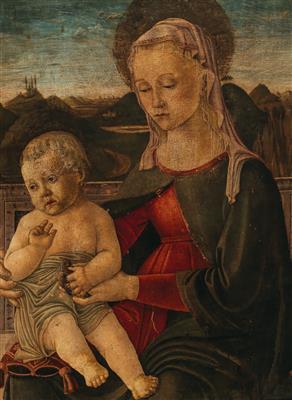
The market for anonymous early Italian painting spans an enormous gap between a decorative object and a work convincingly accepted as Quattrocento. Condition and uncertainty over dating and execution weigh heavily. A Madonna and Child with Angels, catalogued as Florentine School, 15th Century, sold in 2019 for €28,000 including buyer’s premium.[4]
Another Florentine Madonna and Child, offered in 2020 with the support of a technical report, achieved €87,800 including buyer’s premium against an estimate of €25,000-35,000.[5] This helps explain why bidders may already be positioning themselves around the possibility that the work is genuinely early. We are probably not witnessing the discovery of an important Quattrocento panel, but bidders may well be responding to a conservatively set estimate. It is, at the very least, an intriguing lot for further research.
Do you have a particular interest in this artist or in this subject?
Do you follow this artist, or have you come across a work you would like to know more about? We regularly research works appearing on the market and are always happy to exchange views on quality, provenance, art-historical context and previous auction results. You can contact us directly via info@antonello.art.
Notes and sources
[1] MBA Seattle Auction House, Fall Luxuries and Fine Arts Northwest, Renton, Washington, 1 October 2026, lot 182, “Italian School 15th Cent. Madonna and Child Oil on Panel”, estimate $1,000-2,000, 21 × 14.5 in.
[2] The Anderson Galleries / Metropolitan Art Association, Art Collection of the Late Col. Henry Thomas Chapman of Brooklyn, N.Y., New York, 1913, lot 144: “Unknown Painter, Italian School, XVth Century, Madonna and Child”, panel, approximately 20.5 × 14 3/4 in.
[3] National Gallery of Art, Washington, provenance of Frans van Doornik’s Isaac de Peyster and Anna de Peyster, both from the collection of Col. Henry Thomas Chapman and Anderson Galleries, 27-29 January 1913, lots 357 and 358.
[4] Dorotheum, Old Master Paintings, Vienna, 18 December 2019, lot 10, Florentine School, 15th Century, The Madonna and Child with Angels, 47.7 × 31 cm; estimate €20,000-30,000; realized €27,800 including buyer’s premium.
[5] Dorotheum, Old Master Paintings, Vienna, 10 November 2020, lot 143, Florentine School, 15th Century, Madonna and Child, 66 × 48.5 cm; estimate €25,000-35,000; realized €87,800 including buyer’s premium.