A small seventeenth-century head of a man, sold as Studio of Rembrandt, was estimated at £1,500–2,500. The hammer price reached £33,000 (€38,500). That cannot be explained by the associated name alone. Above all, the possibility of further research appears to have been an important factor.
During The Auction Room London’s Fine Art Sale on 29 September, we were not only watching a particular VOC document chest. This painting, offered as Studio of Rembrandt Harmensz. van Rijn, also proved to have been underestimated. It is a small seventeenth-century panel depicting the head of an elderly bearded man.[1]
Why were several bidders prepared to pay £33,000 for a work the auction house had estimated at no more than £2,500? The panel has precisely the kind of scale and subject found in Rembrandt’s immediate artistic circle. Its reverse bears traces of an earlier history, while the provenance offers a lead that warrants further investigation. Whoever bid on it was also buying the possibility of further research.
A small-format tronie
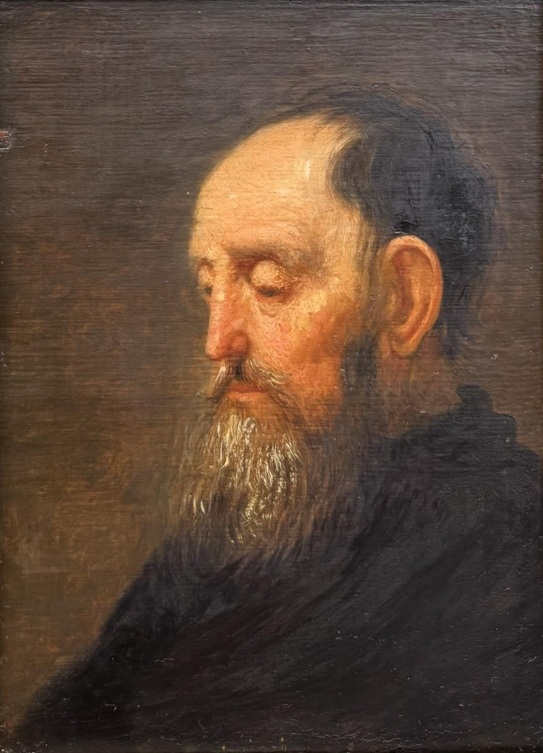
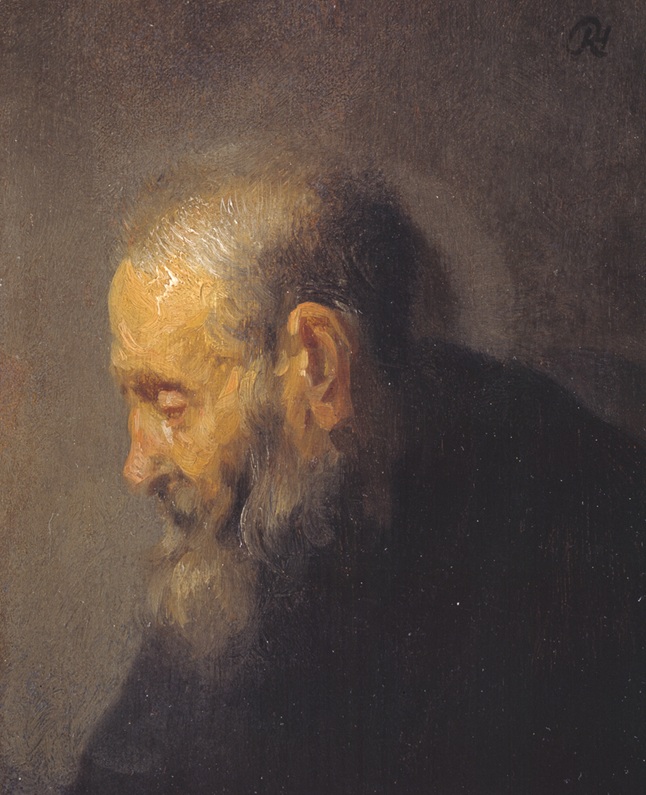
The painting measures just 18 by 23 centimetres. Against a brown background appears an elderly man with a high forehead, dark hair and a long grey beard. He looks downward. The strongest light falls across his face. The forehead is modelled with relatively broad transitions, while the beard is built up with lighter strokes. The large ear is particularly strongly modelled, to the point that it almost appears detached from the head. That impression, however, is partly caused by the varnish layer over the hair.
This is not a portrait in which social status is the principal concern. Almost everything depends on the head, the light and the manner of painting. It therefore belongs to the world of the tronie. Rembrandt, Jan Lievens, Gerrit Dou and other painters in their circle made extensive use of such head studies. Particularly in Leiden in the early 1630s, young and elderly models were depicted independently in order to explore expression, the effects of light, skin and character.
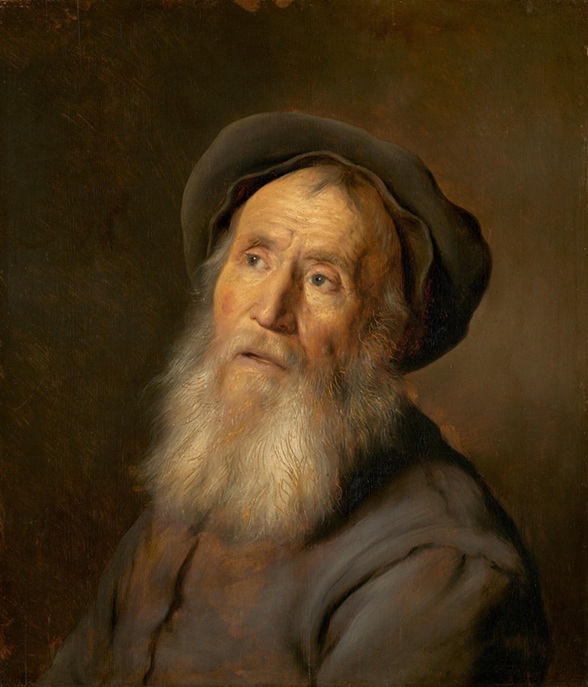
Tronies could function as studies, but they were also valued and sold as independent paintings. The downward gaze also recurs regularly in Rembrandt’s studies.[2] The scale and subject are entirely plausible for the type of painting that was actually produced within his circle.
The danger of fitting the right type
Heads of elderly men of this kind survive by Rembrandt, by pupils, from his studio and by later followers. Some compositions were also repeated. A Rembrandtesque old man on a small oak panel can therefore fit the style convincingly while still being far removed from an autograph Rembrandt.
The panel bears an old handwritten attribution to “Rembrandt”. The catalogue also mentions an inscription reading “Miss Stewart-Bam”. In addition, a restorer’s label is attached to the reverse.[1] The auction catalogue cautiously suggests a possible provenance from the Stewart-Bam family, who at the time owned an extensive collection.[3]
£33,000 is not a normal ‘Studio of Rembrandt’ price
The words “Studio of Rembrandt”, combined with an elderly bearded man painted on panel, do not automatically produce prices in the tens of thousands of pounds. The picture changes once documentation and research enter the equation. The bidders must therefore have found some reason to go beyond what the estimate suggested about the work’s potential.
An interesting comparison can be found in the Mauritshuis. Its Tronie of an Old Man, dated to around 1630-1631, is likewise painted in oil on panel and occupies precisely the uncertain territory between Rembrandt and his studio. Research showed that the panel came from the same tree as two paintings regarded as autograph works by Rembrandt. X-radiography also revealed changes made during the painting process.
Even so, the museum could not definitively attribute the painting to Rembrandt himself, as certain passages, according to the researchers, lack the precision expected of him. Even when the wood and technique point directly towards Rembrandt’s workshop, the question of who actually executed the painting can therefore remain unresolved.
We have seen this happen before
There is also a striking parallel with a lot we discussed previously. At Hargesheimer in Düsseldorf on 12 September, a small panel measuring 21.5 by 17.5 centimetres appeared with the cautious catalogue attribution Rembrandt Harmensz. van Rijn, probably workshop or school and an estimate of just €150–300. It eventually reached a hammer price of €22,000.[4]
In our earlier article, the emphasis was therefore not on the idea that a low estimate might conceal a hidden Rembrandt. More interesting was the speed with which the market moved ahead of a cautious catalogue attribution when small scale, subject matter and the possibility of further research came together in a Rembrandt-related panel.
The result here appears to be a variation on the same phenomenon. Once again, a small painting entered the market under a broad Rembrandt-related attribution and with a strikingly low estimate. That makes both results interesting as market observations, but not automatically as evidence of authenticity.

What might explain £33,000?
The image genuinely belongs to the Rembrandt world of tronies and heads of elderly men. The painter has not overloaded the composition with attributes, but instead concentrates everything on a downward-looking head emerging from the brown ground under strong light. The reverse also preserves older traces that make further research possible.
An estimate of £1,500-2,500 may therefore have been perfectly logical for an object supported by so little scholarly certainty. For a buyer with access to dendrochronology, conservators and Rembrandt specialists, however, such a cautious catalogue attribution can be attractive precisely because so much remains unresolved.
The distinctions are particularly sharp in the case of Rembrandt. A seventeenth-century follower, a work from his circle, an actual studio production and a painting accepted by scholars as an autograph Rembrandt belong to very different categories. It is precisely in the uncertain territory between those categories that competition at auction can accelerate rapidly.
Technical examination may show that the painting’s construction is inconsistent with Rembrandt’s workshop practice. The Stewart-Bam connection may ultimately lead nowhere. The £33,000 hammer price is therefore only the beginning. The next step is research into the panel itself, art-historical investigation, paint analysis and a much more detailed examination of the provenance.
Do you have a particular interest in this artist or in this subject?
Do you follow this artist, or have you come across a work you would like to know more about? We regularly research works appearing on the market and are always happy to exchange views on quality, provenance, art-historical context and previous auction results. You can contact us directly via info@antonello.art.
Notes and sources
[1] The Auction Room London, Fine Art Sale, London/Twickenham, 29 September 2026, lot 291, “Studio of Rembrandt Harmensz. van Rijn, Leiden, 1606-1669, Amsterdam, 17th Century Oil on Panel”; panel 18 × 23 cm; estimate £1,500-2,500.
[2] National Gallery of Art, Arthur K. Wheelock Jr., “Bearded Man with a Beret, c. 1630”; and Rijksmuseum Amsterdam, Rembrandt van Rijn, Old Man with a Long Beard, with White Sleeve, c. 1630.
[3] Christie’s, London, 3 December 1926, lot 130, The Mystic Marriage of Saint Catherine, “Lady Stewart-Bam, Ards, Co. Donegal, Ireland”; National Library of Ireland, Catalogue of the valuable library of books to be sold by auction at Ards House, May 1929.
[4] Antonello.art, “From €150 to €1,400: why this small Rembrandt lot deserves attention”, 30 August 2026, Hargesheimer Kunstauktionen Düsseldorf, lot 3685, Rembrandt Harmensz. van Rijn, probably workshop or school, estimate €150-300; hammer price €22,000.