A small circular landscape by Herri met de Bles, 27 centimetres in diameter, will be auctioned in Cologne on 20 November 2026 with an estimate of €70,000-100,000. The painting once belonged to the renowned collector Marcell von Nemes and is said to have remained in private hands since the 1930s. Above all, it is the composition that impresses.
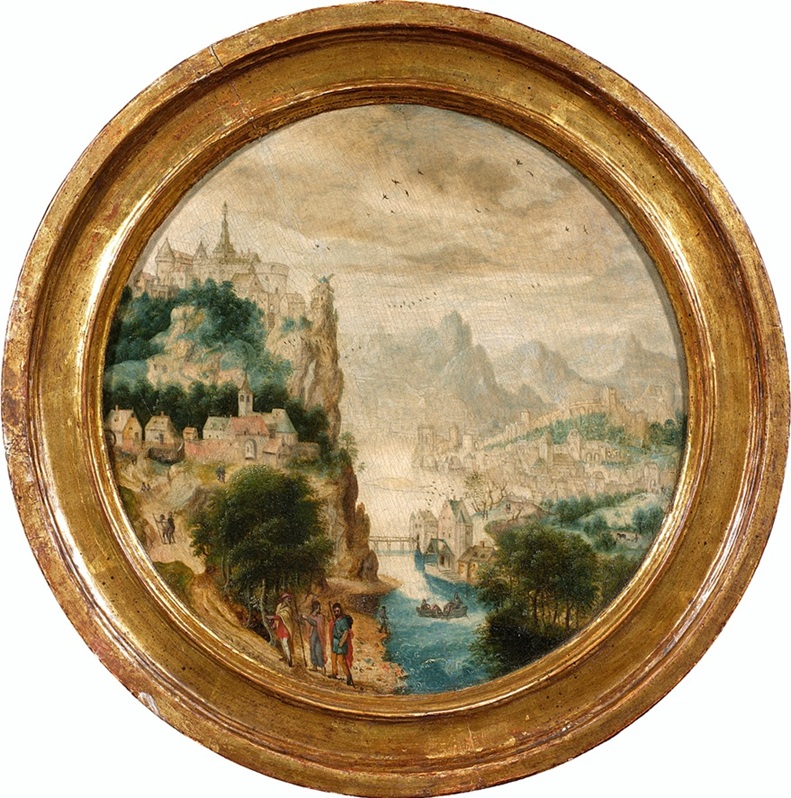
In the landscapes of Herri met de Bles, the viewer becomes lost among rocks, walled cities, rivers and tiny figures. Only on closer inspection does it become clear that these everyday scenes form part of a religious narrative. A good example is the tondo coming up for auction at Van Ham in Cologne on 20 November, titled Riverscape with Christ on the Road to Emmaus and dated to around 1530.[1]
Painted in oil on panel, it measures 26.5 centimetres in diameter. The estimate is €70,000-100,000. That is a substantial sum for a painting of this size. The Cologne auction will therefore provide a test of how the market values this particular type of work. What stands out most in the painting is its composition. The towering rock formation on the left dominates almost half the image. The river creates an opening that draws the eye from the lower edge deep into the painting. The three travellers stand precisely at the point where these two worlds meet.
An expansive world within a circle
Three figures walk along the riverbank in the foreground. They are Christ and two of his disciples on the road to Emmaus. The biblical event occupies only a small part of the composition. The eye is easily drawn away to the buildings, vegetation and activities on and beside the water. On the left rises an imposing rock formation topped by a walled city, its church towers sharply outlined against the sky.
Farther down the slope are houses, a gatehouse and several tiny figures. To the right, the landscape opens towards a river, a bridge, another city and mountain ranges that almost dissolve into the distance. The warm earth tones of the foreground give way to green in the middle distance and then to a cool, misty blue. Despite the painting’s small size, this creates a convincing sense of depth.
This relationship between narrative and setting is characteristic of the so-called world landscape, a genre that developed in the Southern Netherlands during the first half of the sixteenth century under the influence of Joachim Patinir. Herri met de Bles built on Patinir’s example, but his landscapes are often busier, less immediately legible and richer in small incidents.
Despite the wealth of detail, the main subject remains recognisable. The figures have enough colour and presence not to disappear entirely into the landscape. The circular format helps to focus the scene. A rectangular landscape can easily extend to either side, whereas here the entire composition is held together by a single enclosing edge.
Comparisons with other circular works
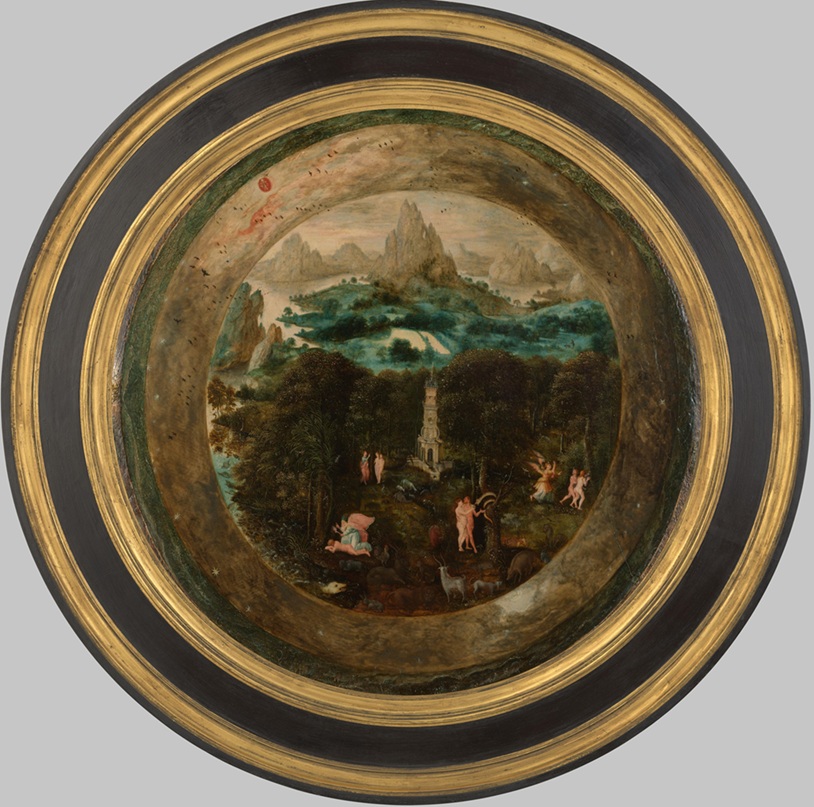
The painting immediately calls to mind another tondo by Herri met de Bles, Paradise in the Rijksmuseum. There too, an expansive landscape is contained within a circle. The painting depicts several episodes from the story of Adam and Eve, scattered across a densely wooded world filled with tiny figures and animals.
Technical research has shown that the frame and the panel originally formed a single piece.[2] The comparison makes clear that the circular format was not merely an isolated experiment in the work of Herri met de Bles. It belonged to a painting practice in which small scale, meticulous detail and an unusual panel shape could reinforce one another.
A more significant comparison in Antwerp
The Museum Mayer van den Bergh in Antwerp owns Landscape with the Road to Emmaus, one of the best-known treatments of this subject in the oeuvre of Herri met de Bles. Here too, Christ and his disciples travel through an expansive landscape. The religious episode is embedded in a world of rivers, rocks, fishermen and architecture. Higher up in the landscape, Christ appears at the meal during which the disciples finally recognise him.
The museum regards this painting as an important point of reference within a group of approximately twelve works in which Herri met de Bles depicted the journey to Emmaus. The subject is therefore not exceptionally rare within his oeuvre. Even so, we believe the painting coming up for auction makes an interesting addition to this group. Its circular format is the most obvious distinction.
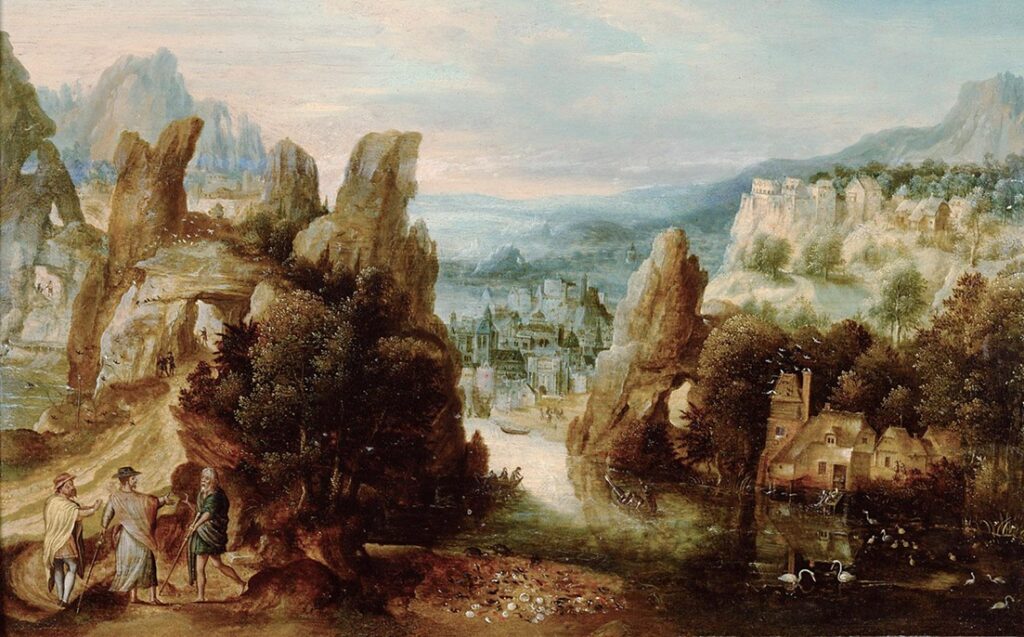
Another Emmaus comparison appeared at Sotheby’s in New York on 30 January 2014. Its relatively large figures, low viewpoint and more expansive sky were presented as distinguishing features among the various Emmaus compositions. In that painting too, bridges, architecture and human activity are woven into the main narrative. The estimate was $80,000-120,000.[3]
A name that lends additional weight to the provenance
The auction house links the painting to Marcell von Nemes, a notable European collector of the early twentieth century. He assembled an extensive collection in which Old Masters hung alongside works by modern artists. He exhibited parts of his collection in major exhibitions, including in Budapest, Munich and Düsseldorf. After his death, his estate was dispersed through a series of auctions.
Van Ham states that the work has remained in the same family since the 1930s. If so, it is returning to public auction after more than ninety years. That makes it tempting to speak of a rediscovery. However, the painting had already appeared on the market in 1916 and 1933, when it was apparently also regarded as a work by Herri met de Bles. It is therefore not a completely unknown painting. More interesting is the opportunity to re-examine a historically documented work after a long period out of public view.
An artist without a firmly established oeuvre
That is not a straightforward task in the case of Herri met de Bles. Although he is regarded as one of the most important early landscape painters of the Netherlands, much remains uncertain. There are no known works whose signatures and dates can serve as secure reference points for establishing his oeuvre. This makes connoisseurship particularly important for this artist.
Not all the landscapes traditionally associated with his name were necessarily painted by the same hand. The figures, too, may have been executed by workshop assistants or other painters. In a small, detailed painting such as this tondo, the quality of execution therefore becomes an important criterion.
The architecture, groups of trees and distant landscape have all been handled with great care. The transition from dark vegetation to the luminous distance is convincing. And the tiny figures in the foreground remain clearly legible without disrupting the scale of the landscape.
What does the auction market suggest about the likely hammer price?
On 29 April 2025, Dorotheum in Vienna sold Landscape with the Vision of the Apocalypse of Saint John on Patmos. The panel, measuring 35.5 × 55 centimetres, carried an estimate of €80,000-120,000 and realised €350,000 including buyer’s premium. That is an impressive result for a painting by this artist. The composition was larger than the present tondo, had complex iconography and was presented by the auction house as a previously unpublished work.[4]
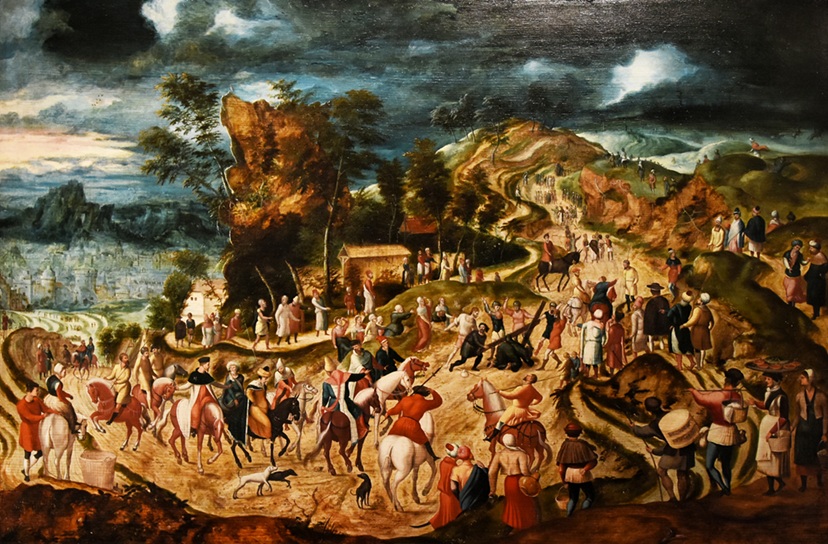
On 28 April 2026, the same auction house offered Christ on the Road to Calvary, an oil painting on panel measuring 32 × 44 centimetres. The estimate was €180,000-220,000. The realised price was €180,000 including buyer’s premium.[5] At Christie’s in London on 9 July 2021, An Extensive Landscape with the Preaching of Saint John the Baptist and the Baptism of Christ was sold. Measuring 76 × 113 centimetres, the painting had an extensive exhibition and literature history and was estimated at £70,000-100,000. It sold for £75,000.[6]
Where does its real appeal lie?
The tondo has several qualities that distinguish it from an average landscape attributed to Herri met de Bles appearing at auction. First is its circular shape, which serves a genuine compositional purpose. The monumental rock formation and the bright opening created by the river are convincingly arranged within the circle.
The journey to Emmaus is a recurring theme in the oeuvre, but the painting coming up for auction shows how the artist could integrate a biblical episode into a densely populated world landscape. Its provenance from the Nemes collection gives the painting a historical identity. It is therefore not merely a small landscape attributed to Herri met de Bles on stylistic grounds, but also an object whose collecting and market history can be traced.
Our interest is therefore not driven by the possibility that an unknown masterpiece has come to light. More compelling is the return of a historically traceable tondo, with a convincing landscape composition and a format that invites comparison with works in museum collections. The Cologne auction will thus test how the market values this particular type of painting, how much weight collectors give to its historical provenance, and the actual demand for the artist’s smaller works.
Do you have a particular interest in this artist or subject?
Do you own a painting by this artist, have you come across a comparable work, or do you have information that might be relevant to further research? We welcome contact from collectors, art dealers and researchers with an interest in this artist or related subjects.
We regularly research paintings appearing on the art market, exploring questions of attribution, quality, provenance and previous sales. If you have a question about a particular work or would like to share information with us, please feel free to get in touch at info@antonello.art.
Notes and sources
[1] Van Ham Kunstauktionen, Cologne, auction of 20 November 2026, lot 1108, Herri met de Bles, Riverscape with Christ on the Road to Emmaus.
[2] Rijksmuseum, Amsterdam, Paradise, Herri met de Bles, c. 1541-1550, inventory no. SK-A-780.
[3] Sotheby’s, Old Master Paintings, New York, 30 January 2014, lot 206, Herri met de Bles, The Journey to Emmaus, oil on panel, 32 × 50.6 cm, estimate $80,000-120,000.
[4] Dorotheum, Old Masters, Vienna, 29 April 2025, lot 9, Herri met de Bles, Landscape with the Vision of the Apocalypse of Saint John on Patmos, oil on panel, 35.5 × 55 cm. Estimate €80,000-120,000, realised price €351,000 including buyer’s premium.
[5] Dorotheum, Old Master Paintings, Vienna, 28 April 2026, lot 23, Herri met de Bles, Christ on the Road to Calvary, oil on panel, 32 × 44 cm. Estimate €180,000-220,000, realised price €182,000 including buyer’s premium.
[6] Christie’s, Old Master Paintings and Sculpture Online, London, 9 July 2021, lot 116, Herri met de Bles, An Extensive Landscape with the Preaching of Saint John the Baptist and the Baptism of Christ, oil on panel, 76 × 113 cm. Estimate £70,000-100,000, realised price £75,000.